MSD: Differential Diganosis
 Call Kai
 Learn
 Practice Test
 Spaced Repetition
 Match
 Flashcards
 Knowt Play
 Podcast
1/27

Earn XP
Description and Tags
Dyarthira types + Apraxia
28 Terms
What causes Unilateral Upper Motor Neuron (UUMN) Dysarthria, what is its hallmark feature, and what metaphor could you use to remember it?
Site of damage = Upper Motor Neuron (UMN)
Hallmark feature = Milder dysarthria
Common etiologies:
stroke w/ lesion being of a unilateral cortical UMN (nonprogressive)
Trauma (nonprogressive)
Tumour (could be either progressive/nonprogressive)
Like driving a car with one axel misaliged » structures pull to one side and make it less smooth and effortful to move
What are the non-speech body & OMA confirmatory signs of UUMN dys?
Controlateral facial droop (CN VII- facial)
Asymmetrical smile (reduced ROM on side controlateral to lesion CNVII)
Tongue deviation (tongue will veer to the weak side CNXII- hypoglossal)
Dysphasia (esp early on)
Often co-occuring w/ aphasia and/or apraxia of speech if lesion = left-sided ___________
Drooling from affected side of mouth
Contralteral vf weakness
Pseudobulbar affect (// more common in spastic)
What are the abnormal speech signs of UUMN dysarthria? And what subsystems of the speech system and what articulators are most affected?
A milder dysarthria
Impresicse consonsants due to face/tongue weakness: ARTICULATION
Slow rate for speech/oral mvts: ARTICULATION & PROSOY
Strained/harsh vocal quality due to vf weakness: PHONATION
What causes Hypokinetic dysarhtira, what is its hallmark feature, and what metaphor could you use to remember it?
Site of pb = basal ganglia pathology
the basal ganglia = a deep subcortical structure wherein many NT are used. Imabalance of these NT results in mvt disorders e.g. low dopamine > Parkingson’s disease (PD)
Hallmark feature =
Reduced amplitude of movement (mvts are smaller/shallower than normal)
Rigidity
Slow movement (bradykinesia)
Tremors
(TRAP (tremours, ridigity, akinesia, postural difficulties)
Common etiologies:
PD: presents several years after onset but in ~90% of patients who dvlp it and often precedes dyshagia (progressive)
Parkinson’s plus syndromes/ atypical parkinsonism. often have mixed dys w/ hypokinetic + other dys type
Stroke (basal ganglia lesions) (nonprogressive)
Trauma (e.g. contact sports repeated head trauma) (nonprogressive)
Like driving an old car w/ that’s slow to respond, stiff/rigid, difficult to control speed/requires more effort
What are the non-speech body & OMA confirmatory signs of hypokinetic dys?
Overall Body:
Tremour - involunatry shaking, pill rolling
Rigidity - stiffness/resistance to mvt e.g. cogwheel (small kery mvts)
Akinesia - difficulty in initating mvts
Postural instability: difficulty maintiang balance
Bradykinesia: slowness of mvt
Reduced arm swing when walking
Micrographia: handwriting becomes small, cramped
Shuffling/festinating gait: short/hesitant steps, stooped posture
Freezing gait
Dysphagia
Cog decline ~ 50% of cases, 30-60% go on to develop dementia
Depression, apathy, sleep disturbances
OMA:
Hypomimia/masked face: reduced facial expression/ appear unemotional
Reduced blink frequency (can cause watery eyes)
Tremor of jaw, tongue, lips as rest/in mvt
AMRs:ONLY DYS TYPE TO HAVE (potentially) RAPID AMRs » slow to start but can become rapid + impresise artic + usually regular rythm (SMRs=AMRs, though sometimes may have difficulty sequencing)
Tongue = slow (bradykinesia) + reduced ROM // strength = grossly normal
Drooling ++ common in PD due to reduced swallow frequency and effectiveness
What are the prominent abnormal speech features of hypokinetic dys?
Hypophonia/reduced loudness: due to weakness/rigidity of laryngeal muscles, reduced respiratory support, and lombard effect - an impairment in the audiotory feedback loop (ARTIC- RESP - SENSORY)
Monoloudness: weak/bradykinesia of laryngeal muscles - LARYNGEAL - PROSODIC
Monopitch: weak/bradykinesia of laryngeal muscles - LARYNGEAL - PROSODIC
Variable rate slow/rapid: poor control of mvt ARTIC + PROSODIC
Short rushes of speech: ARTIC + PROSODIC
Imprecise consontants: bradykinesia, ARTIC
Inappropriate silences: PROSODIC (difficulty intiating mvt)
Rough, breathy voice: LARYNGEAL + RESPIRATOY
Dysfluencies: palilalia vs stuttering
Voice tremour
What causes Hyperkinetic Dysarthria, what is its hallmark feature, and what metaphor could you use to remember it?
Site of pb: basal ganglia pathology
Hallmark feature: excessive, abnormal involuntary mvts, + less commmon type
Common etiologies
Huntington’s disease (progressive/degenrative - death of neurons in brain caused by inherited gene mutation » progressive loss of mvt, cognitive functions, mood )
89% undetermined
Spasmodic dysphonia (voice disorder characterised by involuntary spasms of muscles controling the vocal folds)
Tourette’s, focal myoclonus
Toxic/metabolic
Like driving a car with a faulty steering wheel, sudden/unpredicatble mvts
What are the non-speech body & OMA confirmatory signs of hyperkinetic dys?
Hyperkinesias = excessive, involuntary mvts
depends on type of mvt disorder: can be repetitive, brief/continuous, rythmic/irreg, large-amplitude, rapid/slow, unpredictable
What are the most prominent abnormal speech signs of hyperkinetic dysarthria?
Transient strained-harsh voice (bc of the atypical mvt)
Pitch breaks/voice arrest (bc of brief hyperadduction of VF)
Impresice articulation
Irregular articulatory breakdowns
Variable/excess loudness or pitch
Sudden forced inspiration/expiration
Prosodic difficulties: prolonged phonemes, variable rate, equal and excess stress, inappropriate silences (could be doing this as a compensatory startegy e.g. are you slowing down your speech or pausing on purpose to
AMRs depend on the type of hyperkinesisa:
rate could be normal/slow
artic could be normal when involuntary mvts ≠ occuring and then imparied when it is
rhythm: regular if involuntary mvt ≠ occuring // irreg if interruptions/breaks due to involuntary mvts
SMRs = AMRs ( but you can’t predict when someone will get
What causes Ataxic Dysarthria, what is its hallmark feature, and what metaphor could you use to remember it?
Site of damage: cerebellum
responsible for coordinaition, balance/posture, motor learning
integrates sensory info to coordinate motor function (e.g. proprioception)
Hallmark feature:
impaired coordination
slurred, irreg, unsteady speech (drunk sounding)
Speech worsens w/ alcohol
Causes:
Spinocerebellar ataxia (group of degenerative/progressive disorders that all affect cerebellum)
Friedreich’s ataxia (degenerative)
Multiple sclerosis (often mixed w/ spastic)
Stroke (cerebellum)
Tumour (cerebellum)
Focal trauma (cerebellum)
Like driving a car on a bumpy/uneven road
What are the non-speech body & OMA confirmatory signs of ataxic dysarthria?
Wide-based gait: often used to compensate/ improve balance/stability
Dysmetria: Over/under shooting intended target
Truncal instaiblity: difficulity maintaining upright posture
Head tremors/titubation: rhythmic tremor of head/body
Nystagmus: rapid, jerky eye mvts at rest
OMA non-speech
AMRs
Rate: normal/somewhat slow
Artic: prescision, loudness and/or pitch vary/ = irregular
Rhythm: Usally irreg in timing
SMRs = AMRs
Poor phonatory-respiratory coordination: incoordination bt onset of exhale and phonation, can initate speech late in breath cycle causing a softer/weaker voice
Bite cheek/tongue while talking or eating bc of poor coodination/dysmetria
What are the prominent abnormal speech signs of ataxic dysarthira?
Irreg articulatory breakdowns: ARTIC
Distored vowels: ARTIC + PROSODIC
Execess and equal stress: PROSODIC
Prolonged phonemes: ARTIC/PROSODIC
Varations/irregular loudness/monoloudness: due to poor coordination of laryngeal muscles LARYNGEAL, RESPIRATORY, PROSODIC
Slow rate: PROSODIC
Prolonged intervals/pauses bt sllables/words/phrases- irreg rhythm
Telescoping speech (slurring syllables/words tgt): ARTIC
Imprecise consonants/ slurred/drunk speech: ARTIC
Write summary table of dysarthira + apraxia types.

Write Summary Table comparing AMRs/SMRs of each dysarthira type + AOS
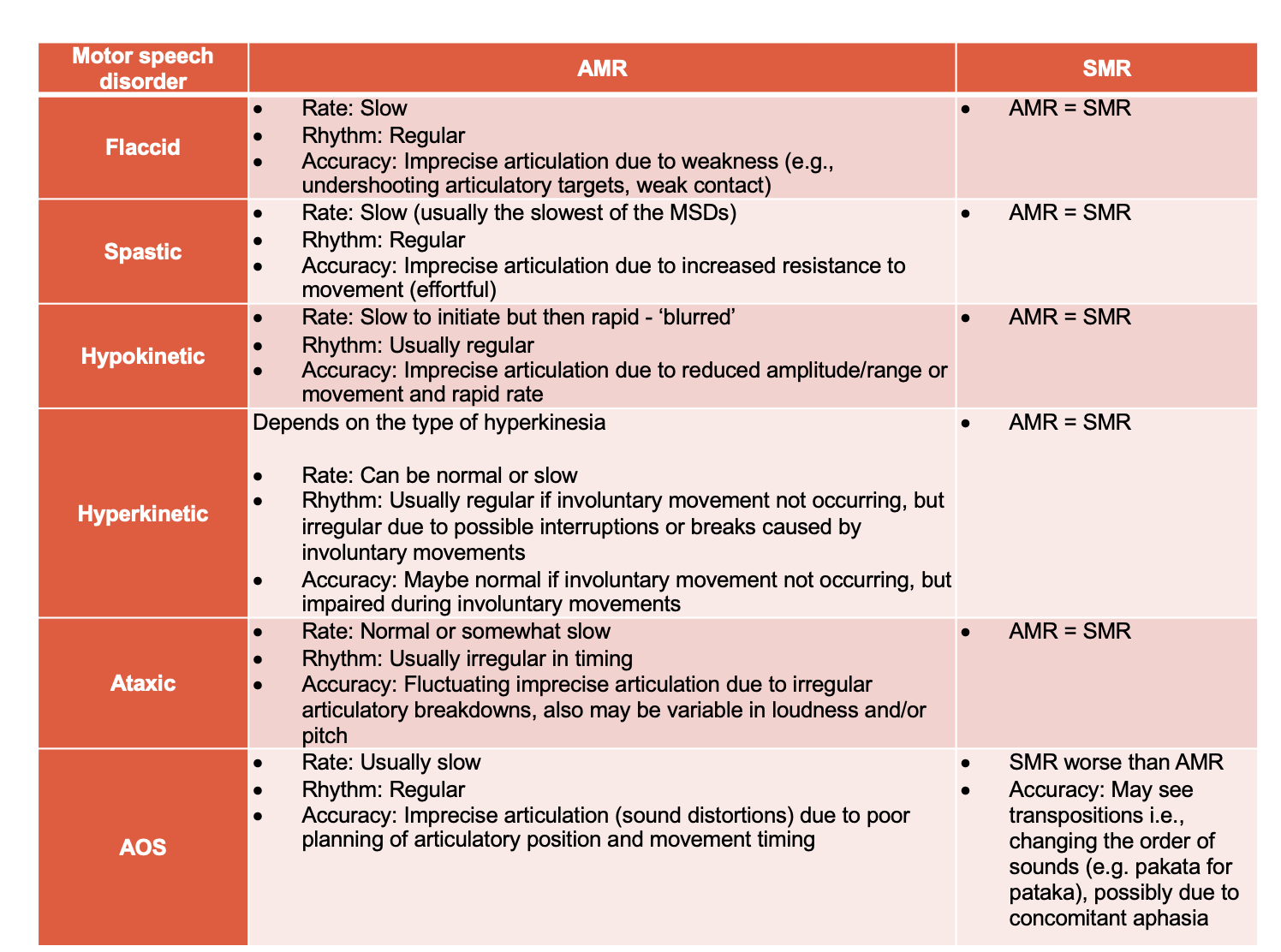
What causes flaccid dysarthria, what is its hallmark feature, and what metaphor could you use to remember it?
Site of damage: LMN
Hallmark feature: weakness
Common Etiologies
Stroke (in brainstem affecting CN)
Trauma
Tumour
Myasthenia gravis (disease of neuro-muscular junction preventing NT from binding to receptor sites)
Guillaine Barre Syndrome (GBS auto-immune disease often occurs after virus)
Bell’s palys (facial muscle paralysis)
Like driving w/ a flat tire
What are the non-speech body & OMA confirmatory signs of flaccid dysarthria?
Hypotonia = reduced muscle tone (bc the muscle fibres are not getting the signals they should)
Atrophy (tongue and body)
Fasciculations (tongue (on floor of mouth) and body)
AMRs
Rate: Slow
Artic: Impresice due to wekaness
Ryhtm: regular
SMRs = AMRs (can have some irreg // not as much as ataxic)
Hyporeflexia (diminished/absent reflexes)
Weak cough
Drooling
Dysphasia/nasal regurgitation
What are the prominent abnormal speech signs of flaccid dysarthira?
Hypernaslity - VELOPHARYNGEAL
Nasal emission - VELOPHARYNGEAL
Audible inspiration/ stridor - LARYNGEAL (bc of weakness of muscles controling VF » as air comes out there’s obstruction to the airflow causing turbuluent
Continuous breathiness - LARYNGEAL
Horase voice - LARYNGEAL
Diplophonia - LARYNGEAL
Monopitch, monoloud - LARYNGEAL + RESPIRATORY
Short phrases - LARYNGEAL + RESPIRATORY
Imprecise consonants - ARTIC
Vowel distortions - ARTIC
What causes Spastic Dysarthria, what is its hallmark feature, and what metaphor could you use to remember it?
Site of damage = BILATERAL UMN
Hallmark = slowness, effortful resistance to mvt/reduced ROM
Common etiologies:
Bilateral strokes
Cerebral palsy
Motor neuron disease (can be mixed w/ flaccid)
Multiple sclerosis (can be mixed w/ ataxic)
Tumours
Trauma
Like driving with the handbrake up
What are the non-speech body & OMA confirmatory signs of spastic dysarthria?
Hypertonia = increased muscle tone
Pseudobulbar affect/emotional libality (e.g. inappropriate crying/laughing bc UML damange impacts neural pathways impacting emotions)
Fatigue esp after prolonged muscle use
AMRs:
Rate: slow
Artic: imprecise, effortful/ ^ resistance to mvt
Rythm: regular
SMRs = AMRs
Hyperflexia
Balance/gait issues
Dysphagia
Drooling
What are the prominent abnormal speech signs of spastic dysarthira?
Slow Rate - ARTIC
Imprescise consonants - ARTIC (bc reduced ROM of articulators: tongue, lips, jaw, soft palate)
Strained-strangled harsh voice - LARYNGEAL (bc the VF come tgt too tight)
Pitch breaks - LARYNGEAL (incoordination of VF)
Low pitch - LARYNGEAL (limited tone in VF)
Short phrases - LARYNGEAL, RESPIRATORY, VELOPHARYNGEAL, ARTICULATION (bc of reduced resp support)
Excess and equal stress (bc slow rate makes it sound like this)- PROSODIC
Distorted vowels - ARTIC
Hypernasality - VELOPHARYNGEAL
Breathy - LARYNGEAL
Monopitch - LARYNGEAL
Monoloud - LARYNGEAL
What is apraxia of speech? What causes it? What is its hallmark feature?
an impairment in planning and programming stage of speech prod that can exist in the absence of physiological disturbances associated w/ dysarhitra and in absence of lang impairment (// often co-occurs with these two (dys and Broca’s expressive aphasia)
Site of pb = almost always pathology of left cerebral hemipshere
Hallmark feature = impairement in articulatory and prosodic (rate/rythm) features of speech
Common etiologies:
Stroke (most common)
1st sign of a neurodegentrative disease:
PSP (progressive superneuclear palsy)
CBD (corticobasal degeneration)
PPA (primary progressive aphasia)
What are the non-speech body & OMA confirmatory signs of apraxia?
Right sided weakness and spasticity (if secondary to a stroke)
Limb apraxia: person has ability to move // cannot plan purposeful mvts, or mimic aka bilateral deficits in purpsive limb mvts that can’t be explained by impairments in strength, mobility, sensation or coordination (important to consider if needing an AAC)
Nonverbal oral apraxia = inability to imitate or follow commands to perform volitional mvts of speech structures e.g. cough, blow, click tongue » NOT due to not being able to understand instructions, senosry or neuromuscular deficts bc reflexes of these tasks are perseved
If isolated AOS rarely compain of chewing/swallowing dificulties so if they do think about accompanying dysarthira
Right lower face and lingual weakness may be present + UUMN dyarthira (if secondary to stroke)
What does AMRs and SMRs stand for?
Alternating motion rates
Sequential Moiton Rates
What are the components of a base otor speech exam? What do you add on for assessment and differential diagnosis of AOS?
Case history
CN Exam/ OMA
Conversation
Reading
AMR/SMR
Motor speech tasks (e.g. volume/pitch modulation)
Additional
Mutlisyllabic words: caterpillar
Words of increasing length: sharp, sharpen, sharpening
Nonsense words (harder for them bc they have to plan a novel sequence)
Automatic speech tasks e.g. counting, days of week, name/address, singing (less likely to have difficulty bc they are so well trained/rehearsed)
Aphasia battery
What are the abnormal speech features of AOS in terms of prosody?
PROSODIC
Slow rate esp if more than 1 syllable (can be both a feature + compensatory strat)
Speech = effortful/halting (pauses, hesitations)
Syllable segregation/segmentation - sepeate words into sylalbles » speech sounds choppy
Prolonged vowels in multisyllable
Equal and excess stress
What are the abnormal speech features of AOS in terms of articulation?
ARTICULATION
Sound distortions - esp affricates and fricatives bc these require high level coordination bt respiration and phonation
Consonants substitutions (rare in dysarthira)
perseverative
anticipitory
Increasing errors w/ increasing complexity
Words increasing in length
low freuqency syllables
syllables w/ more phones e.g. strong vs me
Consonant cluster w/i syllables
Coples cluster transitions
Nonsense words = harder
Difficulty producing stress on words w/ weak onsets
Inconsistent errors // this depends on the task and stimulus context
consistent during blocked practice: cat cat cat» bc they only have to retrieve motor plan once
random practice = more variable/inconsistent errors e.g. cat, dog, mouse, dog »bc they have to retrieve motor plan ++ times
important to consider for treatment: random practice challenges both motor-plan accuracy and retrieval
What are the abnormal speech features of AOS in terms of fluency?
Effortful visible and audible groping for artic postures
Sound and syllable repetitions
Difficulty initating utterances e.g. word
Often aware of errors and attempt to self-correct
False artic starts/ restarts