Particle Physics
 Call Kai
 Learn
 Practice Test
 Spaced Repetition
 Match
 Flashcards
 Knowt Play
1/91

There's no tags or description
Looks like no tags are added yet.
92 Terms
Give the relative mass of a proton, neutron and electron
P = 1
N = 1
E =Negligble
Give the relative charge of a proton, neutron and electron
P = +1
N = 0
E = -1
State the overall charge of an atom and why?
Neutral because atoms have an equal number of protons and electrons.
State the overall charge of a nucleus and why?
Positive as protons have a +1 charge and neutrons have no charge.
In AZ nuclide notation, what do A and Z represent?
A is the nucleon number
Z is the proton/ atomic number
Give the definition of the nucleon number
The total number of protons and neutrons
How is the mass of an atom, ion, or nucleus worked out?
Number of nucleons x 1.67×10^ 27
How do we work out the charge of a nucleus?
Number of protons x 1.60×10 ^ -19
How do we calculate the charge of an ion?
Relative charge of ion x 1.60×10 ^ -19
How do we calculate specific charge?
Specific charge = charge/ mass
What are isotopes?
Atoms with the same number of protons and different numbers of neutrons.
Describe the role of the strong nuclear force (SNF) in nuclear stability
Balances out the electromagnetic repulsion between positively charged protons.
Holds nucleons in an equilibrium position - stopping them from moving further apart or closer together.
Is the SNF associated with charge?
No, it acts equally between protons and neutrons
Describe how and explain why the strength of the NF varies with nuclear separation
Below 0.5fm the force is repulsive to stop nucleons from collapsing into a point.
Between 0.5fm and 3.0fm the force is attractive to bind the nucleons together and balance the electromagnetic repulsion between protons
After 3.0fm the force is zero which prevents nucleons from different atoms being attractive.
What type of nuclei undergo alpha decay?
Large unstable nuclei
What is an alpha particle made up of?
A Helium nucleus (2 protons, 2 neutrons)
Write a general equation for alpha decay
A A - 4 4
X —>. Y + a
Z. Z - 2. 2
What type of nuclei undergo beta minus decay?
Neuton rich nuceli, too many neutrons to protons
What is the beta minus decay particle?
An electron (e-)
Describe the change during beta minus decay
A neutron changes to a proton
What exchange particle is emitted?
Electron anti-neutrino
What type of nuclei normally undergo beta plus decay?
Proton rich nuclei (too many protons to neutrons)
What is a beta plus particle?
A positron (e+)
Describe the change in the nucleus for beta plus decay
A proton changes to a nucleus
What exchange particle is emitted?
Electron neutrino
What type of nuclei undergo gamma decay?
Nuclei in an excited state that have excess energy they need to lose
What is a gamma ray?
A high speed electromagnetic wave
Which decay leads to the formation of an atom of a different element?
Alpha and beta minus decay, as the proton number changes
How did scientists hypothesise the existence of exchange particles?
Beta minus particles emitted with a continuous range of energies up to a maximum.
Total energy after the decay seemed less than the energy before.
Missing energy must be carried away by another particle to conserve energy.
Why was it difficult to detect the extra particle?
It has no mass nor charge.
Describe what is meant by the duality of EM radiation
Can behave as a wave or particle
What is a photon and what is the mass and charge of a photon?
A discrete packet or quantum of electromagnetic energy.
It has no mass nor charge.
What are the two equations for photon energy?
E = hf
E = hc/ lander
The energy of a photon is directly proportional to…
Frequency
The energy of a photon is inversely proportional to…
Wavelength
Define an electron volt
The energy gained by an electron that is moved through a potential difference of 1V.
How do you convert from eV to J and J to eV?
EV to J = x1.6×10 ^ -19
J to eV = /1.6×10 ^ -19
What is the same between particles and anti particles?
Rest energy and rest mass
What’s one difference between particles and anti particles?
Charge
What is energy-mass equivalence?
Energy can be converted into mass.
Mass can be converted into energy.
Calculated using E =mc²
What happens in pair production?
A gamma photon interacts with a nucleus, and the energy of the photon is used to create a particle and anti particle pair.
Which particles are most likely to be created and why?
Electron and positron as they have the lowest rest energy.
Why does gamma need to be present for pair production?
It has the highest energy
How can we calculate the minimum energy of the photon required for pair production?
E(min) =2x rest energy of particle/anti particle
How can you convert MeV into J?
X1.6 × 10 ^-13
What happens in annihilation?
A particle meets its equivalent antiparticle.
Their mass is converted into energy in the form of two gamma photons.
Why are two gamma photons produced?
They travel in opposite directions to conserve momentum
How can we calculate the minimum energy of one of the photons produced in annihilation?
2 x E(min) = 2 x rest energy of particle/anti particle
Why is this the minimum energy of the photon?
The particle and anti particle may have additional kinetic energy.
Describe the role of exchange particles in particle interactions
They move between particles and transfer momentum.
Due to the conservation of momentum this gives rise to a force between the particles.
Name the 4 fundamental forces from strongest to weakest.
SNF/ strong interaction
Electromagnetic force
WNF/ weak interaction
Gravity
Give the exchange particle for each fundamental force
SNF = pions
EM force = Virtual photons
WNF = W+ and W- bosons
Give the particles affected by each fundamental forces
SNF = Hadrons
EM force = Charged particles
WNF = All particles
What are the ranges of each fundamental forces?
SNF = 10 ^ -15 m
Em force = infinite
WNF = 10 ^ -18 m
Describe and explain the relationship between mass of the exchange particles and the range of the force
Large mass = shorter range
Because it requires more energy to create so only exists for a shorter time and travels a shorter distance
What is the graph of electromagnetic repulsion?

What is the graph of beta minus decay/ decay of a free neutron?
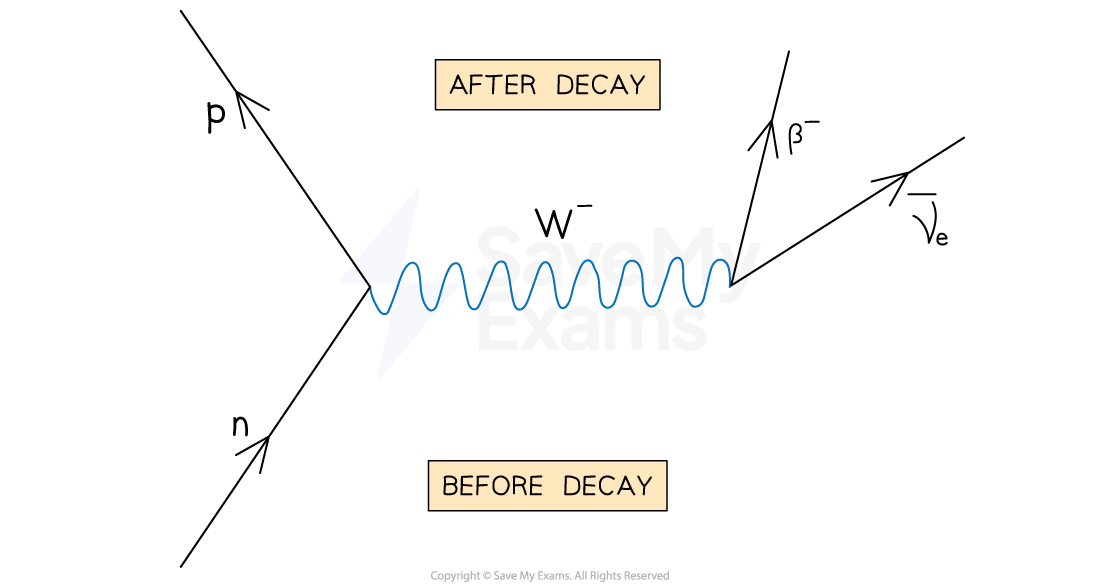
What is the graph for beta plus decay?

Define electron capture
When a proton in the nucleus captures an inner shell electron
What is the graph for electron capture?

Define electron-proton collision
When a free electron and free proton collide
What is the graph for electron-proton collision?

How are particles classified?
Particles are either Hadrons or Leptons
Hadrons can either be Baryons or Mesons
Give 2 differences between Hadrons and Leptons
Hadrons experience strong interaction, Leptons do not.
Hadrons are made up of quarks, Leptons are fundamental
What particles are Baryons?
Protons and Neutrons
What is the quark structure of Baryons?
3 quarks
What Baryon is stable?
Proton
Give the Baryon number of protons and neutrons, and the Baryon number of antiprotons and antineutrinos
Protons and Neutrons = +1
Antiprotons and Antineutrinos = -1
What is the quark structure of a proton?
UUD
What is the quark structure of a neutron?
UDD
Why do neutrons have a higher mass than protons?
A down quark has a higher mass than an up quark
What particles are Mesons?
Pions and Kaons
What is the quark structure of Mesons?
Mesons are made up of a quark and antiquark
Which Meson is stable and why?
No Mesons are stable.
However, Pions are the most stable Meson because they are light, so they have lower energy.
What Meson is strange?
Kaons, they contain one strange or anti strange quark
How are Kaons produced?
By the strong interaction, they are produced in pairs of strange particles.
How do Kaons decay?
They decay by the weak interaction into pions.
Give the quark combinations for Pions
Pion+ = up and anti down
Pion0 = up and anti up or down and anti down
Pion- = anti up and down
Give the strangeness of the four Kaons
K+ = +1 strangeness
K- = -1 strangeness
K0 = +1 Strangeness
Anti K + = -1 strangeness
Give the quark combinations of the 4 Kaons
K+ = up and anti strange
K- = strange and anti up
K0 = down and anti strange
Anti K0 = anti down and strange
Why do Kaons have a higher mass than Pions?
Strange quarks have a higher mass than up and down quarks
What are the three Leptons?
Electrons, Muons, and Neutrinos
Compare Electrons and Muons
Same charge, but Muons are heavier.
Electrons are stable, so Muons decay into Electrons
What is the mass an charge of neutrinos?
0 mass and 0 charge
What is the Lepton Electron and Lepton Muon number of each Lepton?
Lepton Electron +1 = Electrons and Electron neutrinos
Lepton Electron -1 = Positron and Anti electron neutrino
Lepton Muon +1 = Muons and muon neutrinos
Lepton Muon -1 = Anti muons and Anti muon neutrinos
What are the 4 particle conservation laws?
Baryon number = always conserved
Charge = always conserved
Lepton number = Lepton Electron and Lepton Muon number is always conserved
Strangeness = always conserved in the strong interactions, but in weak interaction it can change by +1, -1 or 0
What other quantities are always conserved?
Energy and momentum
Which conservation laws explain why strange particles are produced in pairs?
Strange particles produced by the strong interactions, mean that strangeness must be conserved
So, the pair must have equal and opposite strangeness so they cancel out to zero.
In which interaction can quark structure change?
ONLY in weak interaction
What is the quark change in beta plus and beta minus decay?
BETA MINUS = down quark to up quark
BETA PLUS = up quark to down quark
Define quark confinement
It is not possible for quarks to exist in isolation.
This is because the energy needed to try separate a quark would cause pair production, resulting in another quark and anti quark pair being produced.
Why does particle physics research require collaborative efforts from international teams?
Particle accelerators are very expensive, so collaboration helps to spread the cost.
Many skills and disciplines are required.
There is lots of data to process so it takes a lot of time.