Systematic Review and Meta-Analysis
 Call Kai
 Learn
 Practice Test
 Spaced Repetition
 Match
 Flashcards
 Knowt Play
1/23

There's no tags or description
Looks like no tags are added yet.
24 Terms
Meta-analysis
Quantitative results of approach for previous studies systematically to arrive at combining conclusions about the body of the research
Systematic review
Qualitative results of approach for systematically previous studies to arrive at combining conclusions about the body of the research
- To get the magnitude of an effect with adequate precision
- To increase statistical power
- Resolve uncertainty
- Improve estimates of effect size
- To address questions not posed when the studies were designed
Rationale for meta-analysis
- Multiple studies must test the same or similar hypotheses
- Studies with small sample sizes
- Several studies with contradictory results
- Studies with inconclusive results
Meta-analysis is appropriate when:
MEDLINE
EMBASE
PubMed
Cochrane Library Science Citation Index
Common electronic databases
Preferred Reporting Items for Systematic Reviews and Meta-Analysis (PRISMA)
An evidence-based set of guidelines and a 27-item checklist with a flow diagram developed to help researchers improve the reporting quality, transparency, and reproducibility of systematic reviews and meta-analyses
heterogeneity
Tests for _____ are commonly used to decide on methods for MA analysis
Cochran's Q test (Q test for heterogeneity)
A statistical test used in meta-analysis to check whether the variation in study results (effect sizes) is due to chance alone or whether there is true heterogeneity among the studies.
- the underlying null hypothesis assumes that the true treatment effect is the same across studies and that variations are simply caused by chance
true
- It has low power when the number of included studies is small → it may fail to identify real heterogeneity.
- It becomes too sensitive when the number of studies is large → it may flag trivial differences as statistically significant.
T/F: The Cochran Q test is known to be poor at detecting true heterogeneity
I-squared index
an index that measures the extent of heterogeneity; describes the percentage of total variation across studies that is due to heterogeneity rather than chance.
Fixed model
Which effect size model assumes the effect size is the same across all studies?
- Results of the individual studies are similar enough to combine for heterogeneity
- Study weights are unbalanced
- CIs are narrow
Random model
Which effect size model assumes studies are different but similar in some areas?
- Considers the heterogeneity among studies, both in the point estimate of the treatment effects and in the width of the CIs
- Study weights are more balanced
- CIs are wider
Random model
For determining effect size, if the test of heterogeneity is significant, use the ____ model
Fixed model
For determining effect size, if the test of heterogeneity is non-significant (shoes non-heterogeneity), use the ____ model.
Forest Plot
Funnel Plot
Two graphs used in MAs
Forest plot
A graphical display that shows the results of individual studies and the overall pooled estimate in a meta-analysis.
- Vertical line = no effects
- Left favors the drug; right favors placebo
- Shows individual study results + overall effect size.
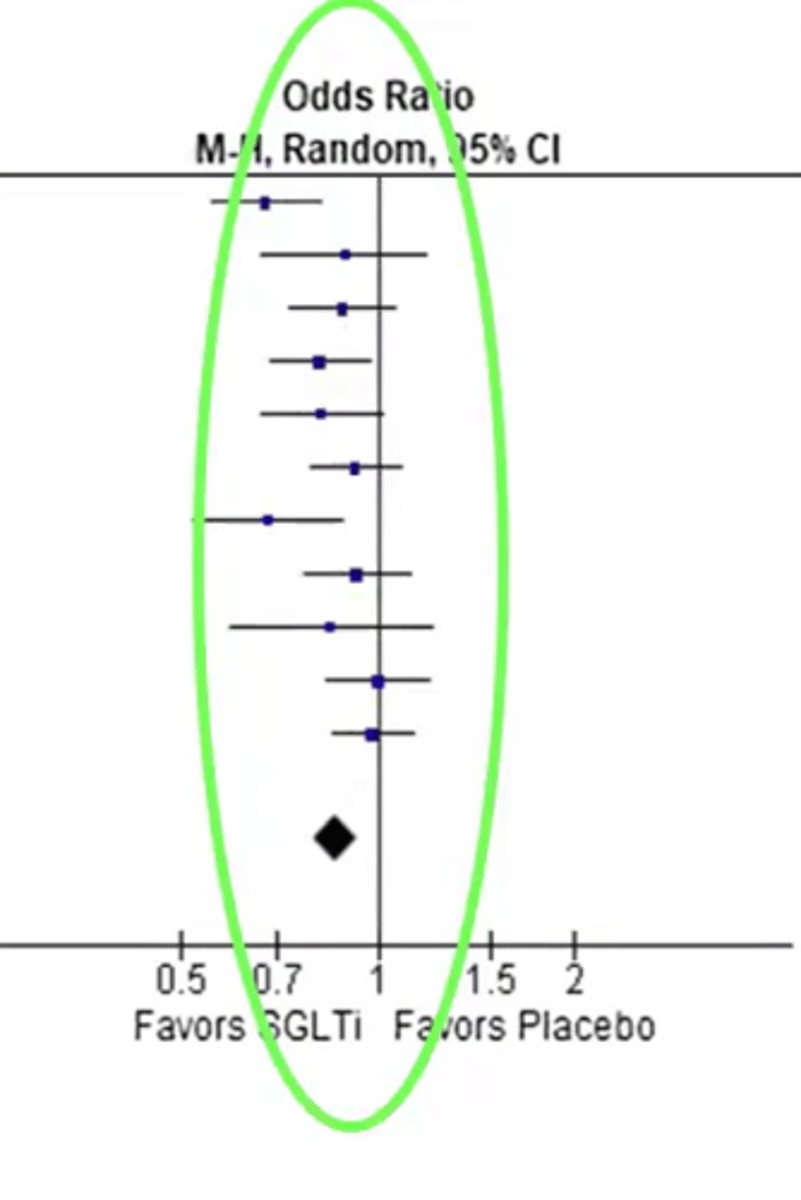
Diamond
- Center = point estimate (e.g., Odds Ratio [OR] or Risk Ratio [RR]).
- Width = confidence interval (CI).
Represents the overall pooled result of the meta-analysis in a forest plot
No statistically significant difference between groups
What does it mean when the diamond touches the line of no effect in a forest plot?
The difference between the two groups is statistically significant
What does it mean when the diamond does not touch the line of no effect in a forest plot?
Fewer outcomes in the treatment group (treatment is protective/beneficial).
What does it mean when the diamond is to the left of the line of no effect in a forest plot?
More outcomes in the treatment group (treatment may be harmful).
What does it mean when the diamond is to the right of the line of no effect in a forest plot?
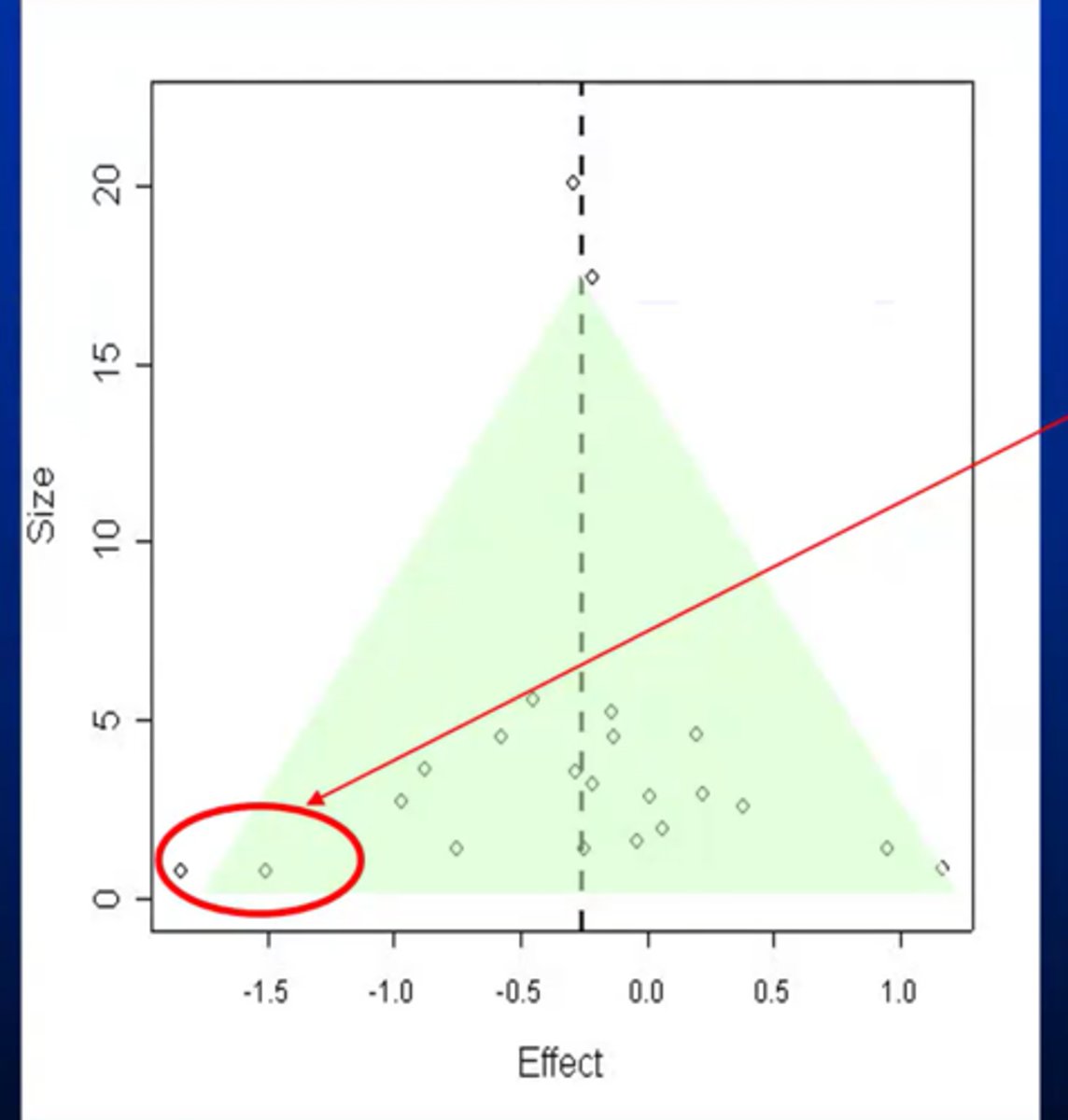
Funnel plot
A scatterplot of individual study results in a meta-analysis that is used to discern publication bias.
- Symmetrical→ No publication bias.
- Asymmetrical → Possible bias (e.g., missing small negative studies)
quality of the studies
Meta-analysis may be limited by ____ of the included trials
A) Dependent on quality of included studies
B) Errors in the original work cannot be checked
D) Vulnerable to publication bias
E) Requires choosing between fixed-effect vs. random-effects models
Which of the following are limitations of meta-analysis? (SATA)
A) Dependent on quality of included studies
B) Errors in the original work cannot be checked
C) Always provides individualized patient-level conclusions
D) Vulnerable to publication bias
E) Requires choosing between fixed-effect vs. random-effects models