Male Reproductive Pathology
 Call Kai
 Learn
 Practice Test
 Spaced Repetition
 Match
 Flashcards
 Knowt Play
1/20

There's no tags or description
Looks like no tags are added yet.
21 Terms
Where is the prostate located and why is this signifcant?
the prostate is located at the base of the bladder and surrounds the urethra- due to its location when the prostate becomes enlarged it causes symptoms related to the bladder/ urethra like hesitancy (difficulty peeing) and interruption of urinary stream
What is the role of androgens?
to maintain the glands of the stroma and make semen
What are the three zones of the prostate?
central zone, peripheral zone and transitional zone
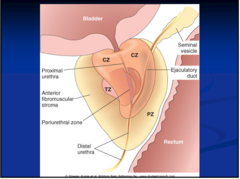
When a patient has a enlargement of the peripheral zone how can this be detected?
palpated by the physician on a rectal exam- less likely to present symptoms
What is benign prostatic hypertrophy?
Enlargement of the prostate gland due to increase in androgens. Enlargement causes urinary flow obstruction causing urgency, frequency and nocturia(irritated bladder) and hesitancy ( difficulty starting a urinary stream)
What zones does benign prostate hyperplasia most often arise?
inner transitional or central zone
What hormone is driving the enlargement of the prostate gland in BHP?
DHT- dihydrotestosterone
How is BHP treated?
5α reductase inhibitors- prevent the productions of DHT
α1 adrenergic blockers - relax the prostate and smooth muscle making urination easier
How does BPH present histologically?
well defined nodules that compress the urethra but overall the glands look normal just enlarged
What is the most common cancer in men?
prostatic carcinoma
What promotes prostatic carcinoma?
androgens
what greatly increases the risk of prostatic carcincoma?
heredity- increased risk in the 1st degree
might be some environmental effects
inherited BRCA1 or BRCA 2 gene mutation
What is the difference in the presentation of symptoms of BPH and prostatic carcinoma?
BPH is causes symptoms due to the location of enlargement in the central and transitional zone while prostatic carcinoma is often clinically silent because the enlargement occurs in the peripheral zone.
What is often the first sign of prostatic carcinoma?
metastasis of bone like osteolytic or osteoblastic involvment
What is PSA (prostate specific antigen) and what is it used for?
PSA a normal product of prostatic epithelium secreted in the semen.
What ages of men may a PSA screening be useful?
55-69; once males reach 70+ the benefits do not outweigh the expected harms, so for patients between the age of 55-69 this is a patient driven decision
what are the risks and benefits of PSA screening?
benefits: out of 1000 men screening may prevent 3 cases of matasis and 1.3 deaths over 13 years
risks: a false positive can lead to biopsy with potential over treatment that include complications like incontinence and erectile dysfunction after a prostatectomy and long term erectile dysfunction, bowel urgency and fecal incontinence after radiation
If a patient has a gleason score below 6 what does that imply?
below 6 well-differenciated glands and has a low risk
If a patient has a gleason score of 8 or above 8 what does this imply?
that the patient is in a high risk group (score of 7 would be intermediate)
What are the possible treatments of prostatic carcinoma?
active surveillance
surgery - robotic prostatectomy
radiation therapy
androgen deprivation - for advanced metastatic disease
What is prognosis for prostatic carcinoma?
for stage T1, T2 - good (90% 10 year survival)
disseminated disease - poor (10 -40% survival)