Oogenesis & the Sexual Cycle
 Call Kai
 Learn
 Practice Test
 Spaced Repetition
 Match
 Flashcards
 Knowt Play
1/40

There's no tags or description
Looks like no tags are added yet.
41 Terms
Oogenesis
production of female gametes (ova/ eggs)
How is oogenesis different from spermatogenesis
it happens before birth in the fetal period
(spermatogenesis happens at puberty)
Oogenesis as a fetus (before birth)
Oogonia (2n) → mitosis + store nutrients → primary oocytes → begins meiosis but stops/ stalls in prophase 1
where do primary oocytes develop
primordial follicles
Oogenesis after puberty
each month after puberty, few primary oocytes are activated → selects one to resume meioisis I → 2 haploids (one secondary oocyte and one first polar body which dies)

Secondary oocyte vs first polar body
secondary oocyte gets all the cytoplasm while first polar body dies
What happesn to the secondary oocyte
begins meioiss 2 → stops at metaphase 2 → ovulated / released into uterine tube
What happens if sperm does not arrive
what happesn if it does
not penetrated by sperm → dies
penetrated by sperm → finishes meioisis 2 → ovum/ova/egg (functional gamete) + second polar body (which dies)
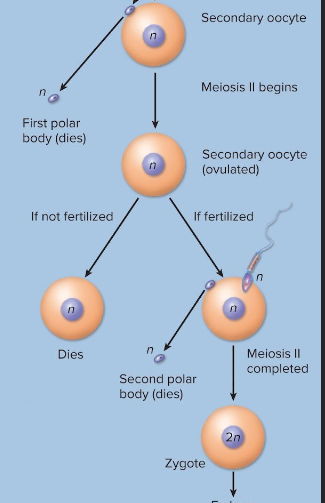
Full oogenesis pathway
Pre birth
oogonium (2n) → mitosis → primary oocytes(n) arrested at prophase 1 → meiosis I → secondary oocyte (n) + first polar body → secondary oocyte arrested at metaphase 2 → ovulation → penetrated by sperm → complete meiosis 2 → ovum + second polar body

What happens right after meiosis 2 is complete
fertilization with sperm → zygote
Reproductive cycle
from fertilization to giving birth to fertility returning
Sexual cycle and what are the 2
events that happen every months when not pregnant
menstrual and ovarian
Ovarian cycle - what are the 2 phases
and what happens in between
happens in ovaries
follicular phase (days 1-14) → follicle growth (immature egg with surrounding tissues)
Luteal phase (days 14-28) → corpus luteum activity (developed from ruptured follicles)
in between → ovulation midcycle (ejection of oocytes)

Follicular phase (first transformation)
primordial follicles activate (squamous like cells → cuboidal)
primordial follicles enlarge → primary follicles

Follicular phase (second transformation)
Primary follicles → secondary follicles
stratified epithelium (granolsa cells) form around oocyte
granulosa cells and oocyte guide each others development

Follicular phase (third transformation)
Secondary follicle becomes late secondary follicle
connective tissue (theca folliculi) + granulosa cells cooperate to produce estrogen
zona pellucida forms around oocyte
fluid accumulates

Follicular phase (fourth transformation)
late secondary follicle → tertiary follicle/ vesicular follicle
antrum (filled with fluid) forms and expands → isolates oocyte
vesicular follicle/ graafian follicle bulging from ovary surface
primary oocyte completed meioisis 1 → secondary oocyte + first polar body
Ovulation
ovary walls rupture → expels secondary oocyte and corona radiata
mittzschmerz
pain felt at ovulation
1-2% of ovulation releases
more than one secondary oocyte → fraternal twins
Luteal phase
ruptured follicle collapses
granulosa cells and internal thecal → corpus luteum → secretes progesterone and estrogen
What happesn to corpus lutuem
if pregnant → produces hormones until placenta takes over at 3 months
if not pregnat → corpus luteum degenerates → corpus albicans in 10 days
Establishing ovarian cycle - childhood → puberty
childhood → ovaries release estrogen → inhibit hypothalamus from release gonadotropin rleasing hormones
near puberty → Leptin (from adipose tissue) decRease estrogen inhibition → GnRH is released → anteriorior pituitary gland releases FSH and LT → act on ovaries → until mature cycle appears and menarche
menarche
first menstrual cycle
Ovarian cycle day 1
hypothalamus release GnRH → release of FSH and LH
FSH and LH act on ovaries → activating and developing follicles → follicles secrete estrogen (remeber late secondary follicle → granulosa cells and theca folliculi secrete estrogen)
as estrogen rises (negative feedback)
inhibit reelase of FSH and LH but promote production and storage
so keep making them but dont secrete them

Near mid cycle
as one follicle becomes the dominant vesicular graafian follicle (before FSH and LH was inhibited) → increases production of estrogen
→ high estrogen level by midcycle → positive feedback effect on pituitary gland at midcycle → surge of LH at day 14
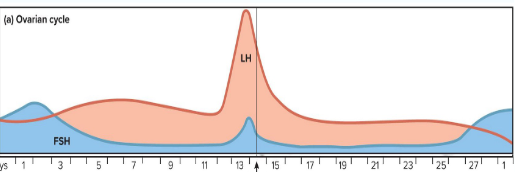
Effect of LH surge midcycle (day 14)
(3)
meiosis I completed → secondary oocyte → continues until metaphase 2
triggers ovulation
transforms ruptured follicle → corpus luteum
Functions of corpus luteum (3)
produce inhibin, estrogen, progesterone →inhibit fsh and Lh secretion
decline lh and fsh levels
end luteal activity and inhibit follicle development
Day 26-28 of ovarian cycle
corpus luteum degenerates into corpus albican + ovarian hormones drop (inhibin estrogen progesterone) → inhibition on FSH and LH drop → starting cycle again
Uterine/ menstrual cycle
cyclic changes in endometrium of uterus in response to ovarian hormones
3 phases of menstrual uterine cycle
day 1-5 -menstrual phase
day 6-14 - proliferative (preovulatory) phase
Day 15-28 - secretory (postovulatory) phase
Menstrual phase of menstural uterine cycle
Days 1-5
ovarian hormones are at the lowest → no inhibition → gonadotropins begining to rise → stratum functionalis is shed and menstrual flow occurs

Proliferative / preovulatory phase of menstrual uterine cycle
Days 6-14
estrogen levels rise → regeneration of stratum functionalis + increase progesterone receptors in endometrium
glands enlarge + spiral arteries increase

Secretory / posovulatory phase of menstrual uterine cycle
days 15-28
progesterone → further endometrium development , glands secrete glycoge, formation of cervical mucus plug (hard for sperm to pass through)
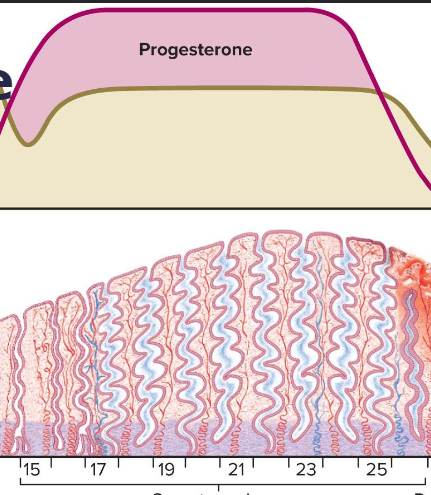
If fertilization doesn’t happen
corpus luteum degenerates → progesterone levels fall → spiral arteries kink / spasm (constrict then relax and open wide) → blood fragments rush in→ stratum functionalis breaks down/sheds → menstruation

Effects of estrogen
promotes what 2
what type of grwoth on female reproductive tract
supports what at puberty
induces what
promote oogenesis and follicle growth
anabolic growth
rapid but shortlived growth spurt
secondary sexual characteristics (breast, subcutanous fat at hips and breasts, widening of pelvis)
Metabolic effects of estrogen (2)
maintain low blood cholesterol and high hdl (good cholesterol)
calcium uptake
Progesterone effects
works with estrogen to establish and regulate uterine menstrual cycle
Placenta progesterone during pregnacny does what
inhibit uterine motility (contracting too much) + prepare breast for lactation
Menopause
permenant end of menstruation (no menstrual period for a year)
decreased estrogen → atrophy of reproductive organs and breast + hot flashes (vasodilation) + skin and bone loss + increased blood cholesterol and decreased HDL