Chem 204 Midterm
 Call Kai
 Learn
Learn Practice Test
 Spaced Repetition
 Match
Match Flashcards
 Knowt Play
1/92

There's no tags or description
Looks like no tags are added yet.
Name | Mastery | Learn | Test | Matching | Spaced | Call with Kai | Chat |
|---|
No analytics yet
Send a link to your students to track their progress
93 Terms
Why is Cp > Cv? (i.e for an ideal gas, the molar heat capacity at constant pressure is greater than the molar heat capacity at constant volume.)
At constant P, a system that expands must use some of the supplied energy to do expansion work against surroundings. Therefore, some energy goes towards expansion, rather than raising the temperature.

Why do gases with more active degrees of freedom generally have higher molar heat capacities than gases with fewer active degrees of freedom?
More degrees of freedom means more ways for energy to be stored (translation, rotation, vibration). Therefore, more energy is needed to increase the temperature.
What is ∆U for an ideal gas undergoing an isothermal process?
Isothermal means ∆T = 0 and since internal energy of an ideal gas depends only on temperature: ∆U = 0.
If temperature changes from 5°C to 10°C what is the ∆T in °C and in K?
∆T = 5°C = 5K (≠ 5 + 273.15; because a temperature difference of 1℃ is equal to a temperature difference of 1𝐾).
An ideal gas expands while being heated; what are the signs of q and w?
q > 0 because heat enters; w < 0 because gas does work on the surroundings
During compression, what is the sign of w?
w > 0 because surroundings do work on the gas
What assumption about 𝐶𝑃,𝑚 is required to use 𝑞p = 𝑛𝐶𝑃,𝑚Δ𝑇 over a temperature range?
It is assumed that 𝐶𝑃,𝑚 is approximately constant over the temperature interval; The expression 𝑞p = 𝑛𝐶𝑃,𝑚Δ𝑇 is an approximation for a finite temperature interval
When does ∆H = ∆U for a constant-pressure process?
When ∆V = 0, because ∆H = ∆U + P∆V
Why do gases with more active DOF have larger heat capacities (C)?
They have more ways to store added energy, so more heat is needed for the same temperature increase
What DOF are active for a diatomic gas at low-moderate temperature? What would its molar internal energy be?
Three translational modes and 2 rotational modes are active while vibrational energy levels are much more widely spaced and therefore less accessible at ordinary T. Since molar internal energy (Um) = f/2 RT according to the equipartition theorem, and f = f,trans + f,rot + f,vib = 3 + 2 (diatomic), then Um = (5/2)RT
Why can a substance's heat capacity change with temperature?
As T rises, additional molecular energy modes may become active, allowing more energy to be stored per degree.
What determines the internal energy of an ideal gas?
For an ideal gas, internal energy depends only on temperature because since molecules are assumed not to interact and therefore intermolecular potential energy is neglected. Its internal energy is then the molecules’ kinetic energy, which depends on T.
If q > 0 but ∆U = 0, what must be true about w
w must be negative and equal in magnitude to q; the gas uses incoming heat to do work.
How can an ideal gas absorb heat without increasing its temperature?
During isothermal expansion, incoming heat is converted into expansion work, so T and U stay constant.
Why is ∆U = 0 for an isothermal ideal gas?
During an isothermal process, T (and n) remains constant. For an ideal gas, internal energy depends only on temperature.Therefore, molecular kinetic energy and internal energy remain constant, so ∆U = 0.

What does the speed of individual molecules in a gas depend on?
Gas molecule speed increases with temperature and decreases with molar mass; at a given temperature, molecules in a gas have a distribution of speeds
Do all gas molecules have the same kinetic energy at one temperature?
No their kinetic energies are distributed over a range; the average kinetic energy of the molecules is proportional to temperature, not the kinetic energy of every individual molecule.
Does same temperature mean gas molecules share the same kinetic energy?
No; average molecular kinetic energy is the same at equal temperature
What happens to the distribution of molecular speeds as temperature rises?
When temperature increases, the average kinetic energy increases, and the distribution shifts toward higher molecular speeds.
What does the Maxwell-Boltzmann distribution describe?
The distribution of molecular speeds among gas molecules at given T.
What does the area under a Maxwell–Boltzmann curve between two speeds represent?
The fraction of molecules whose speeds fall within that range (does not reveal speed of single particle. The total area under the entire curve must be 1 since it corresponds to all of the molecules.
What happens to the Maxwell–Boltzmann speed distribution when temperature increases?
The curve shifts towards higher speeds, becomes broader and its peak diminishes; the total area remains the same because the total number of molecules is unchanged.

What does the peak of the Maxwell–Boltzmann distribution indicate?
The highest point of the curve (peak/ apex) corresponds to the most probable speed (Vmp); It is found by locating the x-coordinate (molecular speed) of the peak of the distribution. This is the speed at which the greatest number of gas molecules are moving (not the average speed).
On a Maxwell–Boltzmann graph, what does the y-axis represent?
number/fraction of molecules at each speed
At higher temperature, does every molecule move faster than it did at lower temperature?
No; temperature changes the distribution, not every molecule’s speed individually.

At the same temperature, do two different molecules have the same average translational kinetic energy per molecule?
Yes

A gas is heated at constant volume. Why does its pressure increase according to kinetic theory?
Heating a gas at constant volume increases molecular speed, causing more frequent and more forceful collisions with the container walls; each collision involves a greater change in momentum (∆p = -2mv), so it exerts more force on the walls.

If the number of molecules in an ideal gas is doubled while the temperature remains constant, what happens to the average kinetic energy per molecule?
Remains constant; average kinetic energy per molecule depends only on the absolute temperature. What does change is the total kinetic energy of the gas which is directly proportional to the number of molecules (N) and the temperature (i.e if number of molecules is doubled at constant temperature, total translational kinetic energy of the gas doubles, because there are twice as many molecules with the same average kinetic energy per molecule)

mean free path:
The average distance molecules travel between successive collisions; the mean speed multiplied by average time between collisions/the inverse of collision frequency (z1)
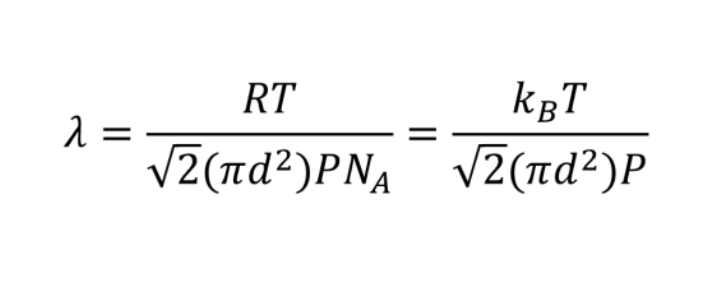
A fixed amount of gas is held in a sealed, rigid container and heated. The pressure increases. What happens to (a) the mean free path and (b) the collision frequency?
(a) Mean free path remains constant because the number density \(N/V\) remains constant in a fixed-volume container. (b) Collision frequency increases because the molecules move faster at higher temperature while traveling the same average distance between collisions.
What determines mean free path of molecules?
Primarily number density (𝜹=N/V) and collision diameter (d)
For an ideal gas, the mean free path is proportional to what values?
For an ideal gas, mean free path is proportional to T and P (𝛌 ∝ T/P)

Does 𝛌 always decrease when P increases?
Not necessarily; 𝛌 ∝ T/P so it depends how T changes too; if T held constant 𝛌 ∝ 1/P but if T rises proportionally with P, mean free path stays constant.
A sealed rigid gas is heated. What happens to its mean free path?
It remains constant because number density (𝜹 = N/V) is unchanged; Despite
𝛌 ∝ T/P, pressure will rise with temperature to hold constant N/V condition.
Why doesn’t high molecular speed lead to large net displacement?
Because the molecule does not travel in a straight line continuously; it undergoes many collisions with other gas molecules.The molecule travels a large total distance, but its net displacement is much smaller due to random motion (vrms = how fast molecules move along instantaneous path).
What does collision frequency depend on?
mean molecular speed; collide more often
molecular size (d); larger molecules = greater chance of collision
particle density (𝜹); more particles per volume = more collisions

State Boyle’s law and relate it to the KTG
Boyle’s law states that pressure and volume are inversely related at constant temperature (P∝ 1/V). At constant temperature, the molecules have the same average kinetic energy and average speed. Decreasing volume means molecules have less distance to travel before reaching the container walls, so collisions with the walls occur more frequently.

State Charle’s law and relate it to the KTG
Charle’s law states that volume and temperature are directly proportional at constant pressure (V ∝ T). At higher temperature, molecules have greater kinetic energy/speed and collide more frequently. If volume is allowed to adjust, it will expand, increasing the distance molecules travel between wall collisions, to maintain constant pressure.

State Dalton’s law and relate it to the KTG
Dalton’s law states that the total pressure is the sum of the partial pressures of all gases (Ptotal = ∑Pi) ; In an ideal-gas mixture, the different gas particles do not interact with one another. Each gas therefore collides with the container walls independently and contributes its own partial pressure

what does the are under a pressure - volume diagram represent?
The magnitude of work; |w| = Pext∆V
If gas expands into a vacuum what is the pressure and work involved?
The vacuum poses no external pressure resisting expansion, therefore no work is done during free expansion; Pext = 0, w = 0
Two processes begin and end at the same states, why do they not necessarily involve the same amount of work?
Because work is not a state function; it is path dependent.
What is the function of a system boundary?
Establishes a separation between the system and the surroundings and determines what exchanges can occur between them
Define heat (q):
The energy transfer through molecular interactions due to temperature differences.
Diathermal boundary:
Diathermal boundary allows energy transfer as heat (q≠0); surroundings can supply or absorb energy (act as thermal reservoir)
Why is heat not a state function?
Because the amount of heat transferred depends on the process; The initial and final states can be identical (meaning ∆U is identical) but q1 ≠ q2.
Why can different values of heat and work produce the same ∆U?
Since ∆U is a state function, it must depend on initial and final states, while q and w can vary depending on the path
∆U, ∆H, P, V, T are all what kind of function?
State functions; they depend only on the current state of the system not how the system went from initial to final state
Adiabatic boundary:
Adiabatic boundary does not allow heat transfer (q=0)
Can energy still change when an adiabatic boundary is involved?
Yes. An adiabatic boundary does not mean the system's energy cannot change; the system can still exchange energy through work. It only means no heat is transferred across the boundary

What is the consequence of a rigid boundary for expansion work?
A rigid boundary means the system's volume cannot change; Since expansion/compression work is directly related to ∆V, w = 0 and ∆U = q; So at constant volume, any heat transferred directly changes the internal energy.
Heat Capacity (c):
Heat capacity measures how much heat is required to produce a change in temperature.
Why is heat capacity at constant pressure greater than heat capacity at constant volume (cp > cv)?
At constant volume, there is no expansion work. However, at constant pressure, a portion of the supplied energy (heat; q) goes toward expansion therefore more heat must be invested to produce the same temperature increase.
What is the distinction between heat (q), work (w) and internal energy (U)?
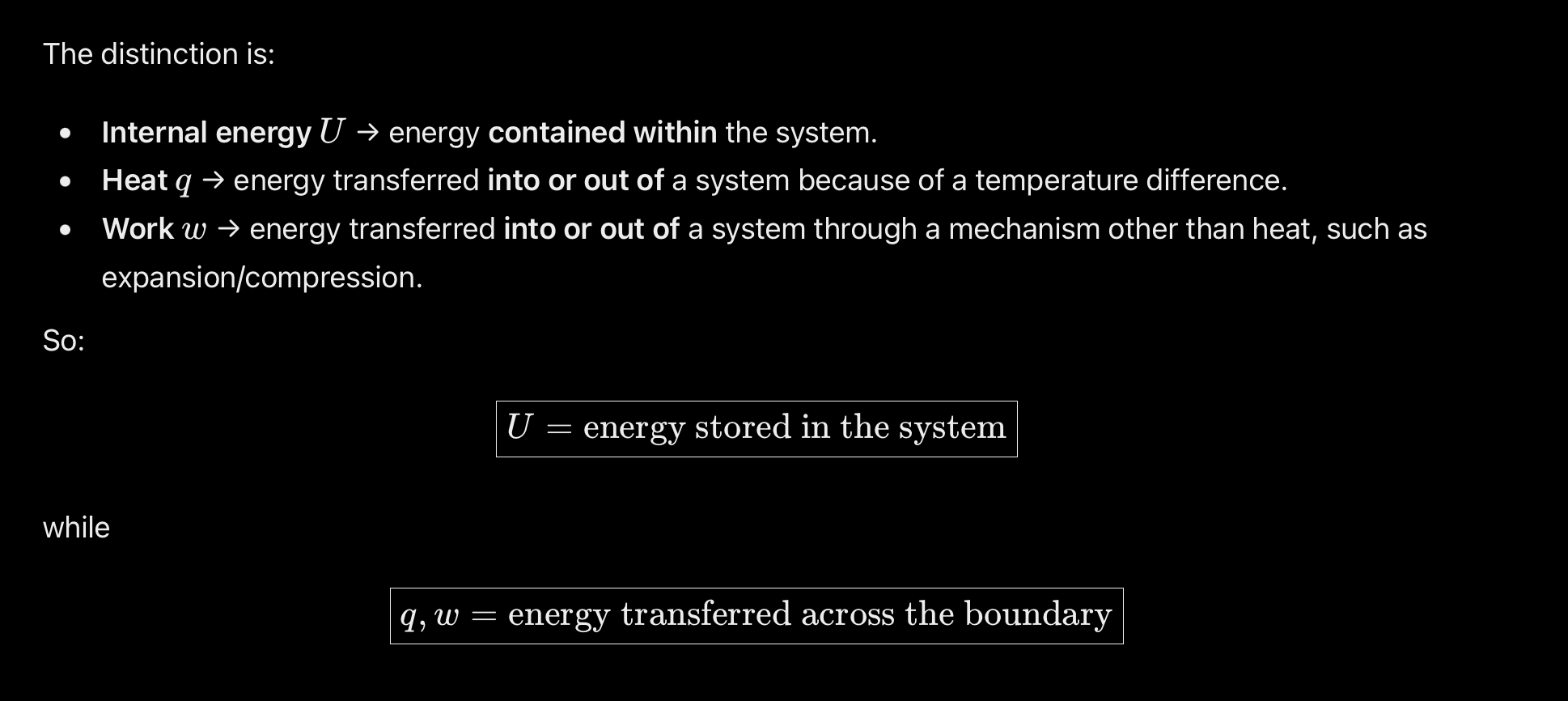
Internal energy (U):
The sum of microscopic energy forms contained within the system, including molecular translational, rotational, vibrational, interactions and chemical/electronic-bond energies (i.e kinetic & potential energy of system’s particles)
In ∆U=q+w what does w include?
The net energy transferred as work, including expansion, electrical, and other forms;

What do the signs 𝑞 > 0and 𝑞 < 0 mean?
𝑞 > 0: heat enters the system. 𝑞 < 0: heat leaves the system.
What do the signs 𝑤 > 0 and 𝑤 < 0 mean?
𝑤 > 0: work is done on the system. 𝑤 < 0: work is done by the system
Why is expansion work calculated using Pext rather than Pgas?
Because work depends on the external force the gas must overcome, which is determined by Pext
Convert -1.0 bar L to J
Given;
1 bar = 10-5 Pa
1L = 10-3m3
1J = Pa m3;
=> (-1.0)(10-5 Pa)(10-3m3) = -100J
For the same initial and final states, which expansion produces greater-magnitude work, reversible or irreversible, and why?
For reversible expansion, the gas expands against an external pressure that is infinitelimally smaller than gas pressure at every step. Therefore the gas does the maximum possible work on the surroundings (reversible maintains Pext ≈ Pgas maximizing work). For an irreversible expansion, the gas expands against lower, finite external pressure, so less work is done.
Analogy; in an arm wrestling match, if the opponents are of nearly the same strength, max work is involved but if one competitor is significantly stronger (ex. Pgas = 5 atm and Pext = 1 atm) winning will not require much work for the strongest individual.

Why is expansion work path dependent?
Because w = - Pext∆V so work depends on the external pressure throughout the process, not just the initial and final states; if you take the gas from the same initial state to the same final state using different pressures along the way, you get different amounts of work.
Why is heat capacity not simply a single property 𝐶independent of how the sample is heated?
Because heat (q) is path dependent (q = C∆T) ; different conditions (ex. ∆V = 0 vs. ∆P = 0) can require different amounts of heat for the same temperature change
When is 𝑞 = 𝐶Δ𝑇 valid?
When heat capacity (C) is constant over the temperature range (∆T) and the process has a specified constraint (ex. constant volume or constant pressure).
A substance has a larger heat capacity than another substance. What does this mean physically?
To achieve the same temperature increase, more energy must be transferred to the system whose heat capacity is greater
For an ideal gas undergoing an isothermal process, what is ∆U and why?
The internal energy of an ideal gas depends only on its temperature; since ∆T = 0 for isothermal processes, ∆U = 0 (This does not mean that no energy is transferred; ∆U = q + w → q = -w)
For isothermal ideal gas expansion, how are q and w related?
Since ∆U = 0, q = -w; heat absorbed exactly offsets expansion work
Why is 𝑞𝑃 not generally equal to Δ𝑈?
At constant pressure, the system may also perform expansion work provided that volume is not constant; some of the energy transferred as heat is associated with expansion work
Why does equipartition theorem give Cv directly but finding Cp requires additional steps?
Both Cv and Cp can be found through equipartition theorem, but while average internal molecular energy (U) is directly related to Cv, Cp is then obtained from ideal-gas relationship (Cp = Cv + R) because at constant pressure, some additional heat goes into expansion work.

Extensive properties (ex. extensive heat capacity includes total heat capacity Cv and Cp but not molar and specific heat capacities)
Extensive properties depend on the amount of matter (n) or size of sample
Intensive properties:
Intensive properties describe the nature of the matter, independent of the amount or sample size (ex. T, P, 𝞺). For instance, dividing total heat capacity by the amount (n) or the mass (m) removes total heat capacity’s dependance on sample size, converting molar and specific heat capacities into properties of the substance itself.

Why does water’s high specific heat capacity make it a good temperature buffer?
Water’s high specific heat capacity means it can absorb or release large amounts of energy without undergoing a large temperature change; this buffers temperature changes and maintains stable environment for organisms and ecosystems
What contribution does an ideal gas' intermolecular interactions make towards molecular internal energy (U)?
According to the ideal gas law, there is no interaction between molecules so Uint = 0
Equipartition theorem:
For a system at thermal equilibrium, each independent quadratic energy term contributes (1/2 KBT) per molecule and (1/2RT) per mole
Why do only contributions that change when ∆T changes contribute to Cv?
Cv measures temperature dependent part of internal energy because it is the derivative of U with respect to T

In the idealized equipartition treatment of molecular degrees of freedom, the potential-energy quadratic term associated with the molecular motion comes from which of the three main molecular motions (translation, rotation, vibration)
Each vibrational mode contributes both a kinetic energy quadratic term and a potential energy quadratic term. By contrast, each translational and rotational DOF (way molecule can move or store energy) corresponds to one quadratic kinetic energy term.

Why does each vibrational contribute potential energy to internal energy while translational and rotational DOF don’t (usually).
The key difference is that vibration involves a restoring force, while idealized translation and rotation do not; when atoms vibrate, restoring force toward equilibrium separation is involved in the bond stretching/compressing; therefore each vibrational mode contributes twice as much energy (1/2KBT + 1/2KBT = KBT ).
(note: real molecules can have additional potential-energy contributions, e.g., intermolecular interactions. The distinction above is the idealized molecular degree-of-freedom treatment used for equipartition.)
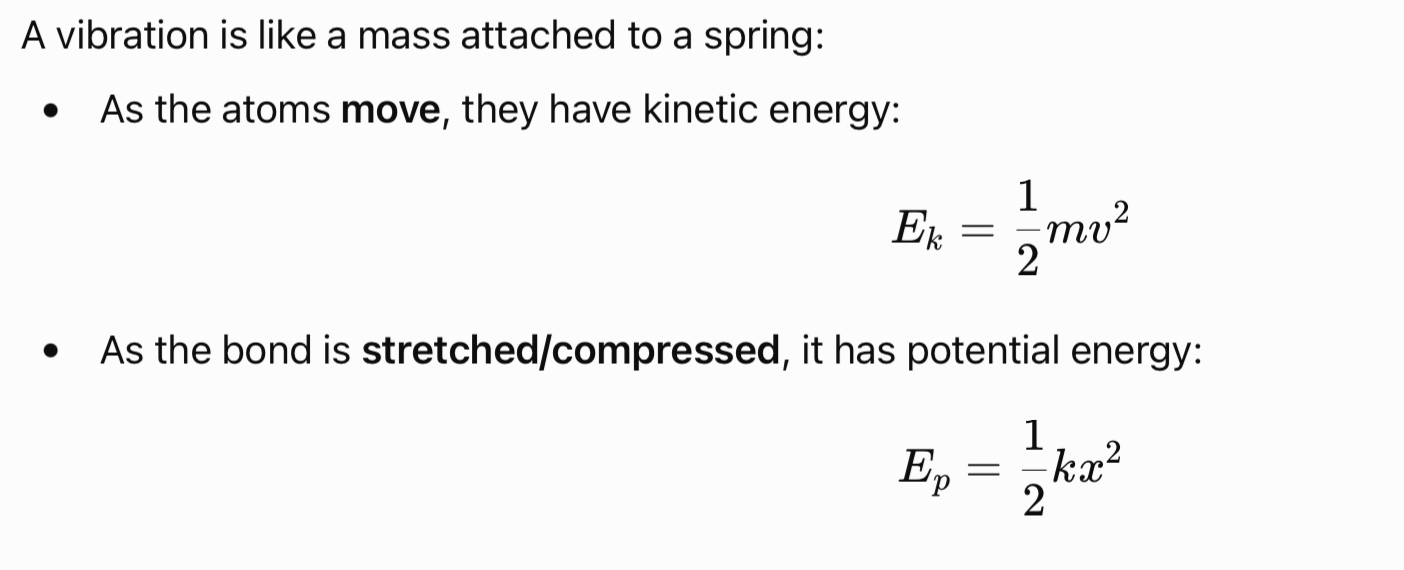
A molecule containing N atoms has how many mechanical degrees of freedom (DOFs)?
f = 3N; each molecule can move in 3 dimensions (x, y, z)
How many translational DOFs does each molecule have? What is the molar translational internal energy contribution?
ftrans = 3, Utrans,molar = 3/2 RT

How many rotational DOFs does each molecule have? What is the molar rotational internal energy contribution?
a) monoatomic molecules: 0 DOF
b) linear molecules: 2 rotational DOF
c) non-linear molecules: 3 rotational DOF
By equipartition, each rotational DOF contributes: ½ RT → Urot,molar = frot/2 RT

How many vibrational DOFs does each molecule have? What is the molar vibrational internal energy contribution?
a) non-linear: fvib = 3N - 6
b) linear: fvib = 3N - 5
Since each vibrational mode contains 2 quadratic DOFs, each vibrational mode contributes RT so Uvib,molar = (vibrational DOFs)RT
For Δ𝐻 = Δ𝑈 + 𝑃Δ𝑉 to apply, must the system be closed and PV work be the only form of work?
Closed system and only PV work is important when deriving qp = ∆H but they aren’t required for the identity ∆H = ∆U + P∆V;
The relationship ∆H = ∆U + P∆V comes from the definition of enthalpy, not from the First Law or from assuming a particular type of work. However, if connected to heat, then the distinction becomes important;
For closed system with only PV work; ∆U = q + w = q - Pext∆V. If process also occurs at constant pressure; ∆U = qp - P∆V. Therefore qp = ∆U + P∆V = ∆H → qp = ∆H

Does 𝑞𝑃 = Δ𝐻 apply only when a gas expands?
As long as system is closed at constant pressure with only PV work, qp = ∆H is valid for a system that can expand, compress or have no volume change.
For an exothermic gas-producing reaction that expands at constant pressure, which is more negative: Δ𝑈 or Δ𝐻?
a) Conceptually: Δ𝑈 is more negative. It accounts for both the energy transferred from the system as heat and the energy transferred to the surroundings as expansion work (Δ𝑈 = 𝑞 + 𝑤). At constant pressure, Δ𝐻 = 𝑞𝑃, so Δ𝐻 only corresponds to the energy transferred as heat
b) mathematically: For a reaction that expands; P∆V > 0 and since the reaction is exothermic, ∆H is negative but ∆U is more negative because ∆H = ∆U + P∆V
When would you expect Δ𝑈 ≈ Δ𝐻?
When the volume change is negligible (∆V ≈ 0); often the case for liquid and solids
For a processes that occurs in a diathermic container, can the sign of ∆U be determined from expansion or compression (the sign of ∆V) alone?
Unlike adiabatic container, the sign of ∆U cannot be determined from expansion or compression alone because heat can enter or exit the system;
∆U(diathermic) = q - Pext∆V
∆U(adiabatic) = -Pext∆V (q=0)
What does the slope of an H vs T graph represent at constant pressure?
Heat capacity at constant pressure (Cp)

What are the characteristics of an ideal gas?
exhibit no intermolecular forces
occupy negligible volume relative to the container
undergo perfectly elastic collisions
Why does a change in volume not affect the internal energy of an ideal gas?
For an ideal gas, internal energy depends only on temperature; an ideal gas assumes that gas particles have negligible intermolecular forces. Therefore, there is essentially no intermolecular potential energy (Uint) to change when the particles move farther apart.
What is the expression for work during reversible isothermal processes?
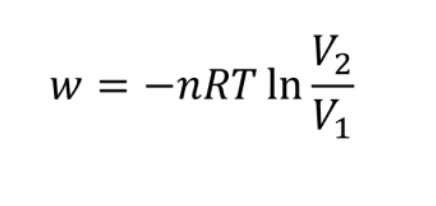
For an ideal gas expanding at constant T against constant Pext, what happens to the magnitude of w if Pext increases? Why?
The magnitude of the work would be unchanged under these assumptions.
Since 𝑉𝑓 = 𝑛𝑅𝑇/𝑃ext, Then 𝑤 = −𝑃ext(𝑉𝑓) = −𝑃ext (𝑛𝑅𝑇/𝑃ext) and therefore 𝑤 = −𝑛𝑅𝑇
At fixed 𝑛 and 𝑇, increasing 𝑃ext decreases the final volume by exactly the amount needed to keep the work unchanged.
When can ∆U ≠ 0 during isothermal processes?
When the system is not ideal; this can occur during change of phase (ex. s → g) which alters intermolecular interactions and internal energy (U)
An ideal gas is compressed isothermally, would the values of Δ𝑈 and Δ𝐻 be different if the compression were carried out reversibly rather than irreversibly?
Both U and H are state functions; their changes depend on initial and final states which are the same whether compression is reversible or irreversible