Lecture 13 - Recombinant Protein Expression
 Call Kai
 Learn
 Practice Test
 Spaced Repetition
 Match
 Flashcards
 Knowt Play
1/96

There's no tags or description
Looks like no tags are added yet.
97 Terms
Genetic engineering
Modification and manipulation of an organism's genetic material to alter existing or create new characteristics
done by deletion, insertion, or alteration.
Purpose of genetic engineering
To create a useful property or function that natural (wild-type) organisms don't have.
Examples of genetic engineering
(1) Heterologous recombinant protein expression — more efficient target protein production and addition of an affinity tag for purification
(2) metabolic engineering of microorganisms to produce valuable compounds.
Recombinant proteins
Foreign proteins produced in expression host cells through recombinant DNA technology.
Uses of recombinant proteins
Medical reagents in human healthcare (vaccines, drugs, antibodies) and in biochemical analysis.
Why produce proteins recombinantly
Most therapeutic proteins are naturally produced at extremely low yields and are difficult to scale up and modify.
Advantages achieved by recombinant protein production
High yields
scalability
lower cost
easy modification

T7 promoter
The most widely used strong promoter in prokaryotic expression systems
recognized specifically by T7 RNA polymerase.
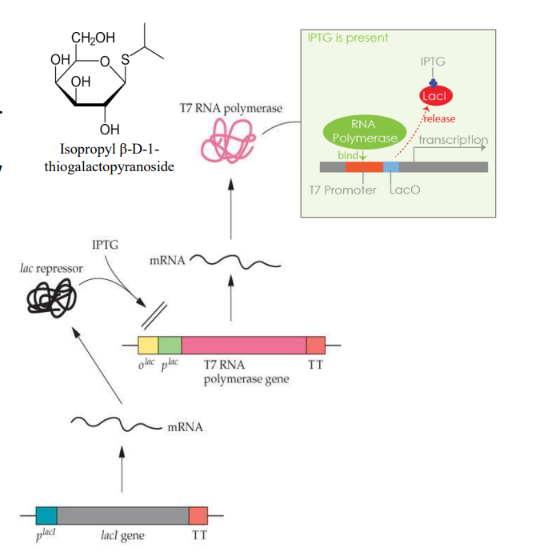
E. coli BL21(DE3)
E. coli strain with the T7 RNA polymerase gene inserted into its chromosome on the bacteriophage T7 lysogen, under the control of the E. coli lac promoter.

Role of IPTG in T7 expression
mimics lactose and binds the lac repressor, releasing it from the operator so T7 RNA polymerase (and the target gene) is transcribed.

T7 system in absence of IPTG
The lac repressor represses synthesis of T7 RNA polymerase, so the target gene is not transcribed.
Plasmid copy number
Number of plasmid copies maintained in a cell, determined by the origin of replication.
Requirement for maintaining multiple plasmids in E. coli
The plasmids must possess compatible origins of replication and different antibiotic resistance genes for selection.
Result of two plasmids sharing the same origin of replication
Replication of one plasmid is inhibited via an RNA antisense mechanism, causing plasmid segregation within the population.
How compatible plasmids coexist
They stably coexist in a single cell by occupying different subcellular locations within the bacterium, and must carry different antibiotic resistance genes.
Plasmid segregation with the same antibiotic resistance gene
Can still occur
only one plasmid needs to be maintained to confer resistance.

Fusion tags
Sequences fused to recombinant proteins for rapid purification and detection
not considered permanent fixtures/domains on the protein.

Why remove fusion tags
Tag removal is essential for highly analytical studies of recombinant protein structure and function (may also require subsequent removal of the protease).

TEV protease
A cysteine protease from Tobacco Etch Virus, commonly used to cleave fusion proteins and remove tags from recombinant proteins in vitro or in vivo.

TEV protease cleavage conditions
50 mM Tris-HCl (pH 8.0), 0.5 mM EDTA, 1 mM DTT
incubated overnight for maximal cleavage.
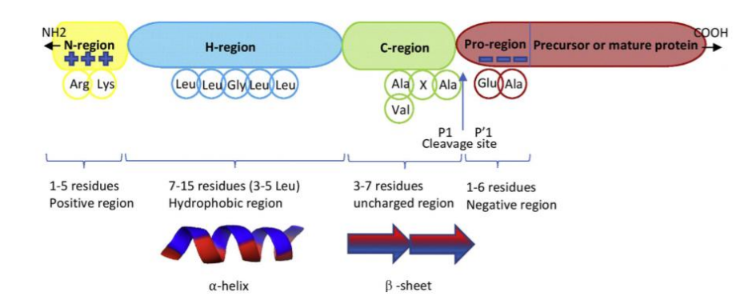
Signal peptide
Sequence required for secretion of proteins outside cells
the initial part of the protein important for secretion is called the pro-region.

Three main parts of a signal peptide
(1) N-region — positively charged domain
(2) H-region — hydrophobic core forming an α-helix
(3) C-region — the cleavage site forming a β-sheet.

P1 and P'1 residues
P1 = residues before the cleavage site
P'1 = residues after the cleavage site.

Signal peptide cleavage motif
Cleavage occurs at an Ala-X-Ala or Val-X-Ala motif (X = any amino acid).

Secretory (Sec) machinery components
SecB, SecA, SecY, SecE, SecG, and SecDF proteins.
Role of SecB
Binds the nascent polypeptide, acting as a chaperone that prevents folding of the protein before secretion.

Sec secretion pathway
Protein is guided to SecA
SecA inserts the pre-protein into the membrane, forming a translocation complex with SecY/SecE/SecG
SecY+SecE form the channel and SecG activates translocation
ATP energy drives secretion
SPase I cleaves the signal peptide to release the mature protein.

Factors that recombinant protein stability depends on
Extent of disulfide bonds (oxidase)
presence of certain amino acids at the N-terminus
internal PEST sequences.

N-terminal amino acids and half-life
Met, Ser, Ala → half-life >20 h
Arg → half-life ~2 min.
PEST sequence
Internal sequence rich in proline (P), glutamic acid (E), serine (S), and threonine (T) that makes a protein more susceptible to proteolytic degradation
altering it by genetic manipulation enhances stability.
Strategies to prevent inclusion bodies
Tagging with proteins like Glutathione S-transferase (GST; 220 aa, ~26 kDa)
overexpressing disulfide bond-forming proteins (DsbC) such as cytoplasmic ribonucleotide reductase that gets oxidized during its catalytic cycle.
Factors determining the expression system used
Time to express the protein
ease of handling
amount of protein needed
destination of the protein
mass of the protein
type of post-translational modifications / number of disulfide bonds.
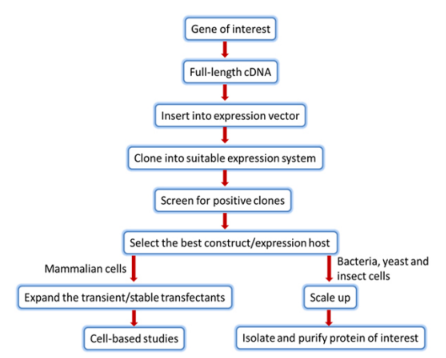
Information/components needed to express a recombinant protein
Identify the gene encoding the protein
generate cDNA from mRNA (for eukaryotic proteins)
select a suitable expression vector, expression system, and modification system
appropriate screening and scale-up methods.
Complementary DNA (cDNA)
A DNA molecule synthesized from single-stranded mRNA through reverse transcription.
Advantages of protein expression in prokaryotes (E. coli)
Host of choice for most experiments
rapid doubling time (~30 min) in simple, inexpensive defined media
extensive knowledge of its genetics with many available promoters and terminators.

Disadvantages of protein expression in E. coli
Cannot remove introns
codon bias (different codon usage frequency)
no post-translational modification (never glycosylates correctly)
may misfold proteins into insoluble inclusion bodies
may degrade the recombinant protein
premature transcription termination.
Humulin (1978)
Human insulin
a milestone in the history of recombinant drugs.

Insulin before biotechnology
Extracted from pig and cow pancreas glands — over two tons of pig pancreas (~4000 pigs) were needed for just eight ounces of purified insulin.

How human insulin was produced recombinantly
Plasmids carrying two insulin genes transformed E. coli to produce human insulin chains A and B, which were then linked via oxidation.
Yeast and fungi expression system
Offers higher-eukaryote advantages like post-translational modification
grows faster, more easily, and more cheaply than other eukaryotic cells with generally higher expression
common species are Saccharomyces cerevisiae and Pichia pastoris.
Insect expression system
Based on baculoviruses — viruses common in insects that do not normally infect vertebrates
the baculovirus genome includes the polyhedron gene (whose product forms nuclear occlusion bodies) can be replaced by a foreign gene for similar high-level production.
Mammalian expression system
Produces proteins processed correctly and indistinguishable from non-recombinant versions
uses transient and stable modes of expression
cell lines include HEK, COS, and BHK, with CHO used predominantly for stable expression.
Yeast as an expression host
Unicellular eukaryotic microorganism
GRAS (Generally Regarded As Safe) and capable of post-translational modification.

Yeast intracellular expression
High protein yield but more difficult extraction/purification
involves N-/C-terminal processing, risk of proteolytic degradation, and possible aggregation/insolubility from added tags.

Yeast secretion expression
Protein secreted outside the cell
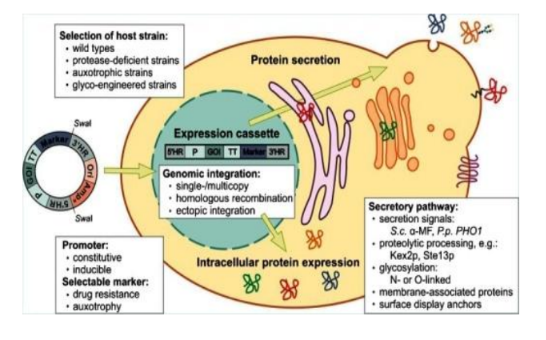
Yeast glycosylation
Modifies N-linked (to asparagine) and O-linked (to serine/threonine) glycosylation, but yeast proteins are only modified by mannosylation
hyperglycosylation in the yeast Golgi is not typical of mammalian cells.
Saccharomyces cerevisiae
Baker's yeast
single-celled eukaryote that grows rapidly (doubling time ~90 min) in simple defined media similar to E. coli
may contain some but not all higher-eukaryote post-translational modifications.
A number of strong promoters (tightly regulatable, inducible) have been used to drive target gene expression

Prominent S. cerevisiae promoters
Phosphoglycerate kinase (PGK), glyceraldehyde-3-phosphate dehydrogenase (GAPD), alcohol dehydrogenase (ADH1), galactokinase (GAL, induced by galactose), and metallothionein (CUP1).

Yeast Artificial Chromosome (YAC)
An engineered, artificially constructed linear DNA molecule used to clone DNA sequences in yeast (Murray and Szostak, 1983)
a shuttle vector able to replicate/be selected in both E. coli and S. cerevisiae.

YAC components
Centromere (CEN)
telomeres (T)
autonomous replicating sequence (ARS) element required for replication/preservation (ARS acts as a replication origin).
YAC capacity
Propagates in eukaryotic hosts like a eukaryotic chromosome and can clone very large inserts (100 kb–10 Mb).

Yeast Integrating plasmid (YIp) vector
Vector that does not replicate autonomously but integrates into the genome at low frequency by homologous recombination, typically as a single copy.
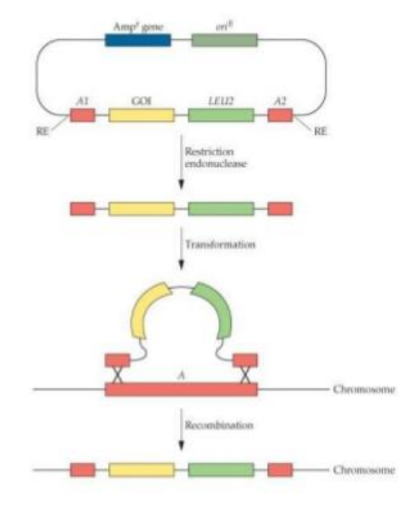
YIp multiple-copy integration
Methods have been developed to integrate multiple copies, giving stable cell lines with up to 15–20 copies for overexpression.
YIp integration sites
With two yeast segments (e.g., YGF1 and URA3 marker) it can integrate at either locus
with repetitive DNA (Ty element A1/A2 or rDNA) it can integrate at any of multiple genomic sites.
Problems with S. cerevisiae
Sometimes hyperglycosylates proteins (retained in periplasmic space, raising purification cost/time) and produces ethanol at high, cell-toxic concentrations.

Pichia pastoris
A methylotrophic yeast used as an alternative host
has the AOX1 promoter, tightly regulated and induced to very high levels by methanol.

AOX1 promoter
Alcohol oxidase 1 promoter driving methanol metabolism
methanol is oxidized to formaldehyde using molecular oxygen (O2) by alcohol oxidase
because the enzyme has poor O2 affinity, P. pastoris compensates by making large amounts of it.
Advantages of Pichia pastoris
Much higher target protein levels than S. cerevisiae (50–5000 mg/L)
glycosylation more closely resembling higher eukaryotes
low ethanol levels
Disadvantage of Pichia pastoris
Sometimes degrades recombinant proteins before they can be purified.
Autographa californica
A baculovirus that commonly infects insects (small beetles and their larvae); uses a super-strong promoter from the polyhedron coat protein to enhance protein expression.
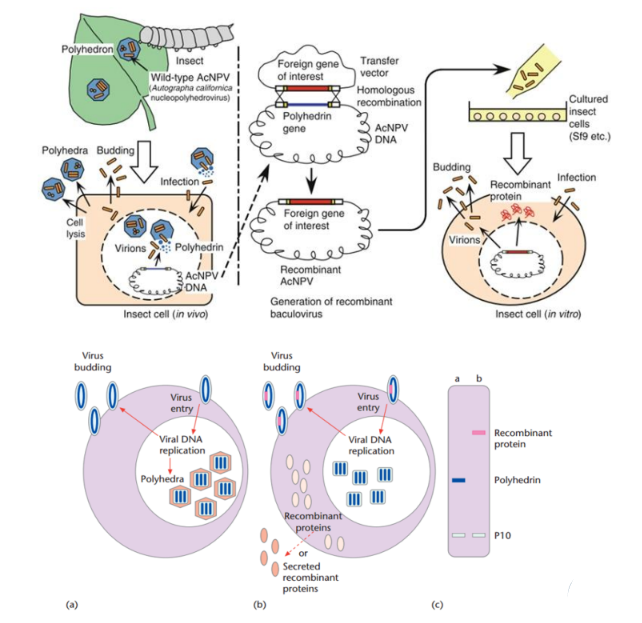
Baculovirus system: wild-type vs recombinant
(a) Wild-type virus makes large amounts of polyhedrin
(b) recombinant virus replaces the polyhedron gene with a foreign gene under the polyhedron/p10 promoter, giving a polyhedron-negative phenotype
(c) high levels of recombinant protein are produced instead of polyhedron.
Polyhedrons
Viral proteins that form occlusion bodies (polyhedra) — large structures that protect virus particles from the outside environment for extended periods.

Baculovirus expression system workflow
Target gene is cloned under the polyhedron promoter into a transfer vector flanking the polyhedrin locus
co-transfected into insect cells with a linearized viral genome using restriction enzymes
homologous recombination forms a functional viral genome producing viral particles.

lacZ screening in baculovirus system
Including lacZ (β-galactosidase) in the transfer vector allows visual identification of recombinant plaques, which appear blue after X-gal staining
recombinants look different because they lack the coat protein.

Advantages of the baculovirus system
Polyhedron gene not needed for continuous infectious virus production (its sequence is replaced by the heterologous gene)
very strong polyhedron promoter → very high protein levels
capable of post-translational modifications.

Disadvantages of the baculovirus system
Expensive
glycosylation in insect cells differs
discontinuous expression (infection kills the host, requiring re-infection of fresh cultures each round)
inefficient for commercial-scale production.
Mammalian cell expression modes
Transient and stable expression.
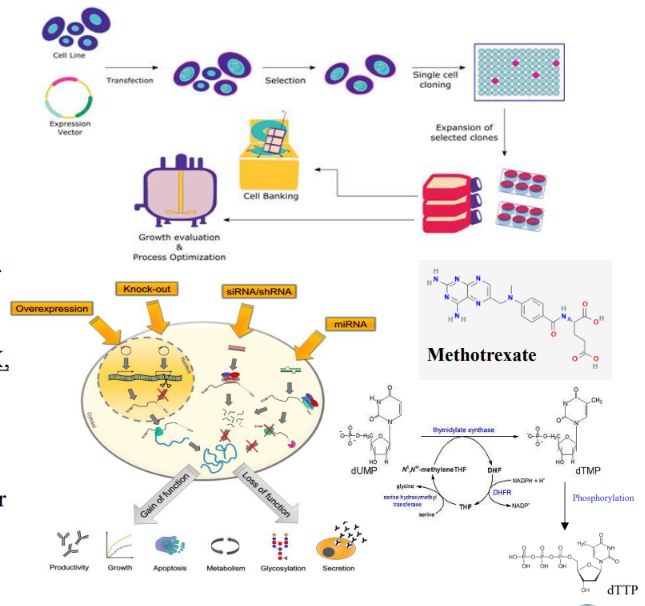
Mammalian eukaryotic origin of replication origin
Derived from an animal virus, e.g., Simian virus 40 (SV40).

Neor selection marker
Bacterial gene encoding neomycin phosphotransferase, conferring resistance to G418 (geneticin).

DHFR selection marker
Gene encoding dihydrofolate reductase, essential for folate biosynthesis
native DHFR is inhibited by methotrexate (MTX), so only cells with a functional transfected DHFR grow in MTX.
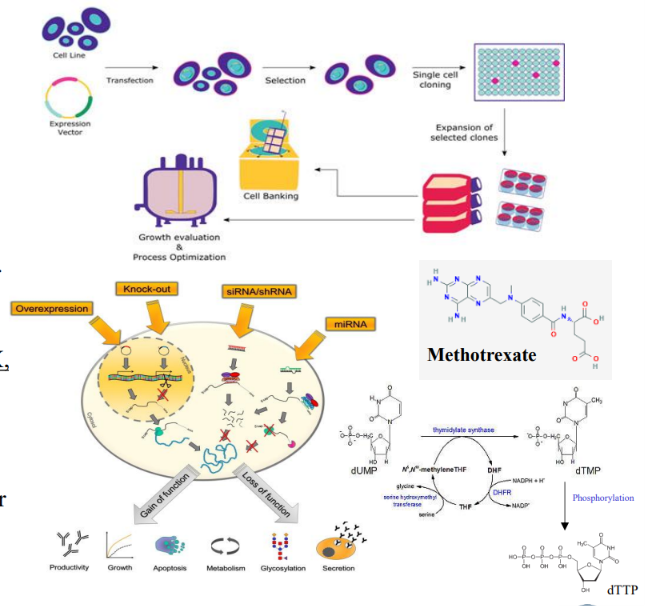
Methotrexate (MTX)
Formerly amethopterin
competitively inhibits dihydrofolate reductase, decreasing dTTP synthesis and cellular replication — useful in cancer treatment and in DHFR-based selection/amplification.

Mammalian promoters/terminators sources
From animal viruses (human CMV, SV40, herpes simplex virus) or mammalian genes (bovine growth hormone, thymidine kinase)
terminators are poly-adenylation signals.
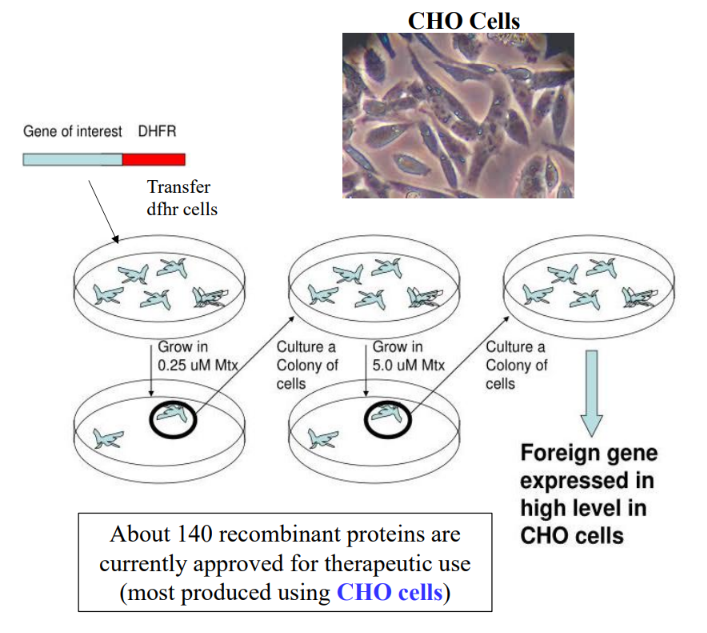
Steps for mammalian (CHO) cell expression
Gene cloned/propagated in bacteria (shuttle vector)
CHO cells transformed by electroporation with linear plasmid
gene integrates randomly (1+ times) into CHO chromosomes
vectors use SV40/CMV/vaccinia promoters and DHFR marker
multiple rounds of growth/selection with methotrexate select highest-expressing cells
Transient mammalian expression cell lines
COS cells (SV40-transformed African green monkey kidney fibroblasts) and HEK-293 cells (human embryonic kidney cells transformed with adenovirus DNA)
convenient for rapid production of small amounts of protein for initial characterization.

CHO cells (therapeutic relevance)
About 140 recombinant proteins are currently approved for therapeutic use, most produced using CHO cells.
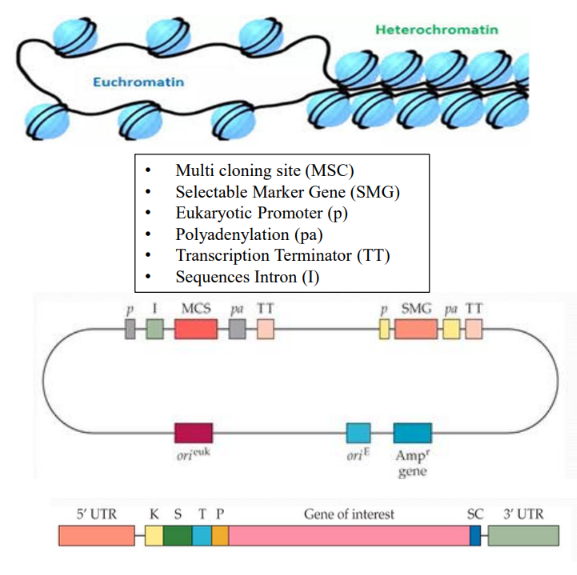
Generalized mammalian expression vector
MCS and selectable marker gene are under a eukaryotic promoter, polyadenylation, and terminator
an intron enhances heterologous protein production
the Amp gene selects transformed E. coli.

Translation control sequences for the gene of interest
Kozak sequence (K, surrounds the AUG start codon)
signal sequence (S)
affinity purification tag (T)
proteolytic cleavage (P) site
and stop codon (SC)

Role of 5' and 3' UTRs
Increase translation efficiency and contribute to mRNA stability.

Mammalian vector type (a) — standard
Contains a promoter (± enhancer) and a 3' polyadenylation sequence; the GOI is inserted into an MCS, and the mammalian/bacterial selectable marker is regulated by a separate set of regulatory elements.

Mammalian vector type (b) — bicistronic
A single cassette expresses the GOI and a mammalian selectable marker separated by an IRES (Internal Ribosome Entry Site), under one upstream promoter and 3' polyA.

IRES (Internal Ribosome Entry Site)
Element allowing cap-independent translation of a second gene from the same mRNA in a bicistronic vector.

Mammalian vector type (c) — DNA opening elements
Contains elements like MARs or UCOEs, typically placed upstream (and possibly downstream) of the polyA.
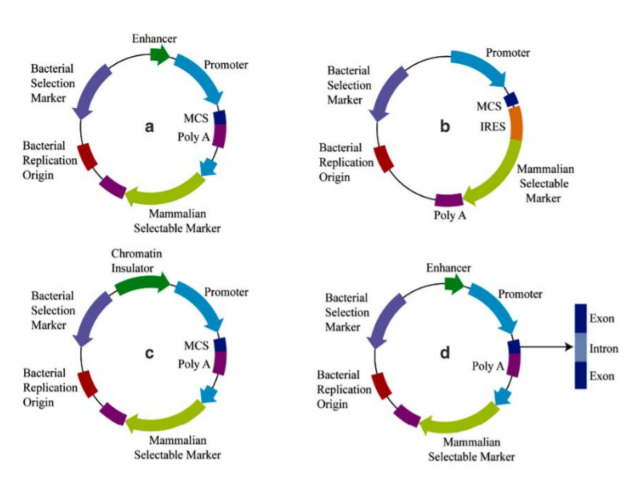
Mammalian vector type (d) — introns
Contains one or more introns frequently inserted into the coding sequence of the gene of interest.
Matrix attachment regions (MARs)
Human DNA elements that can insulate transgene expression from chromosomal position effects.
Ubiquitous Chromatin-opening Elements (UCOEs)
Elements that confer stable, integration-site-independent transgene expression proportional to copy number, even within heterochromatin such as centromeres.

Plasmid integration (A) — random
A conventional vector (promoter, GOI, pA, selection marker like neomycin) integrates randomly into the host genome, often giving low/no expression and transgene silencing over time.

Plasmid integration (B)
Random integration of a plasmid-based vector flanked by chromatin modifiers (cm).

Plasmid integration (C) — targeted
Expression vector targeted into a chromatin-permissive "hot spot" by recombinase-mediated cassette exchange or somatic homologous recombination.

Plasmid integration (D) — BAC
Random integration of a BAC containing the expression vector within a ~200 kb BAC carrying an open chromatin locus (e.g., Rosa26).
Euchromatin vs heterochromatin for expression
For enhanced expression and stability, the target gene should integrate into euchromatin rather than heterochromatin
techniques relax chromatin (chromatin modifiers or inserted anti-condensation DNA elements) to boost expression.
Shuttle vector
A plasmid that can replicate and be selected in more than one host (e.g., both E. coli and yeast or mammalian cells), allowing cloning in bacteria before transfer to the final host.
E. coli expression — advantages vs disadvantages (summary table)
Advantages: rapid expression, less expensive, simple scale-up, well-characterized genetics.
Disadvantages: no eukaryotic post-translational modifications, some proteins not properly folded, proteins rarely secreted.
S. cerevisiae expression — advantages vs disadvantages (summary table)
Advantages: moderately rapid expression, works for secreted and intracellular proteins, less expensive, most protein folding and PTMs possible
Disadvantages: N-linked glycan structures differ from typical mammalian proteins, requires yeast secretion signal peptides, enhanced safety precautions required.
Baculovirus/insect expression — advantages vs disadvantages (summary table)
Advantages: moderately rapid expression, works for secreted/membrane/intracellular proteins, most protein folding and PTMs possible
Disadvantages: N-linked glycan structures differ from mammalian proteins, expensive, difficult to scale up.
Mammalian (transient) expression — advantages vs disadvantages (summary table)
Advantages: moderately rapid expression, works for secreted and membrane proteins, all protein folding and most authentic PTMs possible
Disadvantages: expensive, low yields of intracellular proteins, difficult to scale up.
Mammalian (stable) expression — advantages vs disadvantages (summary table)
Advantages: all protein folding and most authentic PTMs possible, works for secreted and membrane proteins
Disadvantages: expensive, low yields of intracellular proteins, difficult to scale up, lengthy expression time.

General workflow across all expression systems
Transform competent cells with the gene of interest → select and expand positive clones → isolate plasmid/expression vector → introduce into final host (bacteria, yeast, insect, or mammalian cells) → scale up and isolate the protein of interest.