(SEM1Q1, SCI) 3.3 - Effects of Landforms and Bodies of Water on Typhoons
0.0(0)
Studied by 5 people Call Kai
 Learn
 Practice Test
 Spaced Repetition
 Match
 Flashcards
 Knowt Play
Card Sorting
1/29

Earn XP
Description and Tags
30 Terms
1
New cards
What is orography?
study of the formation of mountains
2
New cards
Topography is defined as the record of?
terrains
3
New cards
Topography is defined as the quality of?
the surface
4
New cards
Topography is defined as the recognition of?
landforms
5
New cards
What happens when elevated terrains act as a barrier to airflow?
Orographic lifting occurs.
6
New cards
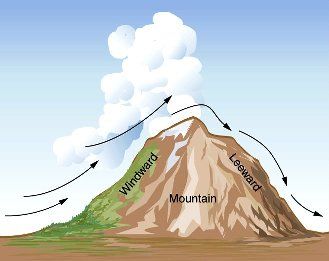
What is orographic lifting?
mechanism that causes air to rise along mountain slopes on the windward side
7
New cards
How can you describe the air coming from above the ocean surface?
warm and heavy with moisture
8
New cards
What happens to warm ocean air as it goes up?
It cools down, the moisture condeses as rain.
9
New cards
Where can you locate the majoirty of the rainiest places on Earth?
windward mountain slopes
10
New cards
In which side of the mountain can you find little or no rain?
leeward side
11
New cards
Why is the leeward side of a mountain dry?
Moisture would have been depleted by the time it reaches here.
12
New cards
What happens when cool air descends on the leeward side?
It becomes warmer and drier. Water evaporates.
13
New cards
What is a rain shadow?
the driest area on the leeward side
14
New cards
What is the leeward side of a mountain at risk for?
droughts
15
New cards
In which side of the mountain can you find fewer typhoons?
leeward side
16
New cards
As the air is lifted up the mountain slope, it cools as it rises - which is a process known as?
adiabatic cooling
17
New cards
What causes the formation of clouds and precipitation on the windward slope of a mountain?
cooling of rising warm air
18
New cards
As the air descends down the leeward slope, it warms and expands - which is a process known as?
adiabatic warming
19
New cards
Why do clouds dissipate and precipitation is reduced in the leeward slope of mountains?
warming of descending cool air
20
New cards
What has an effect on how strong typhoons hit near landmasses?
large bodies of water
21
New cards
How do bodies of water affect a typhoon?
based on how strong the energy is released by the landforms and bodies of water
22
New cards
Where do typhoons get energy from?
warm water
23
New cards
Where do typhoons lose their energy from?
cold water
24
New cards
A typhoon weakens when it interacts with what?
large masses
25
New cards
What does the temperature of the bodies of water determine? (2)
(1) air's temperature
(2) moderation of its humidity
(2) moderation of its humidity
26
New cards
Why is warm water responsible for the formation of a typhoon?
It increases air temperature and humidity.
27
New cards
Why is cold water responsible for lessening the energy of a typhoon?
It decreases the air's temperature and lessens relative humidity.
28
New cards
Which side of the mountain faces the sea?
windward
29
New cards
Which side of the mountain faces away from the sea?
leeward
30
New cards
What is an example of a rain shadow desert located in North America?
Great Basin