Busn3140 CONSUMER BEHAVIOR Chapters 1-4 Review
 Note
Note Call Kai
 Learn
Learn Practice Test
 Spaced Repetition
 Match
Match Flashcards
 Knowt Play
1/86

There's no tags or description
Looks like no tags are added yet.
Name | Mastery | Learn | Test | Matching | Spaced | Call with Kai | Chat |
|---|
No analytics yet
Send a link to your students to track their progress
87 Terms
Segmentation
Identification of groups of people who have common needs (Geographic, demographic, psychographic, behavior)
Geographic segmentation
Climate
Population density
Urban-rural
Demographic segmentation
Age
Life stage segmentation
Gender
Ethnic background
Income, education, occupation
Social class is determined by one’s occupation
Psychographic segmentation
How consumers describe themselves
ALO (activities, interests, opinions)
Values
Lifestyle (what they like to do, leisure time, spend income…)
Behavior segmentation
Benefit desired- Product use, Need
Usage rate - Heavy, medium, light, none
User status - Current, future, ex
Occasion - where/when the product is used
Customer entry points (CEPs) - OCCASION
Positioning Process
In the eyes and mind of the buyer
→ develop a brand image
Positioning objective
→ to differentiate from other brands
→ perceive the brand favorably compared to others
Tasks of positioning
Define the product
Help customers remember
Communicate the product’s attributes
Best strategies to position
By attributes
- economy, reliability, durability, consistency…
By benefits
By usage, occasions (Category Entry Points)
By users
By product class/category
- to get consumers to associate (disassociate) a product with a positive (negative) image
By competitors
By an affiliated brand (partners)
Value
Benefits - cost
Needs/Wants
Specific ways to specify your need
Consumption
Process by which goods, services, or ideas are used and transitioned into value
The Basic Consumption process
→ Need
→ Want
→ Exchange
→ Costs & benefits
→ Reaction
→ Value → Need
Product
A solution to a consumer problem
Benefits
Rational/functional
Psychological (prestige, peace of mind, confidence…)
Social (relationship, status)
Costs
Price, time, effort
Marketing myopia
A shortsighted business approach that focuses on selling specific products rather than understanding and fulfilling broader customer needs
The meaning of consumption
People buy products for what they mean but for what they mean
Create an image/make a lifestyle statement/social identity
People generally choose a brand with an image (personality) that matches underlying needs
Conspicuous consumption- the practice of buying luxury goods and services publicly to display wealth and social status rather than to meet practical needs
Consumer orientation
A business approach that puts the needs, wants, and preferences of the customer first
Market orientation
A business approach that prioritizes identifying and satisfying customer needs and wants before creating or selling a product
Stakeholder marketing
A strategy where a company creates value and builds relationships with stakeholders for long-term mutual benefit
employees, customers, suppliers, local community, general public
Relationship marketing
Long-term business strategy focused on building genuine, ongoing connections and loyalty with customers
Touchpoints
Any interactions a person has with a brand at any stage of their journey
online, offline, physical, virtual interactions
Consumer behavior study
When individuals or groups select, purchase, use, and dispose of goods, services, ideas, or experiences to satisfy needs and desires
Relationship quality
build and maintain relationships with customers
loyal customers are five times more profitable than new ones
satisfied customers bring other customers
buy other products
product line/mix extension
Consumer behavior
helps consumers in making better decisions
consequences of poor budgeting
role of emotions
avenues for redress
social influences
environmental effects
Trends
1. Globalization
2. Technological changes
3. Changing demographics
4. Changing economy
Cognition
thinking/mental processes that go on as we process and store things that can become knowledge (rational)
Affect
feelings experienced during consumption activities or associated with specific objects (emotions)
2 types of benefits/values
Utilitarian (rational)
Hedonic (immediate gratification)
Consumer Value equation
Benefits - Costs = Value
1. Rational
2. Psychological/emotional
3. Social
Utilitarian
product helps the consumer solve problems and accomplish tasks that are part of being a consumer (rational)
Hedonic
immediate gratification that comes from experiencing some activity
Total Value Concept (augmented product)
The original value plus the extra things needed to increase the value from consumption
every products value = basic benefits + augmented product + “feel” benefits
Perceptual map (product differentiation)
Marketplace condition in which consumers do not view all competing products as identical to one another
unique positioning
Customer Lifetime value
Represents the approximate worth of a customer to a company in economic terms
CLV = (sales-costs)+(equity)
Consumer value transformation
The shifting process where companies continuously refine and elevate the benefits of a product or service
Personal values
Enduring beliefs that a given behavior or outcome is desirable or good
what a person should do
what is wrong/right/good/bad/important/less
our preferences and behaviors as consumers
ex: recycled materials, animal-free test products
Somatic maker hypothesis (Dr. Damasio and Elliot case)
Emotional processes guide behavior (decision-making)
Somatic markers are physical reactions that are associated with emotions, influencing subsequent decision-making
ex: rapid heartbeat, dry mouth, nausea
Means-end chain model
Link personal values (END) with products and product benefits (MEANS)
physical, tangible attributes of products can be psychologically linked with personal values
Terminal values
The end-state we hope to achieve in life
Instrumental values
Means of achieving terminal values
Laddering
A research method of analyzing means-end chains
Keep asking why: create hierarchical value maps
Perception
How an individual gathers, processes, and interprets information from the environment
Perception represents a subjective reality
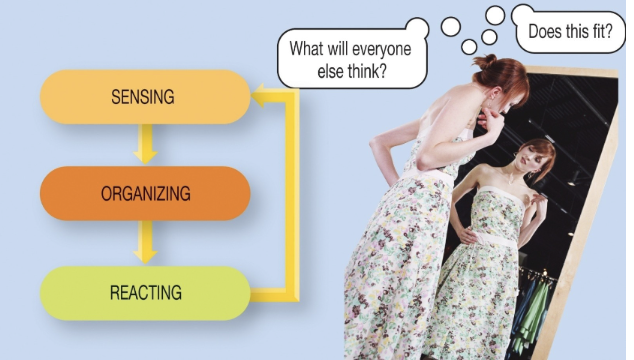
Sensing
Vision, smell, hear, touch, taste
Organization reactions
1- Assimilation
2- Accommodation
3- Contrast
Assimilation
When a stimulus has characteristics that allow for easy recognition as an example of some category
Accommodation
When a stimulus shares some, but not all, of the characteristics that would lead it to fit neatly in an existing category
Consumers prefer slightly different products
Contrast
When a stimulus does not share enough in common with existing categories to allow categorization
People tend not to like things are so completely unknown
Selective perception
1- Exposure
2- Attention
3- Distortion
4- Retention
Selective exposure
Screen out the most stimuli and expose oneself to only a small portion of stimuli
Selective attention
Tendency of a consumer to pay attention only to messages that address a need or interest or are consistent with the consumer’s attitudes, opinions, and beliefs
Selective distortion
People tend to interpret information in a way that supports what they already believe
Selective retention
Process when people more accurately remember messages that are closer to their interests, values, and beliefs
Absolute threshold
The minimum amount of energy that can be detected by a particular sensory receptor
Adaptation
To “get used to” certain sensations
To increase sensory input, use unusual media to place an advertisement
Differential threshold
The ability of our sensory system to detect changes or differences in stimuli
Just Noticeable Difference (JND)
The minimum actual change in a stimulus that can be detected as a change
Marketing implication
Marketing implication of JND
Marketers want to find the relevant JND for their products
Negative changes may not be noticeable
Product improvements are apparent
Update existing packaging, logo, or corporate symbols
Weber’s Law
Law that states that the change in a stimulus that will be just noticeable is a constant ratio of the original stimulus
The stronger the initial stimulus, the greater the change must be for it to be noticed
Subliminal perception
“Below threshold” = stimuli presented below the level of conscious awareness
1- Briefly presented visual stimuli
2- Accelerated speech in low-volume auditory messages
3- Embedded or hidden sexual imagery or words
Mere Exposure Effect
Consumers will prefer an object to which they have been exposed
Consumers prefer stimuli they have previously exposed to over stimuli
which they have not
Familiarity
Humans gravitate to the known, the safe, and the trusted
Enhancing attention
Intensity- stronger stimuli, color sound
Movement
Size
Contrast- Color vs. B&W
Surprise
Involvement- Personal relevance
Classical conditioning
A change in behavior that occurs simply through associating some stimulus with another stimulus that naturally causes a reaction
Classical conditioning theory
All organisms (animal & human) are passive entities that could be taught certain behaviors through repetition
Advertising wear out
After a certain number of repetitions, retention declines
• need to vary the advertising message.
Stimulus generalization
Making the same response to slightly different stimuli
• Family branding (brand extension)
Stimulus discrimination
Marketers want consumers to distinguish their brand in the consumers’ minds
Instrumental conditioning
A learning process that modifies voluntary behaviors through the use of rewards and punishments
Behavior is conditioned through reinforcement
Positive/Negative reinforcement
Behavior modification is reinforced or rewarded by a positive consequence and punished by a negative one
Punishments
A positive stimulus is removed
A negative stimulus is presented
Shaping
A process through which the desired behavior is altered over time in small increments
Message congruity
A business’s communication matches, aligns, and makes sense to consumers

Figure-Ground distinction
The brain organizes visual information by separating the figure (main object/focus) from the ground (the background/negative space)

Framing
The same information can take on different meanings based on the way in which the information is presented
Prospect theory
A decision can be framed in different ways and the framing affects risk assessment
50% off or $10 off (for a $20 product)

Loss aversion
The tendency to feel the pain of a loss twice as intensely as the pleasure of an equivalent gain
losing $100 feels twice as bad as gaining $100 feels good
Multiple store theory of memory
Three memory process utilizing different storage areas within the brain
1- Sensory memory
2- Workbench (short-term)
3- Long-term

Sensory memory
Stores everything that we encounter with our five senses, lasting less than a second
unlimited capacity and very limited duration
works w/ other memories (workbench/long-term)
Workbench (short-term memory)
Bits of data are worked on to create knowledge for active problem-solving
limited capacity and limited duration
coding
Long-term memory
Permanent information storage
unlimited capacity and duration
semantic/associative network
4 mental processes that help consumers remember things
1-Repetition
2-Dual coding
3-Meaningful coding
4-Chunking

Exemplar (prototypical)
A concept within a schema that is the single best representative of some category
Children’s entertainment: Disney
Bleach: Clorox
Episodic memory
The memory for past events in one’s life
childhood, graduation
Cognitive schema
Consumers assign meaning to stimuli based on a set of beliefs (schema) and one’s previous experience
-Social schema
-Social identity
Priming
Certain properties of a stimulus typically will evoke a schema
exposure to a stimulus influences response to a later stimulus
