Sustainable Packaging
 Call Kai
 Learn
 Practice Test
 Spaced Repetition
 Match
 Flashcards
 Knowt Play
1/28

There's no tags or description
Looks like no tags are added yet.
29 Terms
Pillar 1 - Economic
Jobs: Strengthen and Maintain current and future jobs
Incentives: Promote incentives for humans to encourage sustainable practices
Supply and Demand: Promote fully informed accounting practices and market practices to promote environmental health and social prosperity.
Natural Resource Accounting: Improve understanding and quantification of ecosystem services in cost benefit analysis
Costs : Positively impact costs of processes, services, and products throughout the full lifecycle
Prices: Promote cost structures that reduce risk and premium for new technologies
Pillar 2 - Social
Environmental Justice: Protect health of communities over-burdened by pollution by empowering them to take action to improve their health and environment
Human Health: Protect, sustain, and improve human health
Participation: Use open and transparent processes that engage relevant stakeholders
Education: Enhance the education about sustainability of the general public, stake-holders, and potentially affected groups
Resource Security: Protect, maintain, and restore access to basic resources (e.g. water, food, land, and energy) for current and future generations
Sustainable Communities: Promote the development, planning, building, or modification of communities to promote sustainable living
Pillar 3 - Environmental
Ecosystem Services: Protect, sustain, and restore the health of critical natural habitats and eco-systems
Green Engineering & Chemistry Design: chemical products and processes to eliminate toxic hazards, reuse or recycle chemicals, and reduce total lifecycle costs.
Air Quality: Attain and maintain air-quality standards and reduce the risk from toxic air pollutants
Water Quality: Reduce exposure to contaminants in water systems and infrastructure (including protecting source waters), optimizing aging systems, and next generation treatment technologies & approaches.
Stressors: Reduce effects by stressors (e.g. pollutants, greenhouse gas emissions, genetically modified organisms) to the ecosystem and vulnerable populations
Resource Integrity: Reduce adverse effects by minimizing waste generation to prevent accidental release and future cleanup.
How are the three pillars similar?

What are the other sustainability models (not pillars)?
The overlapping sustainability model and the Nested-Dependencies
Overlapping Sustainability Model
The overlapping dependencies sustainability model (seen above) indicates that the nexus of the overlapping components represents achieving sustainability.
However, the sustainability components could be unequally applied or act independently, thereby skewing the ability to reach true sustainability.

Nested-Dependencies Model
Very similar to three pillars of sustainability.
Demonstrates that the environmental, social and financial components are inter-dependent of one another.
Core Idea: Economic sustainability cannot be achieved without having a sustained healthy environment and society

SPC
Sustainable Packaging Coalition
500+ members from the packaging industry, government and academia
List the SPC 8 expanded key design quality objectives and give an example of each. (Conventional vs. Expanded Definitions)
Technical Performance: Does the package protect the product?
Ex: Design probable scenarios for not worst case
Cost: Is the design cost effective?
Ex: Align cost with target market
Appearance: Does the design communicate effectively?
Ex: Rethink assumptions
Regulatory Compliance: Does the design meet or exceed expectations?
Ex: Anticipate regulatory changes
Optimize Resources: Does the design optimize materials and energy?
Ex: Use recycled content
Responsible sourcing: Has the material been produced and delivered responsibly?
Ex: Design with fair labor and trade practices
Material Health: Are all materials healthy for people and the environment?
Ex: Know the chemistry of the materials used in the packaging
Resource recovery: Where will the materials go to recovery?
Ex: Design with the following capabilities in mind: Reduce, reuse, recycle
Biodegradable
Material can be broken down by micro-organisms such as fungi or bacteria . It must completely break down and decompose into natural elements within a short time after disposal – typically a year or less
Photodegradable
Polymer either has bonds in its structure that can be weakened and broken by sunlight, or it contains a chemical additive which absorbs light and then attacks the polymer and breaks some of the bonds
Degradable
Material that will undergo a process of deterioration or breaking- up by the action of natural forces (air, light, water) or by the addition of certain chemicals
Compostable vs Biodegradeable
Compostable means a material breaks down into nutrient-rich soil within a strict, certified timeframe and safe environment, while biodegradable simply means a material can eventually be broken down by microorganisms, often without any time limit or safety guarantee
What plastics are recyclable?
Plastics 1, 2, 5, and 6 are recyclable
1. Polyethylene Terephthalate
2. High Density Polyethyelene
5. Polypropylene
6. Polystyrene
Recyclable
A product or package should not be marketed as recyclable unless it can be collected, separated, or otherwise recovered from the waste stream through an established recycling program for reuse or use in manufacturing or assembling another item.
Recycled Content
A claim may be made only for materials that have been recovered or otherwise diverted from the solid waste stream, either during the manufacturing process (pre-consumer), or after consumer use (post-consumer).
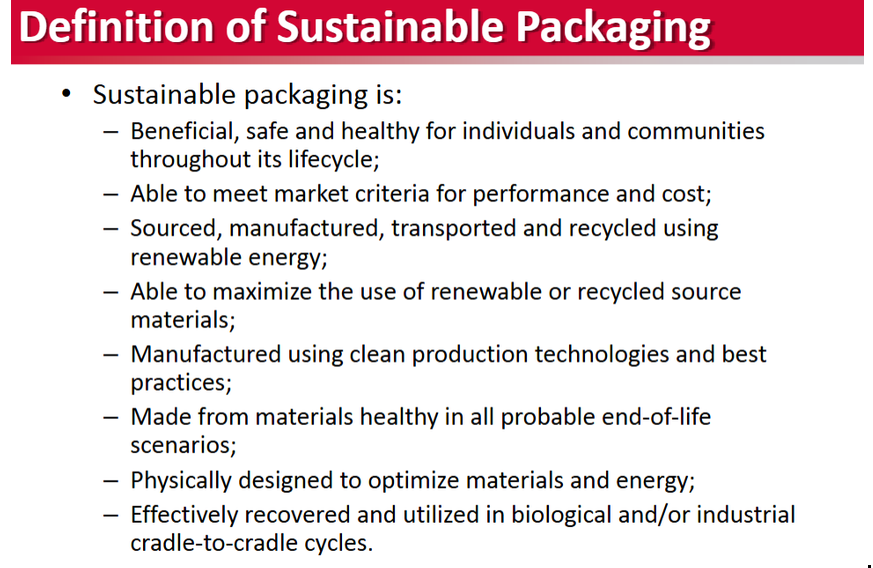
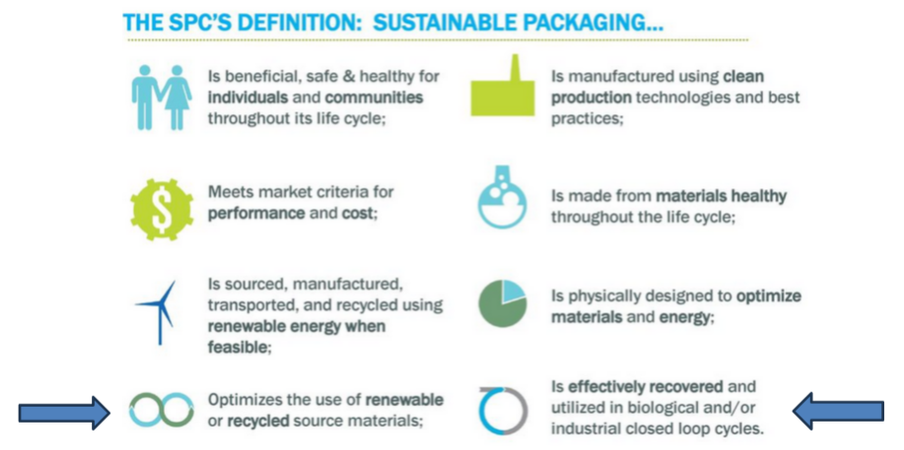
Definition of Sustainable Packaging according to the Sustainable Packaging Coalition
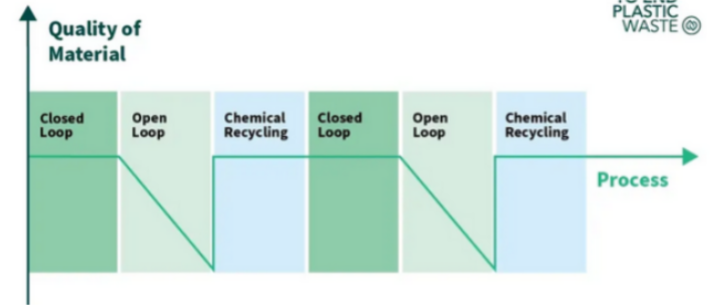
Cascade recycling, upcycling, downcycling, recycling
Cascade recycling: keeps materials in circulation at the highest level of quality, economic, and environmental value as long as possible.
Upcycling: The process of transforming waste materials or discarded products into new, higher value items, which increases the value and prolongs the life of materials
Downcycling: diminishes value recycling plastics is often downcycling because the end product is a lesser-quality plastic
Recycling: the process of collecting, sorting, and processing discarded materials (such as paper, glass, plastic, and metal) and turning them into new raw materials or products instead of throwing them away as trash
Chain of Custody
COC: defines the requirements for the operators in the supply chain that wish to make a claim about the products they are offering.
Mass Balance Approach
Evenly allocate the recycled content to output products where mass balance is used, instead of allocating it arbitrarily (unless the actual recycled content of each output can be verified)
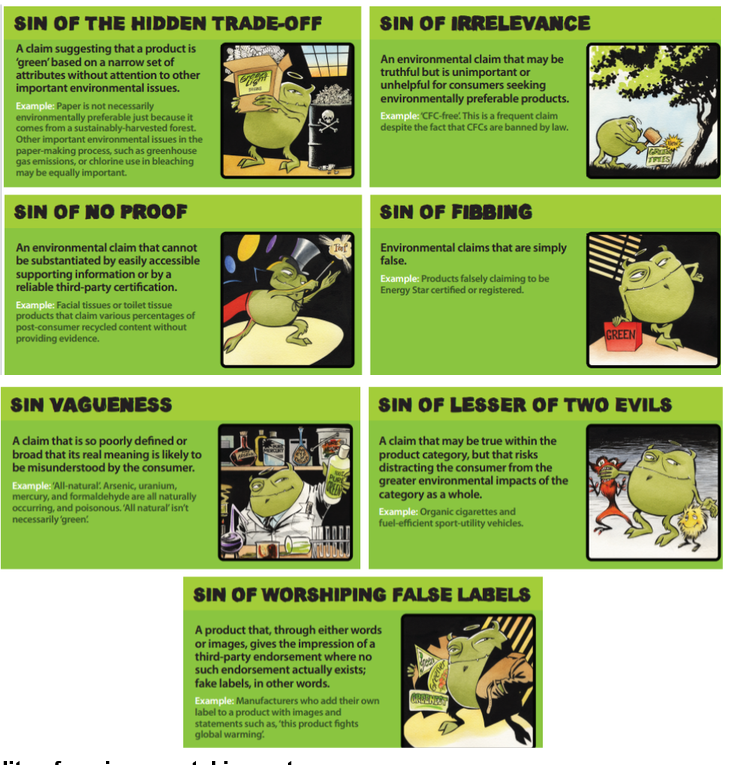
Greenwashing Sins
The Hidden Trade-off - a claim stating that a product is “green” based on a narrow set of attributes.
Irrelevance - Irrelevant or unimportant claim
No Proof- unsubstantiated claims
Fibbing - lying
Vagueness - poorly defined or broad claim
Lesser of two evils - true within a category but still not good for environment
Worshipping false labels - product that gives a false impression based off of the a third party endorsement. (eg: #1 blah blah)
Externality of environmental impacts
A cost created by a business but paid by someone else.
An uncompensated cost or benefit that results from an economic activity (like manufacturing or shipping) and affects people or ecosystems not involved in that activity
Ecological Footprint
the total amount of biologically productive land and water area required to support a specific population or activity, and absorb its waste, given prevailing technology and resource management practices
True sustainability
Ex: Circular packaging system - Reusable or refillable packaging reduces waste (environmental), lowers product cost over time (economic), and offers convenience for consumers (social).
Adheres to all three sustainability pillars. Think of thermodynamic equilibrium - must be in chemical, mechanical, and thermal equilibrium.
Extended Producer Responsibility
an environmental policy approach that shifts the financial and operational burden of managing post-consumer waste from local municipalities and taxpayers directly to the product manufacturers, brand owners, and importers.

Why are plastics used in packaging and what are the challenges with recycling them?
The average contamination rate for materials that we collect in curbside recycling programs has grown to about 25%
Plastics are highly versatile, lightweight, durable, and cost-effective, protecting goods and reducing shipping emissions, but they are difficult to recycle due to resin complexity, mechanical fouling from flexible plastics, material degradation during melting, and low market value for certain numbers; meanwhile, at Mazza Recycling's MRF, metals are separated from the container stream using a two-part mechanical system: an Overbelt Permanent Magnet that pulls ferrous steel and tin cans upward off the conveyor belt, followed by an Eddy Current Separator that creates a repelling magnetic field to launch non-ferrous aluminum cans over a splitter plate into a separate bin
PRF(Plastic Recovery Facility) – A secondary processor takes in baled materials that MRFs would otherwise landfill and separates out cartons, mixed plastics, small paper and plastics such as polystyrene and PLA as well as any other high-value recyclables that may have escaped the initial MRF sort
How are metals separated in the material recovery facility?
Sorting Center Order: 1) Unpacking and tearing bags of recyclables 2) Sifting 3) Sorting into two distinct flows 4) Sorting with optical or infrared detectors 5) Manual Checking
Before grinding, a metal detector is generally installed, which serves to identify and remove any metal residues in the flow that cause premature wear of the blades of the grinding mill.
The mixed waste passes an overhead magnet or a rotor for the removal of ferrous metals (tin plated steel cans) and an eddy current separator for the removal of non-ferrous metals , which is mostly aluminum cans
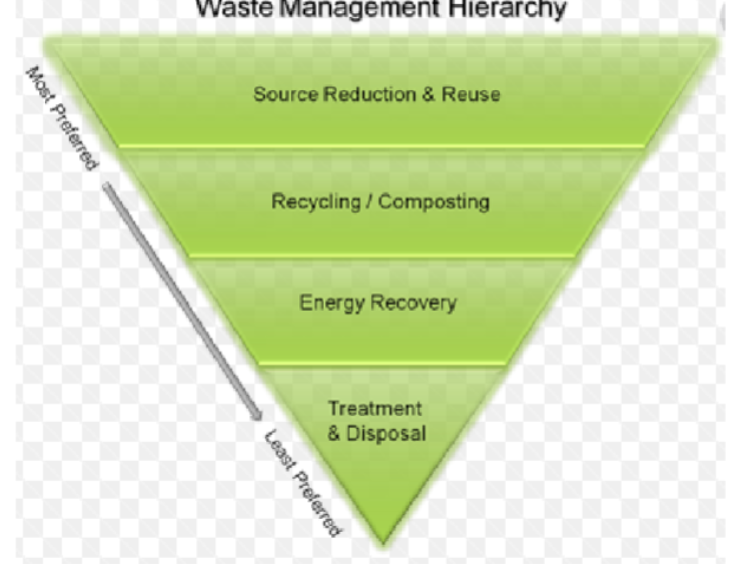
What is preferred order of the Waste Hierarchy? Why are certain waste management methods preferred over others?
Certain waste management methods are preferred over others because they maximize resource recovery and economic efficiency while minimizing environmental degradation, as structured by the global Waste Hierarchy.
Sustainable Packaging