Financial Accounting Midterm 1
 Call Kai
 Learn
Learn Practice Test
 Spaced Repetition
 Match
Match Flashcards
 Knowt Play
1/126

There's no tags or description
Looks like no tags are added yet.
Name | Mastery | Learn | Test | Matching | Spaced | Call with Kai | Chat |
|---|
No analytics yet
Send a link to your students to track their progress
127 Terms
Accounting consists of three basic activities — it ______________ the economics events of an organization to interested users.
identifies, records, and communicates
The accounting process includes the _______ function.
bookkeeping: recording, organizing, and managing a business’s daily financial transactions to maintain accurate ledgers (book or collection of accounts).
Data Analytics:
involves analyzing data, often employing both software and statistics, to draw inferences.
Data Analytics (1)
Past: Descriptive (what happened?)
Data Analytics (2)
Past: Diagnostic (why did it happen?)
Data Analytics (3)
Future: Predictive (what is likely to happen?)
Data Analytics (4)
Future: Prescriptive: (what should we do about it?)
External Users:
individuals and organizations outside a company who want financial information about the company.
External Users: investors (owners)…
use accounting information to decide whether to buy, hold, or sell ownership shares of a company.
External Users: creditors (such as suppliers and bankers)…
use accounting information to evaluate the risks of granting money or lending money.
Departments within the company that use accounting data:
finance
marketing
sales
human resources
management
External users of accounting data:
investors
creditors and banks
government and tax authorities
suppliers and vendors
customers
financial analysts
labor unions and employees
mistake vs fraud
mistake is something wrong but we didn’t mean to do it and fraud is something is wrong and we did it intentionally trying to be dishonest.
Recent financial scandals include:
Enron
WorldCom
HealthSouth
AIG
Sarbanes-Oxley Act:
there were a bunch of big financial frauds that happened so in an effort to reduce unethical corporate behavior and decrease the likelihood of future corporate scandals, congress passed the Sarbanes-Oxley Act.
GAAP - Generally accepted accounting principles:
All publicly traded companies have to follow a certain set of rules that tells them how to record everything called generally accepted accounting principles (GAAP). (required by the SEC)
*you have some pretty big companies that are not public but privately held, they may still have to follow GAAP but it may be modified.
- if you go to the bank for a loan they want to see GAAP based financials because they want to know what they’re getting so sometimes even a private company has to follow GAAP.
Who sets the standards?
Financial accounting standards board (FASB)
Securities and Exchange Commission (SEC)
International Accounting Standards Board (IASB)
*GAAP is within the US.
Financial accounting standards board (FASB):
independent organization that makes up the rules
not tied to an industry or a company, they look at new accounting issues that come up and write rules about how it should be handled.
Securities and Exchange Commission (SEC):
oversee’s all of this
end goal is to make sure standards are fair for consumers and investors; that people aren’t being taken advantage of.
International Accounting Standards Board (IASB):
standards for countries outside the US.
if you do accounting for the US you should know both as it’s a global economy and you have subsidies overseas and foreign companies doing business in the US, so you would see both.
International Financial Reporting Standards (IFRS):
Over 160 countries use international standards called IFRS.
ex: all companies in the European Union follow IFRS
the difference in standards between the US and outside the US are not significant.
Who created GAAP? FASB or SEC?
FASB creates the rules that make up GAAP, but the SEC gives them the legal authority to do so.
Measurement Principles— historical cost principle:
aka (cost principle) dictates that companies recored assets at their actual cost.
if you bought yourself a new laptop for $200, its historical cost is $200.
*assets like buildings or computers are typically recorded at cost.
Measurement Principles— fair value principle:
states that assets and liabilities should be reported at fair value, the price received to sell an asset or settle a liability. (today’s value)
if you bought a share of stock two years ago for $200, but today its market price is $400, the fair value is $400.
What principle do most companies choose to use, cost or fair value?
most companies choose to use cost over fair value.
for things like machinery, delivery trucks, inventory, and real estate companies use historical cost. estimating market value every year can be time consuming and not very practical
for things like stocks, bonds, and crypto (assets that are traded constantly on public markets) current market prices are easy to identify so fair value is used.
*for most items the number you see on a balance sheet is the historical cost.
Monetary Unit Assumption:
we can only record things that can be expressed in terms of money
✅ can record you paying rent
✅ can record you buying computer equipment
❌ cannot record employees who have a really great attitude (cant quantify in terms of money)
Economic Entity Assumption:
activities of a business or government have to be kept separately from other entities as well as the personal lives of the owners.
Forms of Business Ownership:
proprietorship
partnership
corporation
Forms of Business Ownership—Partnership:
pretty much the same thing as proprietorship but you have two or more people
often retail or service type-businesses
no separate tax return
benefit is that you can split profit amongst the owners however you’d like (60/40, 70/30)
downside is that there is generally an unlimited personal liability; if your partner takes on a debt, you are still responsible
Forms of Business Ownership—Corporation:
it’s own separate entity
owner and manager are separate
there are different people who manage target, corporation just owns stock.
if target takes on a loan it cant pay i’m not personally responsible, i just own the stock. there’s a separation.
target is a separate entity from me the owner; we are not one.
no liability there
the worst that could happen is i lose my stock investment in target
downside is there are more restrictions, more laws, and subject to higher taxes
benefits are unlimited life so if i decide next week i don’t want to own target i could just sell my stock.
Forms of Business Ownership—Proprietorship:
owned by one person
if you run your own business you could set up as a proprietorship
the benefit is the simplicity; you’re the owner, manager, operator, and you report to yourself (receive all profits)
you don’t have to file a separate tax return
whatever the business makes can flow right into your personal 1040 return
the downside is that you get all the profits but are personally liable for all debts of the business (suffer any losses)
What is the accounting equation?
Assets = Liabilities + Stockholders’ Equity
for any business this equation will always hold true^
What are assets?
the stuff you own, the stuff you have
personal life: you might own a car, you might own a laptop (both are assets)
it’s the same thing in a business:
cash
accounts receivable
supplies
equipment
we expect that it provides some sort of future service or benefit.
Accounts receivable is…
when a customer owes you money.
it is an asset because it’s money that will be coming in.
What are liabilities?
stuff that you owe, stuff that you borrow (lines of credit)
example: you might own a car but you may have taken out a loan to help finance that purchase, so you don’t completely own it outright because the bank does have to claim the car if you stop making the payment.
in a business: amounts they owe to creditors (party to whom money is owed)
line of credit
loan
take out a loan to buy the car
vehicle
ex: target took out a loan to buy some computer equipment
typical accounts:
accounts payable
notes payable
salaries and wages payable (paying employees on a later day (next friday))
interest payable
unearned service revenue
Accounts payable is…
normal day-to-day bills
electric
insurance
but you haven’t payed them yet.
What is Stockholders’ Equity?
stockholders’ equity is the owners’ claim on a company’s assets after all liabilities (creditors’ claims) have been paid
everything that’s left over (ownership claim on total assets)
ex: if you business were to go bankrupt first you would pay all creditors (liabilities) and once you’ve done that, or if you don’t have to do that (you dont have any debt) then whatever is left is the equity you had in the business (owners equity in the business).
*some assets are claimed by creditors and the rest are claimed by owners
if you’re the buyer of stock that an investment to you (asset)
if you’re company is selling the stock, they’ll have it reported as common stock.
creditors have claims through liabilities, while owners have the residual claim through equity
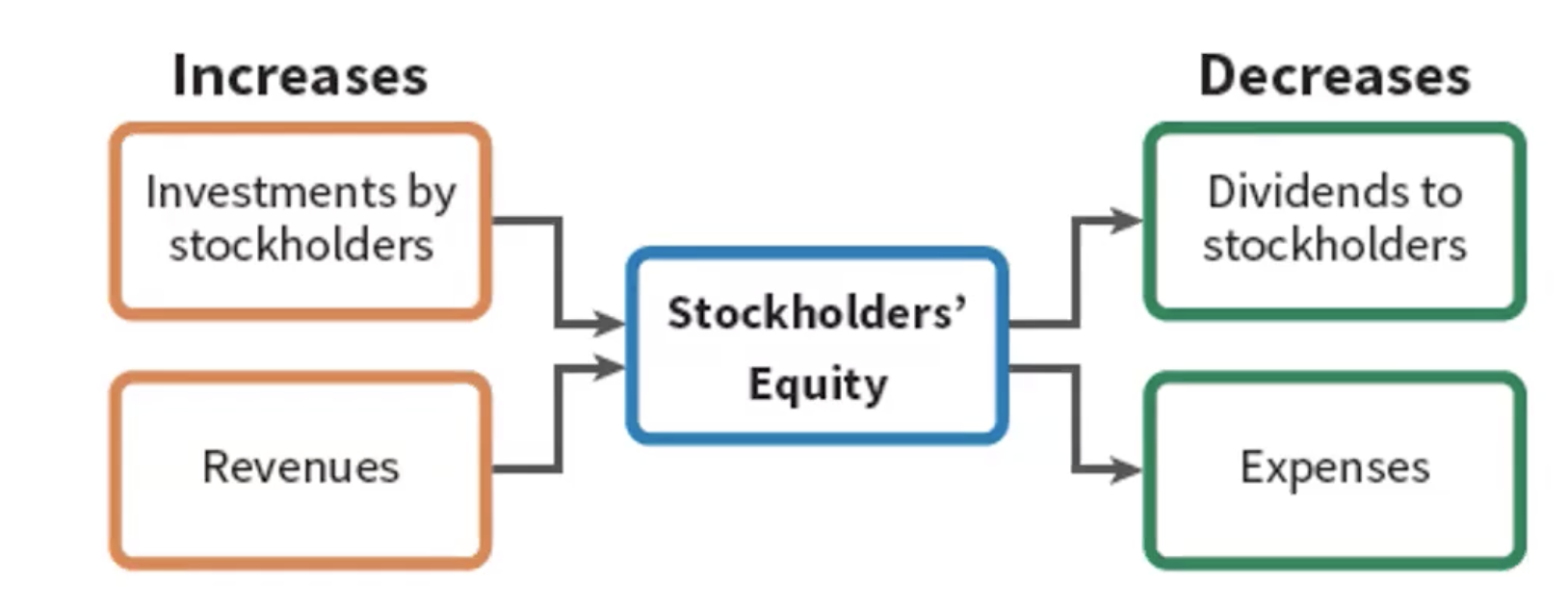
What two categories are a part of stockholders equity?
Common Stock + Retained Earnings (Revenue-Expenses-Dividends)

What is Common Stock?
aka (investments by stockholders) represents the total amount paid in by stockholders for the shares they purchase
INCREASES stockholders’ equity
What are Revenues?
whatever activity a business is doing, it is for the purpose of earning income.
Retained Earnings (Revenue-Expenses-Dividends)
* you can’t earn revenue without incurring some costs
ex: you have to have insurance, or you need people to work for you so you have to pay them
» expenses
INCREASES stockholders’ equity
What are Expenses?
costs that a company incurs either assets consumed or services used in the process of generating that revenue
Retained Earnings (Revenue-Expenses-Dividends)
DECREASES stockholders’ equity
What are Dividends?
a dividend is where a company takes some of what earned (like cash or assets) and it distributes it back to stockholders
* it is NOT an expense
Retained Earnings (Revenue-Expenses-Dividends)
DECREASES retained earnings
Common sources of revenue:
sales
fees
services
commissions
interest
dividends
royalties
rent
Common expenses are:
salaries (you have to pay people to work)
rent (you have to pay for office space)
utilities (you have to keep the lights on and the ac/heater running)
tax expense (you have to pay taxes)
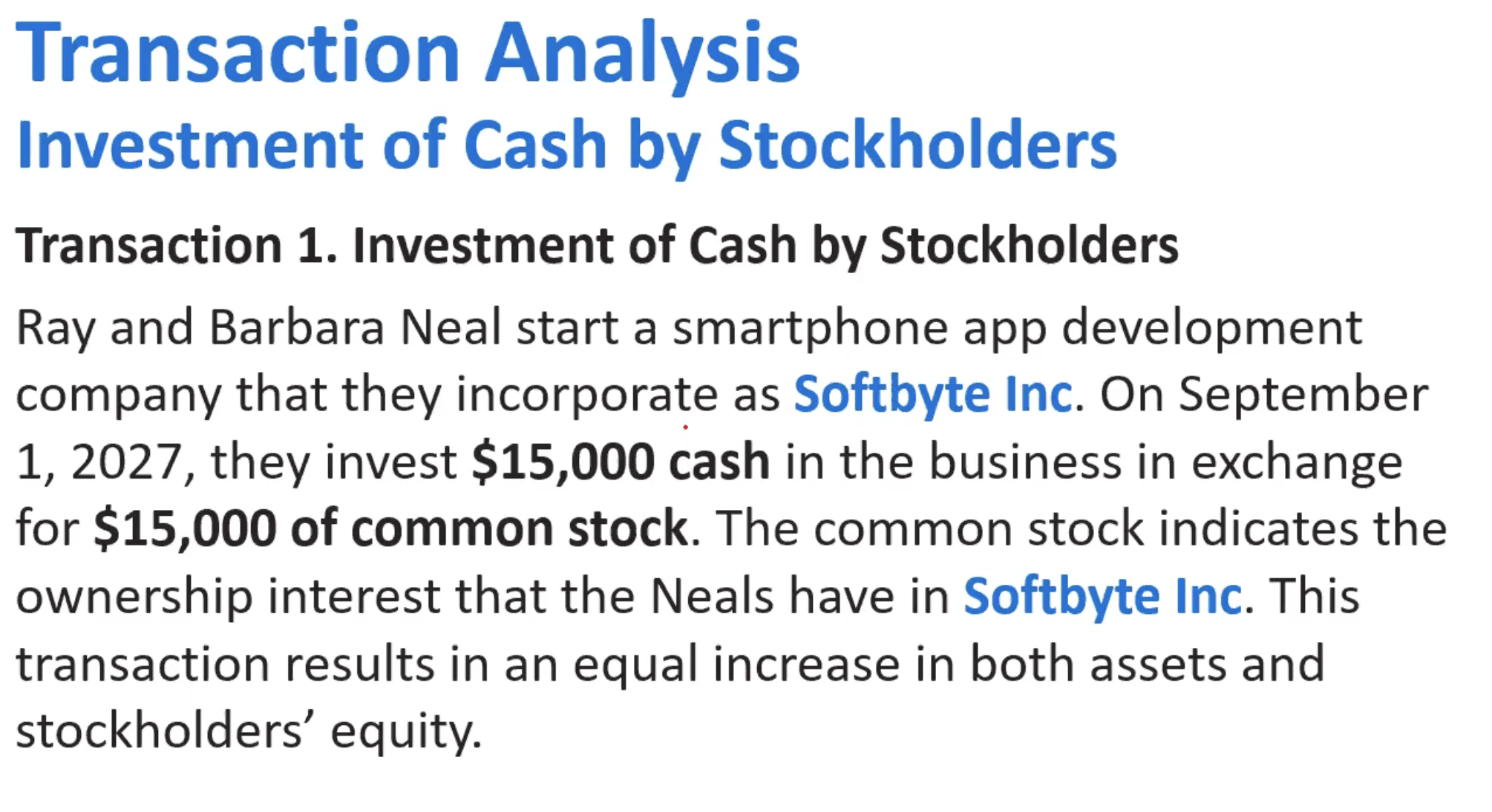
Transaction 1:


Transaction 2:


Transaction 3:
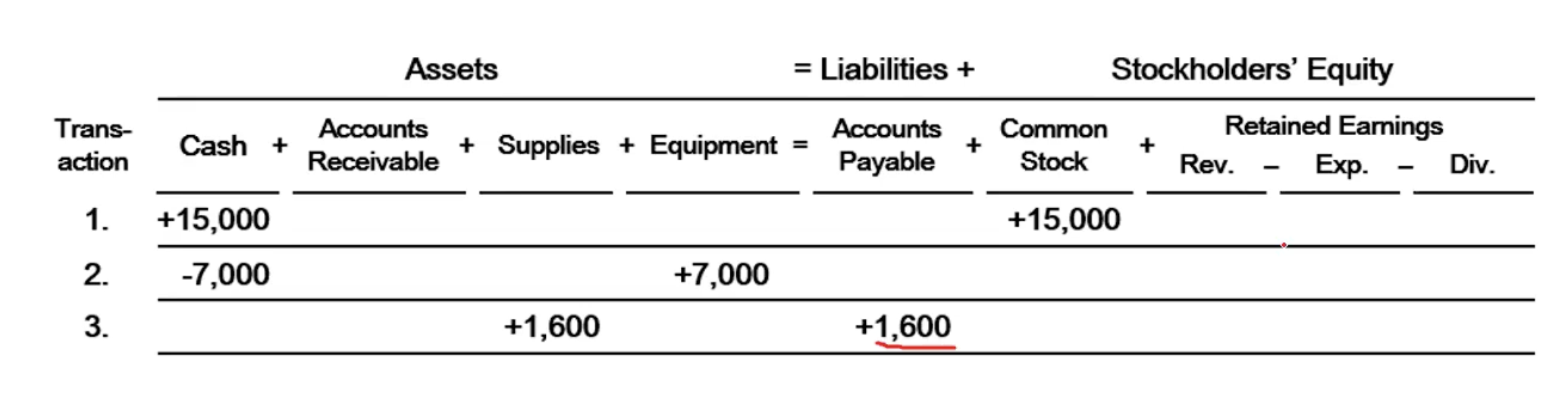
What is the difference between supplies and equipment?
supplies last several months (headphones)
equipment last several years (computers, trucks)
If stockholders’ equity increased during the period by $25,000 and liabilities decreased by $5,000 during the same period, then total assets must have:
increased by $20,000
By the Beach Surf Company provides surfing lessons in Belmar, NJ and selected account balances as of June 30 are as follows: Service Revenue $8,000, Accounts Receivable $3,000, Supplies $2,500, Retained Earnings $9,200, Accounts Payable $1,300, Common Stock $10,000, Operating Expenses $3,500, and Cash $15,000. What are total assets?
$20,500

false
false
false
true
true

assets: $337,000
liabilities: $32,500
stockholders’ equity: $ 210,000

classify each item as an asset, liability, or stockholders’ equity:
liability
asset
asset
asset
asset
liability
liability
stockholders’ equity
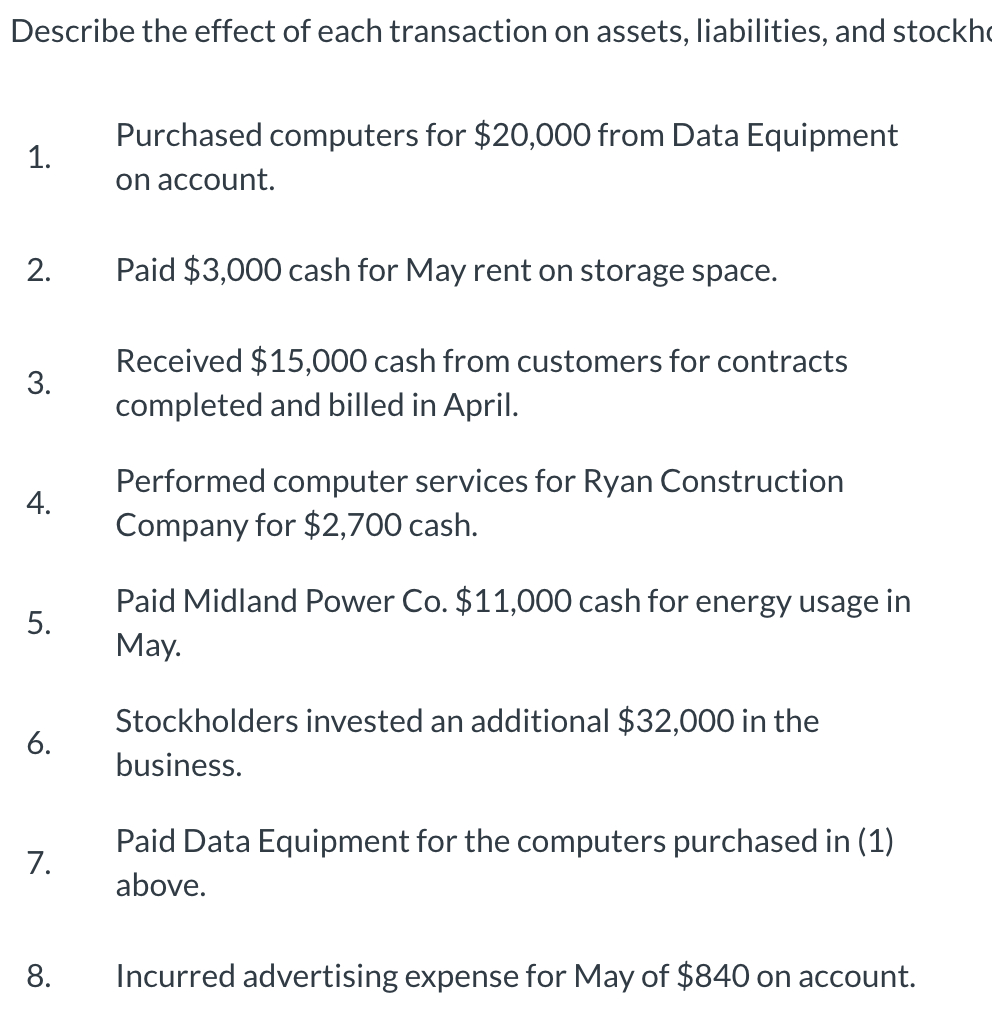
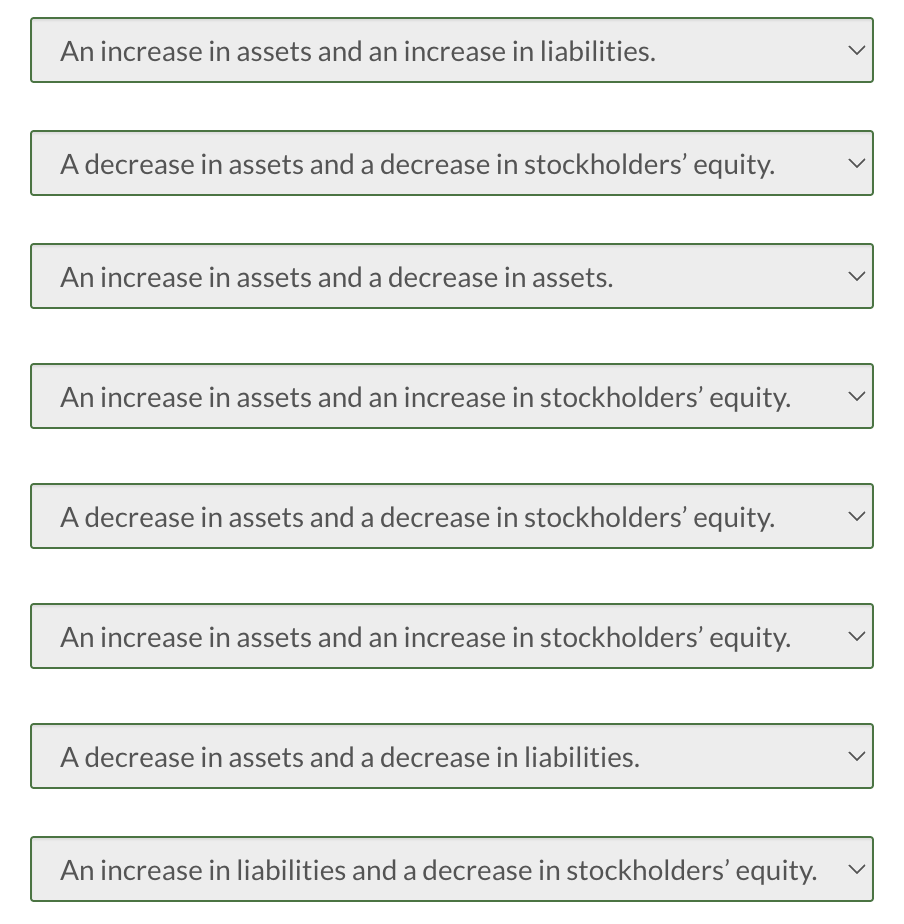

Part 1:

Part 2: Prepare an income statement and balance sheet:



Transaction 4:

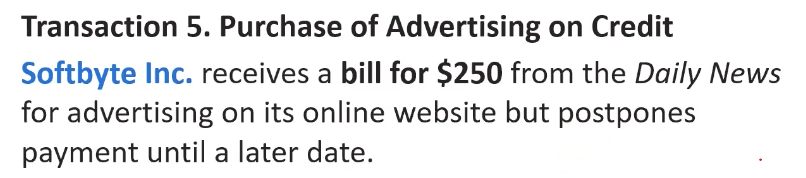
Transaction 5:

Transaction 6:

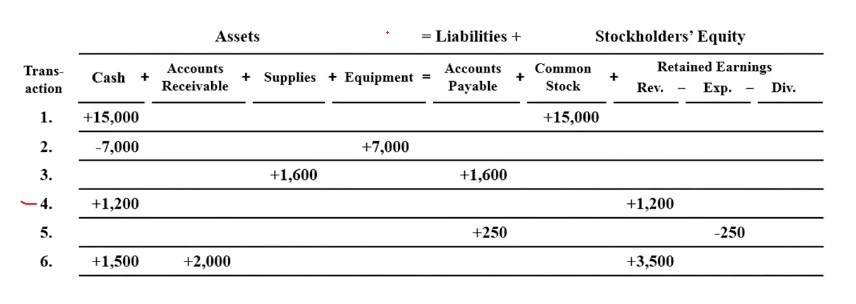
Transaction 7:

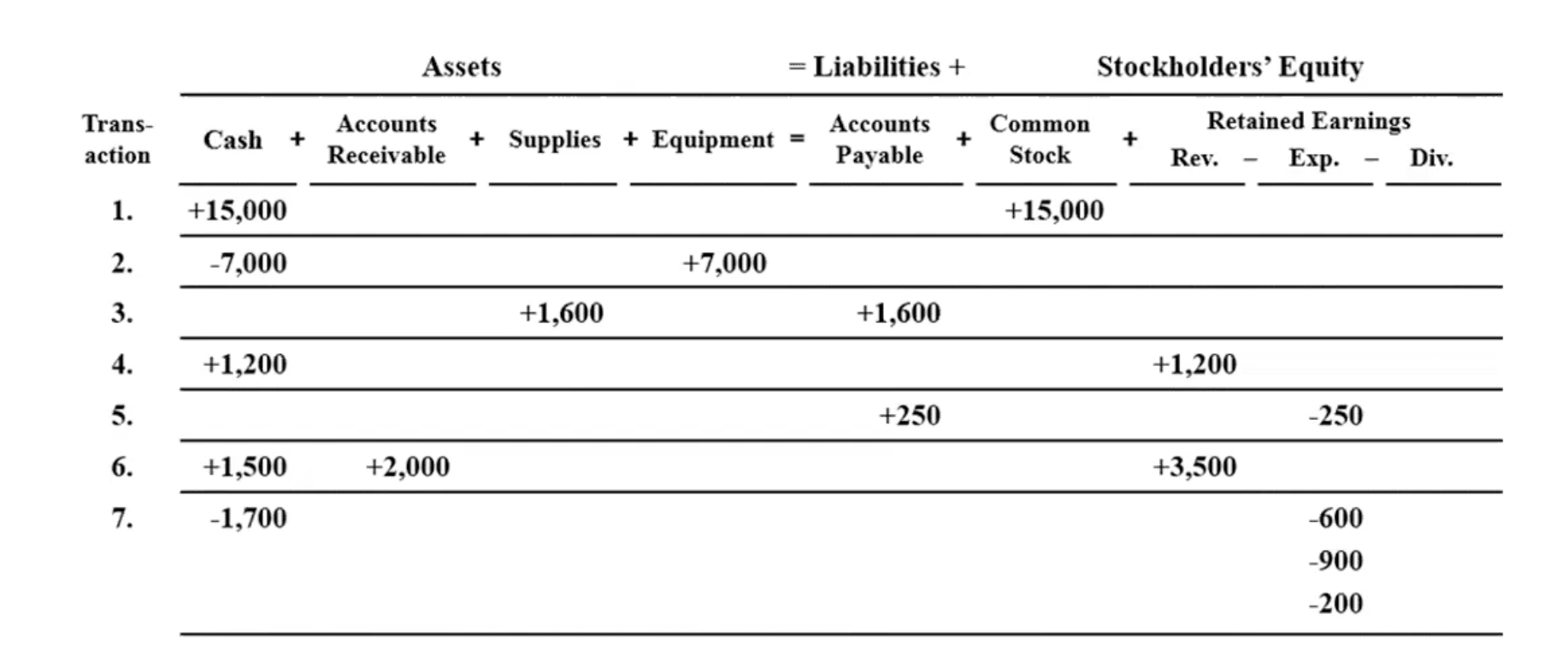
Transaction 8:


Transaction 9:


Transaction 10:

Example Income Statement:

Example Retained Earnings:

Example Balance Sheet:

Net income will result during a time period when:
revenues exceed expenses.
Which financial statement is prepared as of a specific date?
Balance sheet
What are the four financial statements?
The income statement
The retained earnings statement
The balance sheet
The statement of cash flows
Every account has a place on _____ of these statements and every statement will have a number that ________.
ONE
goes on to some other statement
What is the income statement?
presents the revenues and expenses and resulting net income or net loss for a specific period of time. (a month or year usually)
reports the activity (profitability) of the company’s operations (the generated revenue by providing products and services and incurred certain costs) so their net income (revenues - expenses) will tell us how profitable and what’s left over after they incurred certain costs.
activity for a period of time
first revenues are listed, then expenses are listed
does NOT include investment and dividend transactions between stockholders’ and the business
*net income is needed to determine the ending balance in retained earnings
*if expenses are higher than revenue, you would call it NET LOSS
The income statement is sometimes referred to as:
the statement of operations
earnings statement
profit and loss statement
What is the retained earnings statement?
summarizes the changes in retained earnings for a specific period of time (month or year usually)
earnings that have been retained in the business
retained earnings is all prior year net income collapsed into that one account
beginning balance is whatever accumulated from the past
ADD current year net income
SUBTRACT dividends
EQUALS (=) new ending balance (new retained earnings) —> which will be used in the balance sheet
whatever period of time you were talking about in the income statement is the same period of time used in the retained earnings statement.
information provided by this statement indicated reasons why retained earnings increased or decreased during the period.
*ending balance in retained earnings is needed in preparing the balance sheet
What is the balance sheet?
all the other accounts we didn’t use yet:
assets
liabilities
stockholders equity (common stock)
a point in time (snapshot), UNLIKE the other two
has to balance, must equal each other
lists:
assets at the top
followed by liabilities
finally stockholders’ equity
What does ESG stand for?
Environmental, social, and governance performance
What is ESG reporting?
reports prepared by a company to point out its performance regarding environmental, social, and governance issues (sustainability)
the idea is that a company’s responsibility lies with anyone who is influenced by it’s actions
a socially responsible business does not exploit or endanger any group of individuals
measurement of these factors is difficult, but many interesting and useful efforts are underway
Career opportunities in Accounting:
Public Accounting: audit, tax, management consulting all serving the general public.
Private Accounting: you work for a firm and provide all the services to different clients.
Forensic Accounting: if a crime occurred you’d go through financial records.
Governmental Accounting: local governments need records and books checked
Internal Audit: do the work of an auditor but you work for a company (you don’t go to clients)

Determine net income (income statement), and prepare a statement of retained earnings and balance sheet.


Who created GAAP?
FASB
Do dividends decrease stockholders equity or just retained earning or both?
Both
OFFICIALLY debit is _____ and credit is _____.
debit = LEFT
credit = RIGHT
Debit does not always _____ and credit does not always _____.
increase
decrease
An account can be illustrated in a _____ form.
T-account
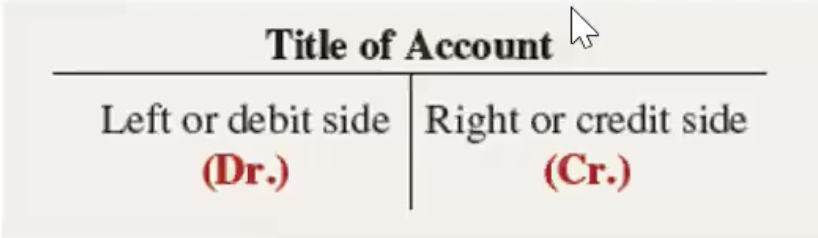
Debits MUST equal Credits.
just like the basic accounting equation, each transaction mist affect two or more accounts
you will always credit one account and debit another
What causes a debit balance?
if the sum of debit entries are greater than the sum of credit entries, the account will have a debit balance.

When cash increases we _____ it.
debit
What causes a credit balance?

if the sum of credit entries are greater than the sum of debit entries, the account will have a credit balance.
What is the basic idea?
Some accounts will always have a normal debit balance, while other accounts will always have a normal credit balance. These accounts will always behave in the same way.
Asset and Liability Balances
assets: debits should exceed credits
liabilities: credits should exceed debits
normal balance is always on the increase side

all assets work the same way (have the same type of behavior)
Debits and Credits: Common Stock

Which 2 accounts from stockholders’ equity have a normal credit, or an increase on the credit side?
Common stock
Retained earnings
Which 2 accounts from stockholders’ equity have a normal debit, or an increase on the debit side?
Expenses
Dividends
Debits and Credits: Retained Earnings

Debits and Credits: Retained Earnings (Dividends)
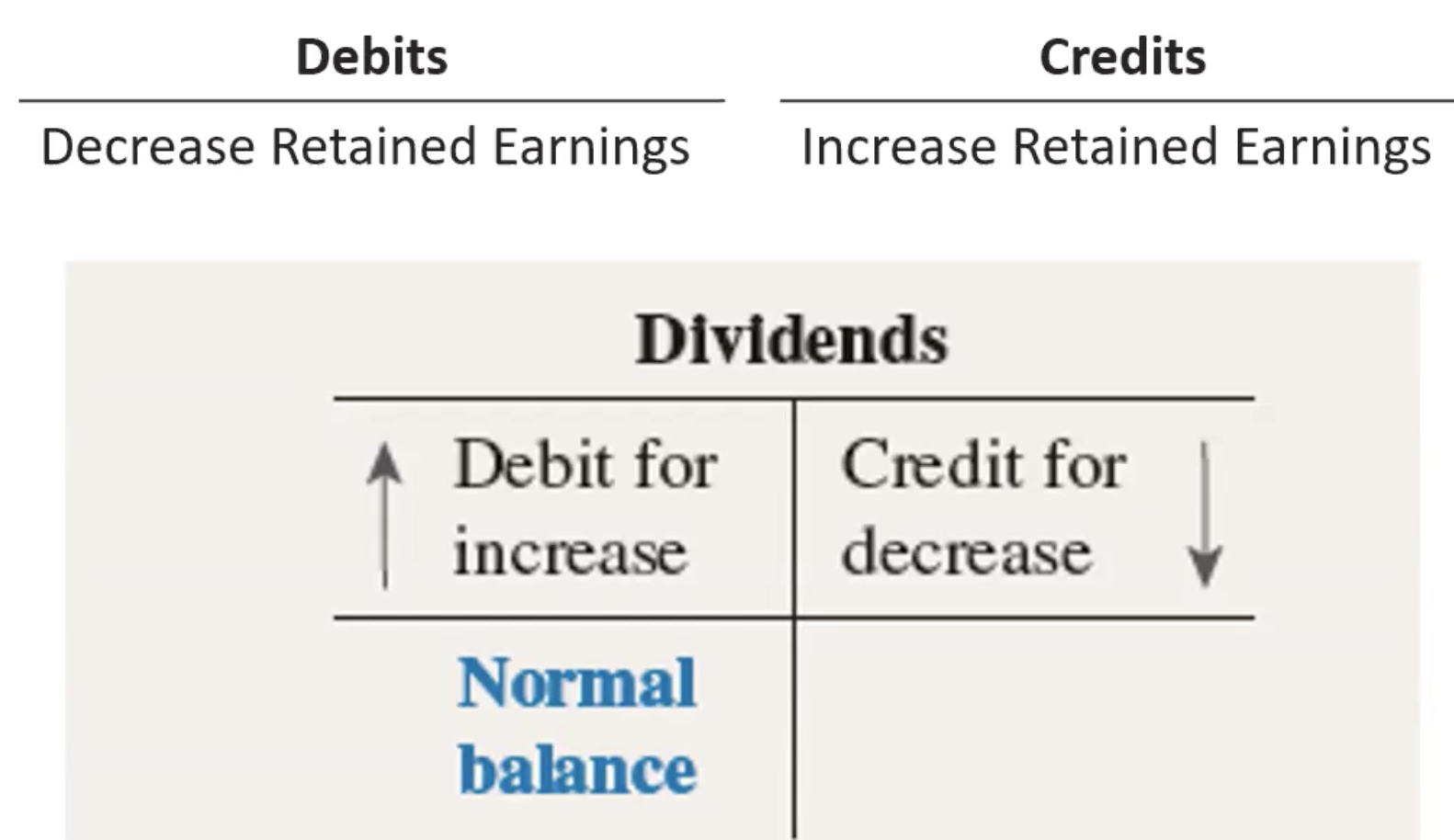
Debits and Credits: Retained Earnings (Revenue + Expenses)

Summary of Debit/Credit Rules

everything on the left side increases debits and decreases credits, and everything on the right side is the opposite EXCEPT the two exception: expenses and dividends.

Indicate if the normal balance of the account is a credit or a debit:
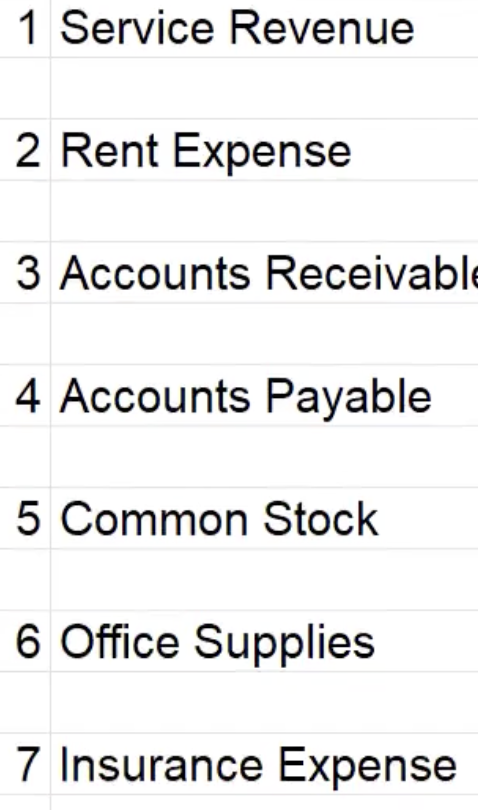
credit
debit
debit
credit
credit
debit
debit
debit
debit
credit
debit
Stockholders’ equity relationships


c

d