chem
 Call Kai
 Learn
 Practice Test
 Spaced Repetition
 Match
 Flashcards
 Knowt Play
1/25

There's no tags or description
Looks like no tags are added yet.
26 Terms
What determines average kinetic energy?
Temperature only (K).
Why can a light gas move faster than a heavy gas at the same temperature?
Both have the same average kinetic energy, but lighter particles must move faster to have that energy.
What determines RMS speed?
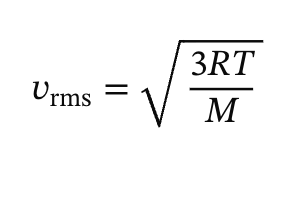
Temperature and molar mass.
How does molar mass affect RMS speed?
Lighter gas = faster; heavier gas = slower
What happens to RMS speed when Kelvin temperature doubles?
Increases by √2 or about 1.41 times.
What is the RMS speed equation?

What is effusion?
Gas escaping through a tiny hole into a vacuum.
What is diffusion?
Gas spreading throughout a space and mixing.
Which gas effuses faster: lighter or heavier?
Lighter gas because its particles move faster.
What is Graham's law for effusion rate?

What is Graham's law for effusion time?

How are effusion rate and time related?
Inverse: faster rate = shorter time.
When do gases behave most ideally?
High temperature and low pressure.
What are the two reasons real gases deviate from ideal behavior?
Intermolecular attractions and particle volume.
How do attractions affect measured gas pressure?
They can make pressure lower than ideal.

How does particle volume affect pressure?
It reduces free space and can make pressure higher than ideal.
What does van der Waals constant a represent?
Intermolecular attractions; larger a = stronger attractions.
What does van der Waals constant b represent?
Particle volume; larger b = greater excluded volume.
What does PV=nRT tell you?
=1: ideal
<1: attractions dominate
>1: particle volume dominates.
What is Dalton's law?
Total pressure = sum of all partial pressures.
How do you calculate partial pressure from mole fraction?

How do you find gas pressure when collected over water?

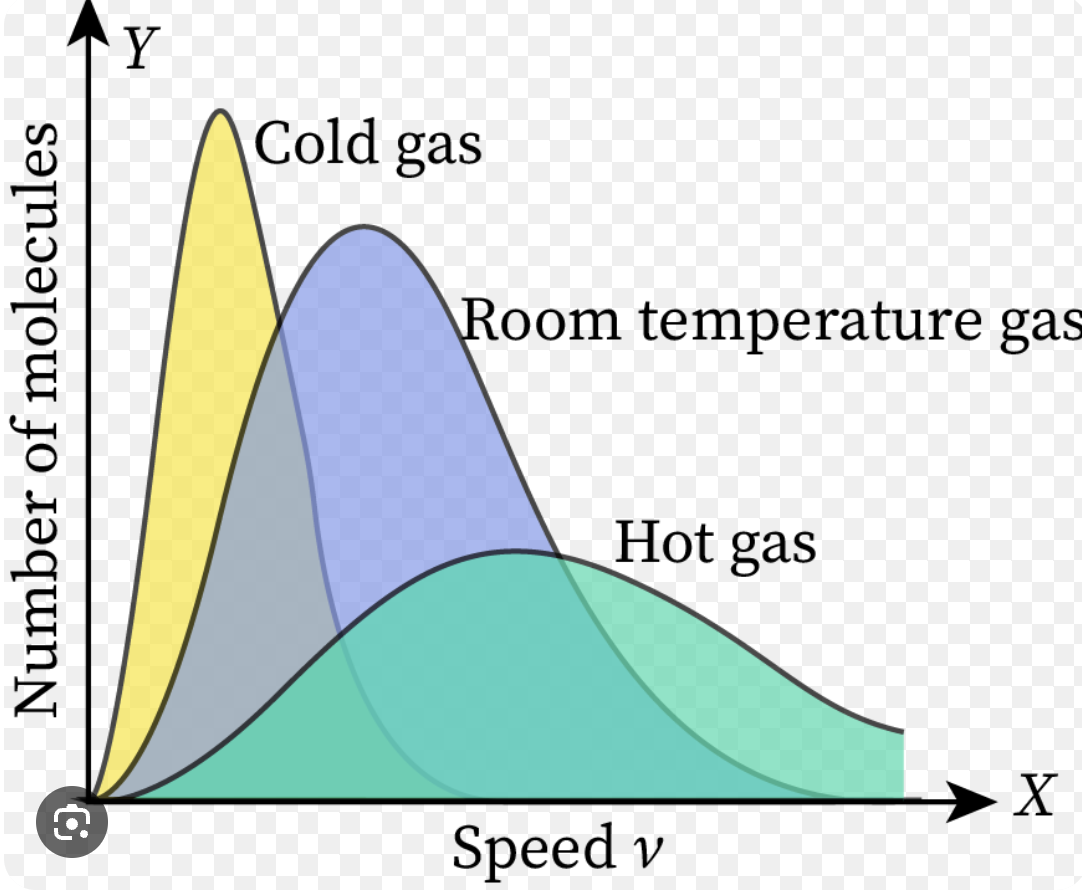
What happens to a Maxwell-Boltzmann curve when temperature increases?
Shifts right, becomes wider and flatter.

What does the area under a Maxwell-Boltzmann curve represent?
Total number (or fraction) of gas particles.
What does an elastic collision mean?
Total kinetic energy is conserved.

What are the five KMT assumptions?
Random motion, negligible volume, negligible forces, elastic collisions, average KE proportional to Kelvin temperature.