Ch 11+ 20 Endocrine Glands and Reproductive
 Call Kai
 Learn
 Practice Test
 Spaced Repetition
 Match
 Flashcards
 Knowt Play
1/118

There's no tags or description
Looks like no tags are added yet.
119 Terms
How do endocrine glands communicate with the body vs. the nervous system?
Nervous system: action potentials + neurotransmitters
Endocrine: ductless glands secrete hormones into the bloodstream
What are neurohormones? Examples?
Neurotransmitters secreted into the blood by specialized neurons
Epinephrine
Norepinephrine
In general, what do hormones affect in their targets?
Their metabolism
What are amine hormones derived from? Examples?
Tyrosine or tryptophan
Norepinephrine
Epinephrine
Thyroxine (thyroid)
Melatonin (pineal)
What are polypeptide/protein hormones? Examples?
Longer chains of amino acids
ADH
GH
Insulin
Oxytocin
Glucagon
ACTH
PTH
What are glycoproteins? Examples?
Peptide hormones with sugar attachments
LH
FSH
TSH
What are steroids derived from? Examples?
Lipids (cholesterol)
Testosterone
Estrogen
Progesterone
Aldosterone
Cortisol
Steroid vs. amino acid–based hormones: lipophilic or hydrophilic?
Steroids: lipophilic (hydrophobic)
Amino acid–based: hydrophilic (lipophobic), except thyroxine (lipophilic)
What’s the difference between NTs and hormones?
Hormones are transported in blood
Hormones have more diverse effects on targets
What must targets of both NTs and hormones have?
Specific receptor proteins for that chemical
Synergistic hormones: what are the 2 types?
Complementary: work together to produce one effect
Additive: produce a larger effect together than alone
Example of complementary synergism?
Nursing
Prolactin → milk production
Oxytocin → milk secretion
Example of additive synergism?
Epinephrine + norepinephrine → much stronger excitation together than alone
What is a permissive effect? Example?
One hormone enhances the target’s response to a 2nd hormone
Estrogen ↑ progesterone receptors in the uterus → progesterone has a stronger effect
What are antagonistic hormones?
One hormone inhibits the effect of another
What is the physiological range?
The hormone concentration range in which targets produce a normal response
What is a pharmacological dose? Risk?
An administered hormone dose. If it falls outside the physiological range (too high or too low), it causes side effects, probably by binding receptors of closely related hormones
What is the priming effect (upregulation)?
Low hormone levels → the target adds more receptors → greater response (more sensitive)
What is desensitization (downregulation)?
Too much hormone, or exposure for too long → the target removes receptors → lesser response
What is pulsatile secretion? Purpose?
Hormone is released in pulses, so blood levels go up and down. This prevents overstimulation and downregulation (seen in most peptide hormones)
What 3 properties do hormone receptors have?
Specificity: bind only their own hormone
High affinity: bind strongly
Low capacity: a low hormone concentration activates them
Lipophilic hormones: where are their receptors, and what is their action?
Receptors are in the cytoplasm/nucleus (the hormone diffuses through the membrane)
Genomic action: activates genes → protein synthesis
Slow: takes at least 30 min
Hydrophilic hormones: where are their receptors, and what is their action?
Receptors are on the cell surface (the hormone can’t cross the membrane)
Act through 2nd messengers → quick effects
Nongenomic action: no gene expression
Why do lipid (steroid) hormones need carrier proteins?
They’re hydrophobic and plasma is about 90% water, so they’re carried through the blood and released from the carrier at the target to cross the membrane
Why are they called nuclear hormone receptors?
The receptor enters the nucleus and activates genes
Lipophilic vs. hydrophilic hormones: how do they act on the cell?
Lipophilic (steroids): diffuse through the membrane → bind a receptor inside → turn on genes → new proteins (slow)
Hydrophilic: bind a receptor on the cell surface → 2nd messenger (cAMP) → activates kinases → fast response

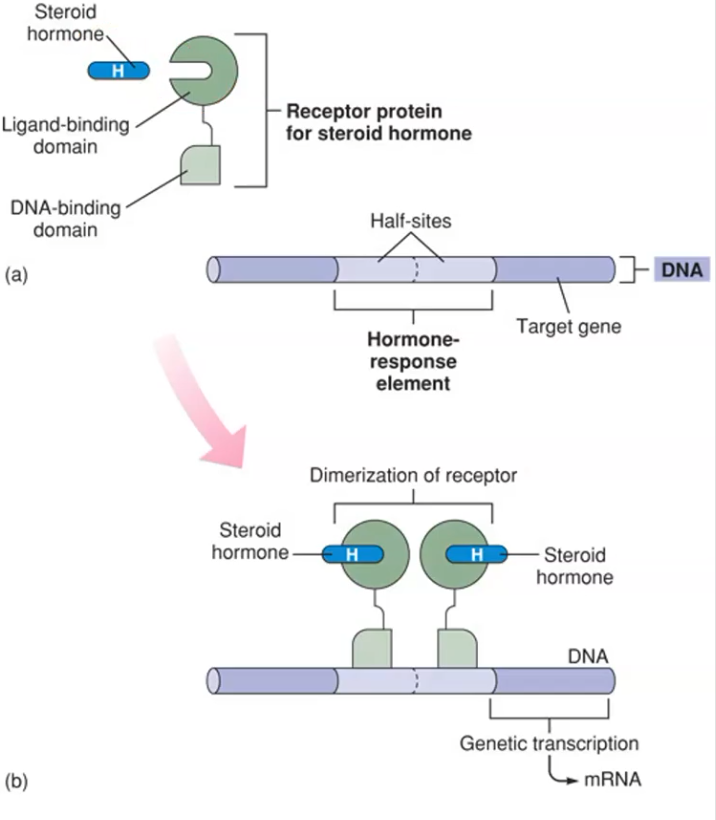
What do nuclear hormone receptors act as when bound to a hormone?
Transcription factors: they bind DNA and activate transcription
What 2 domains does a nuclear hormone receptor have?
Ligand (hormone)-binding domain: binds the hormone
DNA-binding domain: binds DNA

Where on the DNA does the receptor bind?
The hormone-response element (HRE), located next to the target gene
What is the HRE made of, and what’s needed before transcription can start?
2 half-sites
2 hormone-bound receptors must come together (dimerization) and each binds one half-site → transcription of the target gene
What does the thyroid secrete?
Mostly T4 (thyroxine)
Some T3 (triiodothyronine)
What carries T4 in the blood, and why is a carrier needed?
Thyroid-binding globulin (TBG). because T4 and T3 are lipophilic
Which thyroid hormone can enter cells?
What does protein-bound T4 do?
Only free T4/T3 can enter cells
Bound T4 serves as a reservoir
What happens to T4 inside the target cell, and where is its receptor?
T4 is converted to T3
T3 binds a receptor located in the nucleus (not the cytoplasm, unlike usual)
What does the thyroid receptor dimerize with?
One receptor binds T3 and the other binds retinoic acid. Each binds one half-site of the HRE → transcription

What is a heterodimer? Example?
2 different receptors dimerize
T3 receptor + retinoic acid receptor

What is a homodimer? Example?
2 identical receptors dimerize
Steroid hormone receptors

Steroid hormone pathway?
Steroid travels in blood attached to a carrier protein →
Steroid is released near the target cell →
Enters the cell through the membrane →
Binds to a receptor in the cytoplasm →
Hormone-receptor complex enters the nucleus →
2 complexes join together (dimerize) →
Bind to specific DNA sites (HRE) →
DNA is transcribed into mRNA →
mRNA is translated into a protein →
Protein causes the target cell response

The remaining cards are hydrophilic hormone related. (Second messenger system)
What are the 3 advantages of 2nd messenger systems?
Amplify the signal
Need little ligand to activate
Lead to complex responses in the cell
In the cAMP system, what’s the 1st vs. 2nd messenger?
1st: the hormone (extracellular signal)
2nd: cAMP (carries the signal inside the cell)
What does adenylate cyclase do to ATP?
Removes 2 phosphates → cyclic AMP (cAMP)
cAMP 2nd messenger pathway?
Hormone binds to a receptor on the cell surface →
Activates a G protein →
G protein activates adenylate cyclase →
ATP becomes cAMP (2nd messenger) →
cAMP activates protein kinase →
Protein kinase adds phosphate groups to proteins →
Proteins activate or deactivate enzymes → cell response

In the Ca²⁺ 2nd messenger system, which enzyme does the G protein activate?
Phospholipase C (instead of adenylate cyclase)
What are the 2nd messengers made by phospholipase C? What do they do?
IP3(Inositol triphosphate) and DAG (diaglycerol), which cause Ca²⁺ release from the ER
What does released Ca²⁺ bind to?
Calmodulin → calcium-calmodulin → activates a protein kinase
Phospholipase C–Ca²⁺ pathway?
Hormone binds to a receptor on the cell surface →
Activates a G protein →
Activates phospholipase C →
Splits a membrane phospholipid into IP3 + DAG (2nd messengers) →
IP3 opens Ca²⁺ channels on the ER →
Ca²⁺ enters the cytoplasm →
Ca²⁺ binds to calmodulin →
Calcium-calmodulin activates protein kinase →
Protein kinase adds phosphate groups to enzymes → cell response

Epinephrine acts through which 2 receptors, and which 2nd messenger system does each use?
Beta-adrenergic → cAMP system
Alpha-adrenergic → phospholipase C–Ca²⁺ system
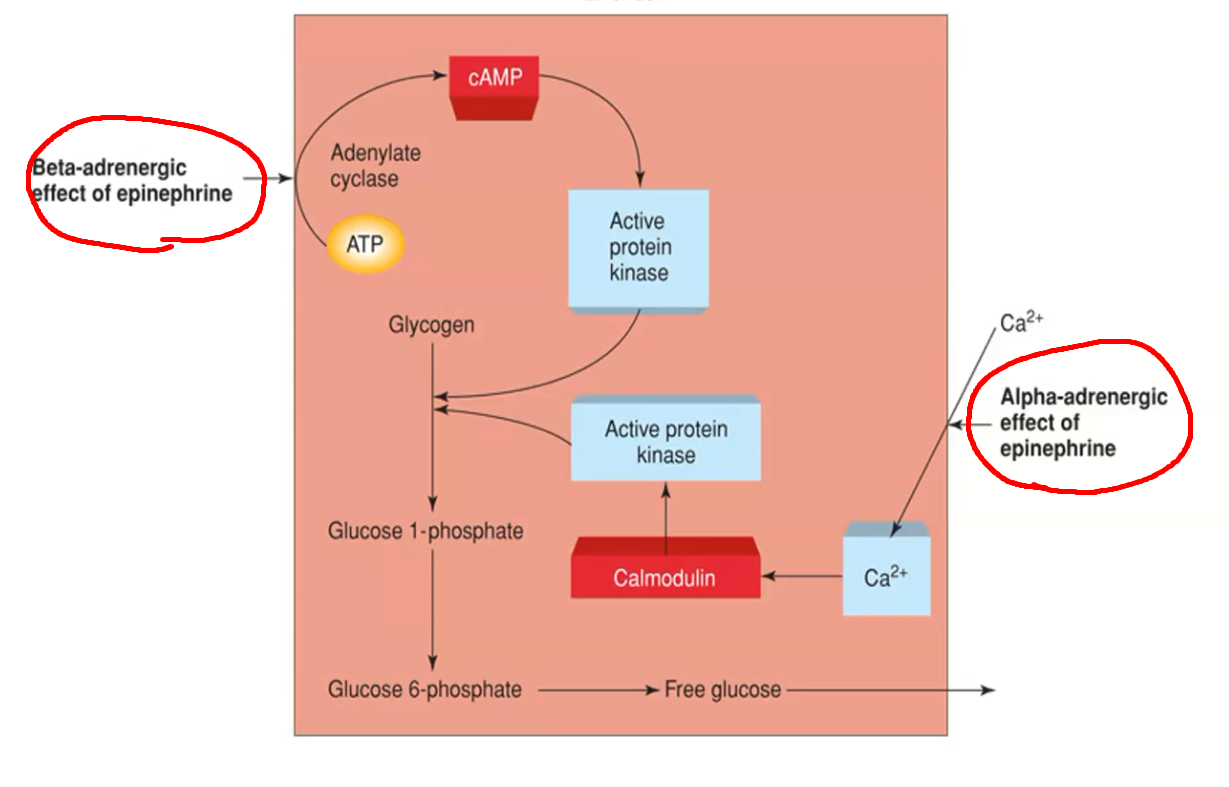
Epinephrine beta-adrenergic pathway (cAMP)?
Epinephrine binds the beta-adrenergic receptor
Activates a G protein → adenylate cyclase
ATP is converted to cAMP
cAMP activates protein kinase
Glycogenolysis: glycogen → glucose 1-phosphate → glucose 6-phosphate
Liver dephosphorylates it → free glucose → blood

Epinephrine alpha-adrenergic pathway (Ca²⁺)?
Epinephrine binds the alpha-adrenergic receptor
Activates a G protein → phospholipase C
Phospholipase C makes IP3
IP3 releases Ca²⁺ from the ER
Ca²⁺ binds calmodulin → activates protein kinase
Glycogenolysis → free glucose → blood

What’s the end result of both epinephrine pathways in the liver?
Protein kinase → glycogenolysis (glycogen breakdown) → glucose is released into the blood
What uses the tyrosine kinase 2nd messenger system?
Insulin and many growth factors
What is autophosphorylation?
After insulin binds, the 2 tyrosine kinase receptor units dimerize and each phosphorylates the other half → the receptor becomes active
Insulin (tyrosine kinase) pathway?
Insulin binds to tyrosine kinase receptors →
Receptors join together (dimerize) →
Receptors phosphorylate themselves (autophosphorylation) →
Activates a signaling cascade →
GLUT4 vesicles move to and insert into the cell membrane →
Glucose uptake increases →
Blood glucose decreases

Congrats you finished the first video’s flashcards
Main role of each endocrine organ?
Gonads:
Adrenal:
Thyroid:
Parathyroid:
Pancreas:
Gonads: produce gametes
Adrenal: stress
Thyroid: metabolism + calcium regulation
Parathyroid: calcium regulation
Pancreas: glucose regulation
Where is the pituitary, and what connects it to the hypothalamus?
It hangs below (inferior to) the hypothalamus, attached by the infundibulum (pituitary stalk)
What are the 2 lobes of the pituitary?
Anterior lobe (adenohypophysis)
Posterior lobe (neurohypophysis)
What does trophic mean for anterior pituitary hormones?
They have a nutritive effect on the target’s size
High blood levels → target hypertrophies
Low blood levels → target atrophies
What are the 6 anterior pituitary hormones and their targets?
1) Prolactin:
2) GH:
3) TSH:
4) ACTH:
5) FSH:
6) LH:
Prolactin → mammary glands (milk production)
- No prolactin in malesGH → body organs (growth)
TSH → thyroid (thyroid releases T3/T4)
ACTH → adrenal cortex (stress)
Gonadotropins:FSH → gonads
LH → gonads
Effect of prolactin in males?
Impotence
What does “thyroid hormone” refer to?
T3 and T4 (thyroxine), which regulate metabolism
What does ACTH make the adrenal cortex secrete?
Cortisol and aldosterone (for stress)
FSH vs. LH function?
FSH: gamete production (ovarian follicle growth, sperm production)
LH: se* hormone production (estrogen in females, testosterone in males) + ovulation in females
How are ACTH and TSH regulated?
ACTH: stimulated by CRH(Corticotropin-releasing hormone), inhibited by glucocorticoids
TSH: stimulated by TRH(Thyrotropin-releasing hormone), inhibited by thyroid hormones
How is GH regulated?
Stimulated by GHRH (growth hormone–releasing hormone)
Inhibited by somatostatin
How are FSH and LH regulated?
Both stimulated by GnRH (Gonadotropin-releasing hormone)
Both inhibited by sex steroids
FSH is also inhibited by inhibin
How is prolactin regulated?
Inhibited by PIH (prolactin-inhibiting hormone)
What controls the release of anterior pituitary hormones?
Hypothalamic releasing factors (releasing hormones), which trigger release
Hypothalamic inhibiting factors (inhibiting hormones), which prevent release
Feedback from target gland hormone levels
Which 3 hypothalamus → anterior pituitary pathways must you know entirely?
TSH (thyroid)
ACTH (adrenal cortex)
Gonadotropins: FSH + LH (gonads)

General hypothalamic control pathway?
Hypothalamus releases a releasing hormone (RH) → anterior pituitary releases its hormone → targets its organ → target releases its hormones → effect on the body

3 types of feedback in the hypothalamic-pituitary-gonad axis?
Short feedback loop: the anterior pituitary inhibits the hypothalamus’s releasing hormone
Negative feedback: target gland hormones inhibit the hypothalamus and the anterior pituitary
Positive feedback: estrogen triggers the “LH surge” during the menstrual cycle

Gonadotropin pathway?
Hypothalamus releases GnRH →
Anterior pituitary releases FSH + LH →
FSH stimulates egg/sperm production →
LH stimulates estrogen/testosterone production →
Excess sex hormones cause negative feedback →
Hypothalamus decreases GnRH; anterior pituitary decreases responsiveness to GnRH →
FSH + LH decrease →
Summary:
Hypothalamus → GnRH → Anterior pituitary → FSH + LH → Gonads

Why does inhibiting the anterior pituitary stop FSH/LH even if GnRH is still released?
The anterior pituitary no longer responds to GnRH, so no FSH or LH is made or released

delete
Follicular phase (days 1–14): one follicle develops
Ovulation (day 14): the oocyte (egg) exits the ovary
Luteal phase (days 14–28): the remaining follicle cells become the corpus luteum

What does the corpus luteum secrete, and why?
Progesterone, to prepare for embryo implantation

What happens to the corpus luteum if the egg isn’t fertilized?
It degenerates into the corpus albicans → the cycle restarts

3 phases of the uterine cycle?
Menstrual (days 1–5): Uterine lining sheds →
Proliferative (days 6–14): Uterine lining rebuilds →
Secretory (days 15–28): Uterine lining releases nutrients to support a potential embryo
FSH: Stimulates ovarian follicles to grow (blue arrow – days 1–14).
Estrogen: Growing follicles release estrogen, which rebuilds the uterine lining and lowers FSH (yellow arrow – days 6–14).
LH: A sudden LH surge triggers ovulation and formation of the corpus luteum (purple arrow – around day 14).
Progesterone: The corpus luteum releases progesterone, which maintains the uterine lining and prepares it for implantation (green arrow – days 15–28).
FELP mnemonic
F = FSH → Follicle growth (releasing E)
E = Estrogen → Endometrium rebuilds
L = LH → Ovulation
P = Progesterone → Prepares lining for implantation

What’s the purpose of the hormones in the ovarian/uterine cycles?
To synchronize events in the ovary with events in the uterus
What hormone switches the uterus from
menstrual → proliferative?
From proliferative → secretory?
From secretory → menstrual?
Menstrual → proliferative: ↑ estrogen
Proliferative → secretory: ↑ progesterone
Secretory → menstrual: ↓ progesterone
What triggers ovulation?
The LH surge at day 14

Ovarian and uterine cycle hormone pathway?
Days 1–14: FSH increases → follicle grows → estrogen increases → menstrual phase → proliferative phase
Around Day 14: LH surges → ovulation → remaining follicle becomes the corpus luteum
Days 14–28: Corpus luteum → progesterone increases → secretory phase (uterus prepares for implantation)
No fertilization: Corpus luteum becomes corpus albicans → estrogen and progesterone decrease → menstruation begins → cycle restarts
What does ADH (vasopressin) do?
Targets the kidneys → water conservation (we pee less), released when dehydrated
What does oxytocin do?
Uterine contractions during birth (parturition)
Mammary alveoli contraction → milk ejection
Where are ADH and oxytocin made?
ADH: supraoptic nuclei of the hypothalamus
Oxytocin: paraventricular nuclei of the hypothalamus
How do posterior pituitary hormones get there?
Made by hypothalamic neurons → travel down the axons (hypothalamo-hypophyseal tract) → stored in axon terminals in the posterior pituitary → released
Anterior vs. posterior pituitary: which makes its own hormones?
Anterior: makes and releases its own hormones (when triggered by hypothalamic RH)
Posterior: only stores and releases hormones made by the hypothalamus
Where are the adrenal glands, and what are their 2 parts?
On top of the kidneys
Outer: adrenal cortex
Inner: adrenal medulla

What does the adrenal medulla secrete, and what controls it?
Mostly epinephrine, controlled by the sympathetic NS.
Adrenal medulla vs. cortex: which type of stress?
Medulla: short-term/immediate stress (fight or flight)
Cortex: longer-term stress
What does the adrenal cortex secrete, and what controls it?
Controlled by ACTH
Cortisol
Aldosterone
Some sex steroids
How does cortisol help with stress?
Switches the body from glucose to lipid use (except the nervous system, which keeps using glucose)
Stimulates gluconeogenesis
What does aldosterone do?
Kidneys reabsorb Na⁺ (and water) and secrete K⁺ → water conservation
What is general adaptation syndrome (GAS)?
The nonspecific response to long-term stress, which causes ACTH and cortisol release
ACTH (stress) pathway?
Long-term stress → hypothalamus releases CRH →
CRH stimulates anterior pituitary to release ACTH →
ACTH stimulates adrenal cortex to release cortisol →
Increased cortisol causes negative feedback → hypothalamus decreases CRH and anterior pituitary decreases ACTH

4 negative effects of chronic stress (high cortisol)?
Atrophy of the hippocampus → memory loss
Reduced sensitivity to insulin (insulin resistance)
Inhibition of vagus nerve activity
Suppression of GH, thyroid hormone and gonadotropins
How does chronic stress lead to insulin resistance?
Cortisol switches the body to lipid use → ↑ blood glucose → ↑ insulin → insulin receptors (tyrosine kinase) downregulate → ↓ insulin sensitivity → can lead to diabetes
Effects of epinephrine/norepinephrine during “fight or flight”?
↑ Respiratory rate
↑ HR and cardiac output
General vasoconstriction → ↑ venous return and BP
Glycogenolysis + lipolysis → more fuel for ATP
What 2 hormones does the thyroid release, and what does each regulate?
Thyroxine (T3 + T4) → metabolism
Calcitonin → Ca²⁺
What is basal metabolic rate (BMR)?
How fast the body metabolizes (the sum of all anabolic + catabolic reactions), set by T3/T4