L6 Threats and solutions
 Call Kai
 Learn
 Practice Test
 Spaced Repetition
 Match
 Flashcards
 Knowt Play
1/25

There's no tags or description
Looks like no tags are added yet.
26 Terms
What are farm wastes (e.g. slurry)
effects on freshwater
reuction in oxygen → aquatic life
trout and salmon die when oxygen conc. >3mgl-1
anarobic bacteria decomposes the polluting organic material
reduces organc material
reduces organi material to H2S, NH3, CH4 → foul smell and severe pollution
biochemical oxygen demand (BOD) = high
What are the effects of organic pollution on rivers and the solution
A → immediate impact at discharge point (physical changes)
B → downsteam recovery (chemical changes)
C → bacterial and fungal growth (changes in micro-organism populations)
D → impacts on macroinvertebrates and animal communities (changes in invertebrate populations)
Solutions:
monitoring
stricter regulation and standards enforcement

What is the result of impervious (not pernetrable) surface cover
changes in hydrological flow with increasing impervious surface cover in uran catchment compared to forested catchments
water quality and biodiversity affects:
increased surface run off
run off water collected in storms drains→ released into watercourses
increased water quantity into stream and transports debris, pollutants, etc.
stream organisms are stressed or killed as a result of increased water and water pollution

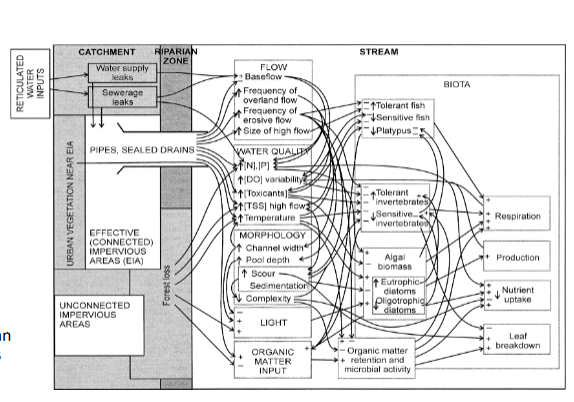
What is Urban Stream Syndrome
a conceptual model of the mechanism of the major urban impacts on stream ecosystems
Why is there improper wastewater management in informal urban settlements (slums)
infrastructure and governance
water quality and public health
inequality and social exclusion
How to address improper wastewater management in slums
promote better infrastructure → affordable technology
upgrade salination → protect shallow well and install hand/mechanical pumps
conduct regular water sampling to ensure tap water is safe
promote interdisciplinary collaboration
engineers, ecologists, scientists, social scientists → develop practical solutions
encourage community participation
involving resident in planning and decision making
e.g. local leaders, women, youth, landlords and caretakes
What can we learn from FFGs of macroinvertebrates in river ecosystems
every organism has a unique role to maintain healthy balance in nature
like organisms in nature → each of us has a unique responsibility to protect natural ecosystems in colllaboration with others
How to ensure colloborative solutions to protects natural ecosystems
Stewardship → person who has responsibility to take care of something (environment)
Who has responsibilities for processes and management
institutions
academic/ research facilities
operators → e.g. wastewater treaments orgs.
environmental policy organisation/ environmental regulators
Integrated (collaborative) management
catchment-based approach
partnrship goals

What are solutions of environmental regulators and policy organisations
Global stewardship
compliance with internaton standards
ensure availability and sustainable management of water and sanitation for all → Goal 6 and Goal 14 (protect life below water) of SDGs
global → all nations adopt management of water stategies
What does the UK’s Environmental Agency do
non-department public body which implements environmental policies and quality standards
think global, act local
central government regulation through Department of Environment, Food and Rural Affairs (DEFRA)
4 major frameworks
asses environmental state
identify pressures affecting environment
examine optional actions
manage environment to deliver correct response

why is monitoring freshwater necessary and what are the outcomes
requirement → good ecological status for chemical, physical and biological variable
result → comply with standards and protects freshwaters and its biodiversity
What is the Biological Monitoring Working Party (BMWP); Average Score Per Taxon (ASPT) = BMWP/no. taxa index → + / -
indicator:
organic pollution/ used for river → applied to all waters
pros:
broad indication of water quality
can respond to inorganic pollutants
cons:
doesnt include abundance-element for individual taxa
operates at familt level only
BWMP influence by habitat, season, sampling efforts
some families are misclassified
What is the Whally, Hawkes, Paisley, and Trigg (WHPT) index → + / -
indicator:
organic pollution → revision of WHPT
for rivers → applied to all water
pros:
includes abundance
based on actual data → more objective
cons:
operates at family level
could incluse species-level data
What is the Shannon-Weaver Diversity Index → + / -
indicator:
evaluation of diversity
universally applicable
pros:
operates across broad range of taxa
describe community diversity
cons:
describes numberical balance between taxa
doesn’t allow for ecological needs of community to be considered
What are academic institutions apprach for protections of frreshwaters
diagnosis
treatment (suggest solutions)
prevent future reoccurence
integrated approach
continued monitoring
What are operators approach to proection of freshwaters
Wastewater Treatment work
e.g United Utilities (NW), Severn Trent, Welsh Waters, Thames Water
Purpose
treat water to minimal harm to natural resource
reduce flood risk → damage to lives, industry and agriculture
Regulation
OFWAT (Office of Water) → water industry in England and Wales
Environmental Agency → oversees effluent discharge and abstraction of wate
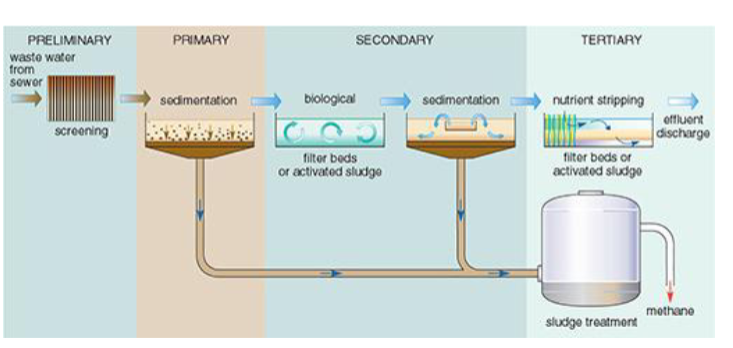
How do water treatmeants work
4 stages:
screening
sedementation
biological
sedimentation
nutrient stripping
effluent discharge
Describe the purpose, mechanism, removal rates and output of the preliminary stage
purpose → protect equipment and remove coarse solids
mechanism → screening and grit removal
removal rates → neglible BOD reduction
output → coarse water
Describe the purpose, mechanism, removal rates and output of the primary stage
purpose → remove settleable suspended solids
mechanism → sedimentation
removal rates
~ 70% SS
~40% BOD
~30% P
~20% N
output → primary sludge + liquid effluent
Describe the purpose, mechanism, removal rates and output of the secondary stage
purpose → biodegrade dissolved and colloidal (mixture of one particle suspended in another) oganics
removal rates:
~95% SS
~90& BOD
~40% P
~40% N
~ 99% E.coli
output → secondary sludge + treated effluent
Describe the purpose, mechanism, removal rates and output of the tertary stage
purpose → remove nutrient and pathogens (polshing)
mechanism → filtration, chemical, disinfection
removal rates:
>95% BOD
~97% P
~40% N
~99% bacteria
output → final effluent
Describe the purpose, mechanism, removal rates and output of the sludge stage
purpose → stabilise and reduce volume of solids
mechanism → anaerobic digestion, drying, incineration
removal rates:
organics → CH4 and CO2
volume reduced
output → biosolids for disposal/ resuse

What is the future for our freshwater ecosystems
effective policies → environmental and water company regulation
continued monitoring
research collaboration
engagement with local communities
develop human and instutional capacity → i.e more people learning and skill developing
How to apply solution for freshwater ecosystems
Water Resource Management
RCC guides river basin management to maintain ecological integrity from headwater to mouth
Polltuion Control
indentify sensitive biological marks (FFGs, benthic macro.inv) for aly detetion
Conservation Planning-Management zones
littoral, pelagic, benthic
sets priorities for habitat restoration and species protection
Tourism & Cultural Service
understanding ecology can inform recreation while safegaurdig ecology
e.g. boating, fishing, swimming
UN SDGs → 6,12 and 2