BK3B 4 Nature of Waves
 Call Kai
 Learn
 Practice Test
 Spaced Repetition
 Match
 Flashcards
 Knowt Play
1/10

There's no tags or description
Looks like no tags are added yet.
11 Terms
Primary function of a travelling wave
A wave transmits energy from one place to another without transferring matter.
Trap: Candidates often forget to explicitly write "without transferring matter" in long questions.
Transverse vs Longitudinal Waves
Transverse wave: Particle vibrations are perpendicular to the direction of wave travel.
Longitudinal wave: Particle vibrations are parallel to the direction of wave travel.

Relationship between frequency (f) and period (T)
f = 1/T.
Trap: Frequency is determined solely by the vibrating source, not the medium!
[IN DSE FORMULA SHEET]
Wave Equation v = f * λ (full thing)
v = f * λ.
Trap: Wave speed (v) is determined strictly by the medium. Changing frequency (f) only changes wavelength (λ) inversely, assuming a uniform medium.
[IN DSE FORMULA SHEET]

Wave Speed on a Stretched String/Spring
v = sqrt(T/μ), where T is tension and μ is mass per unit length. Trap: Increasing the flicking frequency does NOT increase the wave speed; it only decreases the wavelength.
[NOT IN DSE FORMULA SHEET - MUST MEMORIZE/DERIVE]

Conditions for particles to be "in phase" and "in antiphase"
In phase: Particles are separated by exactly n * λ (where n = 1, 2, 3…) and move in the same direction at all times.
In antiphase: Particles are separated by exactly (n - 0.5) * λ and always move in completely opposite directions.
Trap: Particles moving in the same direction are not necessarily in phase unless their separation is exactly a whole wavelength!

Determining the direction of motion of a particle on a travelling wave
Sketch the waveform a very short time later, shifted in the direction of wave travel.
The vertical arrow from the original particle position to the new waveform indicates its direction of motion.
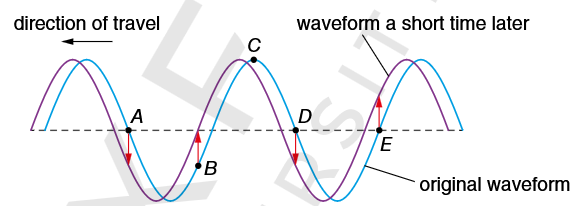
Particle Velocity & Energy Traps
Maximum speed (and max Kinetic Energy): At the equilibrium position (s = 0).
Zero speed (momentarily at rest): At the crests and troughs (s = maximum amplitude).
Trap: Many candidates falsely assume particles move fastest at the crest.
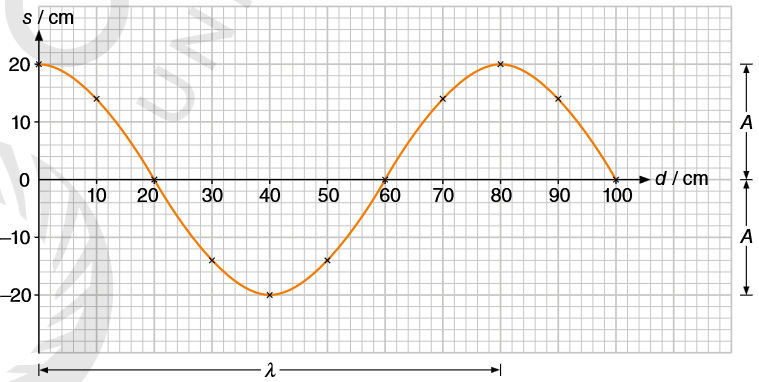
Displacement-distance (s-d) graph properties
Parameters obtained directly: Amplitude (A) and Wavelength (λ).
Trap: You CANNOT determine period, frequency, or wave speed from an s-d graph alone.
Displacement-time (s-t) graph properties
Parameters obtained directly: Amplitude (A) and Period (T).
Trap: Do NOT attempt to read wavelength from the horizontal axis of an s-t graph! This is a highly tested HKEAA distractor.

Particle kinematics vs Wave kinematics
All particles on a transverse travelling wave vibrate with the exact same amplitude (A), period (T), and frequency (f) as the wave itself. They only differ in their phase.