mushroom dissection lab
 Call Kai
 Learn
Learn Practice Test
 Spaced Repetition
 Match
Match Flashcards
 Knowt Play
1/12

There's no tags or description
Looks like no tags are added yet.
Name | Mastery | Learn | Test | Matching | Spaced | Call with Kai | Chat |
|---|
No analytics yet
Send a link to your students to track their progress
13 Terms

Name this slide, then label the gill and basidia.
Corprinus at 40x
Light blue = basidia
Dark blue = gill (dark edges)
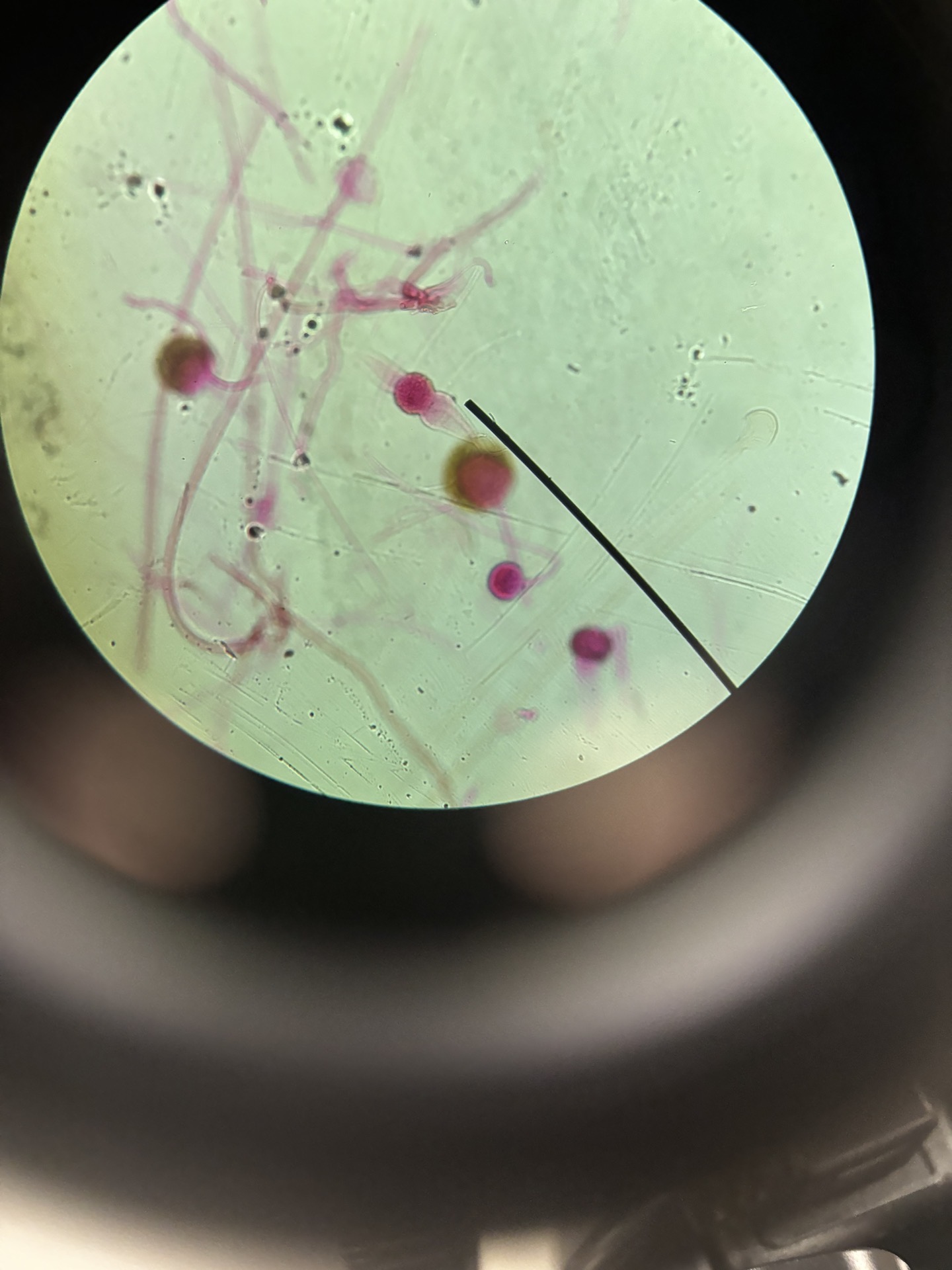
Name this slide, then label mycelium and zygospore.
Rhizopus conjugation at 10x
Mycelium is what’s sticking out from both sides of the circle; pointer is pointing at the said circle which is the zygospore.

The mushroom examined contained basidia. To what major phyla does it belong?
Basidiomycota
Fungi reproduce by spores. Are spores used for asexual, sexual reproduction or both?
The spores can be both asexual and sexual.
Asexual reproduction produces spores by mitosis. In sexual reproduction, spores (haploid, n) from 2 mating strains will fuse their cytoplasms and have 2 nuclei per cell. Nuclei will later fuse to become zygotes (diploid, 2n).
How are spores dispersed?
By wind or water, or ejected from underground.
Are spores haploid or diploid?
haploid (n)
Is the mycelium haploid or diploid?
haploid (n)
What cellular process produces haploid cells from diploid parent cells?
meiosis
What advantages does sexual reproduction have over asexual reproduction?
genetic recombination, nuclear fusion, vegetative growth, meiosis.
What advantages does asexual reproduction have over sexual reproduction?
produces offspring without needing a mate; fast and efficient.
What is the common name for Rhizopus?
black bread mold
Where does Rhizopus grow and feed?
hyphae grow and feed on the surface of the bread and produce clumps of erect, sporangium-bearing stalks.

Label the cap, stem, and gills of the mushroom