Evolution Exam 1
 Call Kai
 Learn
Learn Practice Test
 Spaced Repetition
 Match
Match Flashcards
 Knowt Play
1/85

There's no tags or description
Looks like no tags are added yet.
Name | Mastery | Learn | Test | Matching | Spaced | Call with Kai | Chat |
|---|
No analytics yet
Send a link to your students to track their progress
86 Terms
Which statement best describes evolution through natural selection?
Individuals with successful phenotypes have an increased chance of producing viable offspring, which changes the population's genetic structure between generations.
How do consensus trees help explore evolutionary relationships?
They group the most equally parsimonious trees into a consensus.
The taxonomic group of reptiles without birds represents which type of clade?
Paraphyletic, because birds are closely related to reptiles but would be excluded.
Which of the following is not an example of homology?
The skin flap for gliding that evolved independently in placental and marsupial mammals
Identify the statement that best defines biological evolution.
A change takes place in the genetic traits passed from one generation of the population to the next.
Vestigial structures, like the pelvic spines of freshwater sticklebacks, are best described as:
Structures that have important functions in closely related species but reduced or no apparent function in others, inherited from a common ancestor.
Identify the statement that best describes how fossils supported Darwin's theory of evolution:
Fossils show how simple organisms become more complex over time.
The heritability of a trait is defined as:
The fraction of the variation in a population that is due to differences in genes
Select the statement that best describes Darwinian fitness:
Fitness is measured by the relative contribution to reproductive success across an individual's lifespan.
Jean-Baptiste Lamarck is best known for:
His early theory that plants and animals could adapt to their environment and that these traits were heritable
An evolutionary biologist proposed four cladograms to group various carnivores. Select which tree is the most parsimonious:
A cladogram with 12 evolutionary steps.
Which of these is a synapomorphy that identifies Cetaceans(whales) as a monophyletic group?
An elongated snout that places the front teeth inline with the cheek teeth, instead of in an arc across the front of the mouth.
The similarities in body features of a Whale Shark,a filter-feeding fish,and a Blue Whale,a filter-feeding mammal,can be explained by:
Convergent evolution, the traits evolved independentlyin two distantly related clades.
Synapomorphies can often be drawn in several configurations resulting in phylogenies with different evolutionary steps. How do evolutionary biologists choose between various hypothetical cladograms?
The cladogram with the fewest evolutionary steps is favored. If there are multiple configurations, a consensus is drawn between equally parsimonious trees
A node in a cladogram represents:
The common ancestor to one or more descendants.
The outgroup in a cladogram is always
Typically has the fewest similarities because it split from the rest of the clade deeper in evolutionary time.
Which of the following is a derived character(apomorphy) in the bird phylogeny example from your slides?
Colored masks, wing tips,and long beaks.
The astragalus is a bone in the ankle that:
Allows the foot to rotate in a wide arc around the end of the ankle,contributing to long stridesand strong running in artiodactyls.
Identify an example of evolution via natural selection
Antibiotic-resistant bacteria surviveandincrease in frequency across generations.
In the snapdragon experiment by Jones and Reithel,the white-petal phenotype had a reproductive advantage because
White flowers attracted twice as many bumblebee visitsandproduced slightly more seeds than yellow flowers.
A polytomy occurs when:
A node or branch point has more than two descendant lineages at the same time.
The process of omitting species or merging a clade into a single tip is called:
Collapsing.
Why might evolutionary biologists prefer a parsimonious cladogram?
Because it explains the shared ancestrywith the fewest evolutionary transitions.
Charles Darwin is best known for his contributions to:
Proposing natural selectionas a mechanism of evolution.
In the Daphne Major finch study, the intense drought of 1977 resulted in
The extinction of approximately 84% of the medium ground finch population,with broad-beaked birds surviving better because they could crack hard Tribulus fruits.
_________________ is the broadest level of taxonomic organization.
Domain.

A _________________ is a shared derived trait that is shared by a group of closely related species that evolved in the most recent common ancestor and was inherited by all its descendants.
Synapomorphy
The striking similarities found in the bodies of Whale Sharksand Blue Whalesis known as a ______________________
Convergent evolution (also accept homoplasy
A ________________________ is used when several phylogenies that are equally parsimonious need to be consolidated into a single phylogeny.
Consensus tree
A clade that contains multiple common ancestorsanddoes not represent closely related groupsat the tips is known to be __________________________________.
Polyphyletic
Describe how fossils can provide evidence about the ecology or behaviors of a species. A full-credit answer will provide a detailed description and identify the specific measurable evidence.
Fossils provide evidence through measurable morphology — body shape, teeth, and limb bones reveal diet(e.g., broad beaks = hard seeds)and locomotion(e.g.,the astragalus in artiodactyls indicates running ability). Stratigraphy —the rock layer a fossil is found in tells you its age and environment(marine vs. terrestrial). Transitional forms — intermediate fossils(like early whales with limbs)show how traits changed over time. Homology with living relatives — comparing fossil bones to living species reveals functionandancestry. Specific measurable evidence includes beak depth in mm,bone proportions,and tooth wear patterns.
Name two other evolutionary thinkers besides Charles Darwin that contributed to our understanding of the evolutionary theory. Briefly describe their contributions to the theory of evolution.
Alfred Russel Wallace — independently developed the theory of natural selection;his letter spurred Darwin to publish;described Wallace's Line(a biogeographic boundary).
Jean-Baptiste Lamarck — early theory that organisms adapt to their environmentandpass on acquired traits(though wrong about the mechanism,he proposed species change over time.
Georges Cuvier — established extinction by comparing fossils to living species(mammoths/mastodons);founder of comparative anatomy.
Mary Anning — discovered spectacular fossils that provided powerful evidence for extinction.
Georges Buffon — proposed Earth was very oldandlife changed gradually;early particle-based evolutionary theory.
Nicolaus Steno — established stratigraphy(fossils in rock layers reveal order of succession.

In the cat phylogeny, what does node 1 represent?
Node 1 represents the most recent common ancestor of all 8 cat species (the root of the tree).
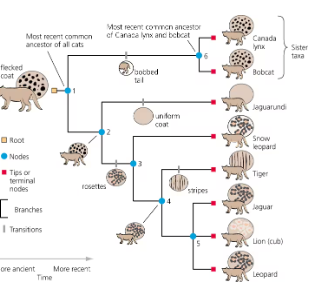
Rosettes evolved as a homology at which node?
Rosettes evolved at node 3 (the homology shared by the descendants of that node).

Which lineage evolved a transition toward stripes, away from the ancestral rosettes?
Tigers — they evolved a transition toward stripes away from the ancestral rosettes.

Which species is the most distantly related of the eight cats?
The Canada lynx / bobcat — whichever lineage branches off earliest (the most basal lineage,most distantly related to the others).

What does the split at node 2 represent?
The split at node 2 represents the common ancestor of the jaguarundi and the lineage that became the common ancestor of the snow leopard,tiger,jaguar,lion,and leopard.
What does monophyletic mean?
The term is used to describe a phylum (or a group of taxa) in terms of evolutionary origin or phylogeny. Thus, the phrase “monophyletic group” pertains to a group of organisms (usually species) that are more closely related to each other than any other group. This, therefore, implies that they descended from a common ancestor. Typically, the monophyletic groups possess characteristics that they commonly share with one another as they inherited them from a common ancestor.
What does synapomorphy mean?
Synapomorphies are indicators of common ancestry. For example, within the clade of terrestrial vertebrates the ancestral, or plesiomorphic, character state is “has four legs.” However, both owls and parrots have the synapomorphic character state “has two legs and two wings,” indicating that owls and parrots are closely related.
What does parsimonious mean?
Parsimony in biology is a method favoring the phylogenetic tree with the fewest evolutionary changes.
Identify the best statement that describes how fossils supported Darwin’s theory of
evolution
Fossils show how simple organisms become more complex.
In carbon dating A half-life is best described as
The time it takes for half of the carbon-14 atoms to decay.
A half-life is the time required for half of the radioactive atoms in a sample to decay — for carbon-14, that's about 5,730 years. Option a and c describe the time for all of the carbon to decay, which is not what a half-life means (and that full decay takes many half-lives, not one).
When did animals emerge in the fossil record?
Around 600 million years ago
The oldest fossils on Earth were of which of these organisms?
Cyanobacteria
Wallace’s Line is best described as:
A trend showing evolution by natural selection.
Which of these observations is not an example of homologies?
a. The bones that support the wings of birds, bats, and pterosaurs.
b. The pharyngeal arches found in all vertebrate embryos.
c. The sequence of limb bones (e.g., pectoral girdle, humerus, radius, and ulna)
found in ancient Tetrapods, bats, cats, and whales.
The skin flap for gliding that evolved in placental and marsupial mammals
Synapomorphies can often be drawn in several configurations resulting in phylogenies with different evolutionary steps. How do evolutionary biologists choose between various hypothetical cladograms?
The cladogram with the fewest evolutionary steps is favored. If there are multiple configurations, a consensus is drawn between equally parsimonious trees.
Evolutionary biologists use parsimony — they favor the tree requiring the fewest evolutionary changes. When several trees are equally parsimonious (tied),they combine them into a consensus tree, rather than picking arbitrarily
Jean-Baptiste Lamarck’s theory was criticized due to his belief that:
An individual's response to the environment is always heritable. For example, if a giraffe develops strong neck muscles, their offspring will inherit muscles proportional to that of its parents.
Lamarck's theory proposed the inheritance of acquired characteristics — the idea that traits an organism develops during its lifetime (like a giraffe stretching its neck) would be passed on to its offspring.
The similarities in body features of a Whale Shark, a filter-feeding fish, and a Blue Whale, a filter-feeding mammal, can be explained by:
Convergent evolution, the traits evolved independently in two distantly related clades.
The whale shark (a fish) and blue whale(a mammal) both evolved filter-feeding body features, but they're distantly related — so the similarity arose independently, which is convergent evolution.
Why is carbon-14, ineffective for dating fossils older than 50,000 years old?
The amount of Carbon-14 in older fossils is too small to measure accurately.
After about 50,000 years, so many half-lives have passed that the remaining carbon-14 is so scarce it can't be measured reliably.
Charles Darwin is best known for his contributions to
Proposing Natural Selection as a mechanism of Evolution.
A ________________ is a shared derived trait that is shared by a group of closely relatedspecies that evolved in the most recent common ancestor and was inherited by all its descendants.
Synapomorphy
The striking similarities found in the bodies of Whale Sharks and Blue Whales is known as a ______________________.
Convergent evolution
A clade that contains multiple common ancestors and does not represent closely related groups at the tips is known to be _________________________
Polyphyletic.
What is special creation in terms of evolution?
posits that all living creatures are
unchanged since their origin and
thus variation among individuals
is limited.
What is descent with modification?
posits that species
change over time in patterns of
both micro- and macroevolution
Microevolution
descent with modification across a few
generations

Macroevolution
descent with modification reflected across
many generations, where homologous features can be
traced back to ancient ancestors
Early worldviews categorized living beings according to their
proximity to divinity
Aristotle provided one of the earliest categorizations in the
Scala Naturae.
Cuvier and Anning were instrumental in laying the foundational evidence to solidify
periods of extinction recorded within the rocks of the Earth.
Vestigial structures
have important functions in closely related allied species, but no
apparent function in the other.
Dodd’s experiments on fruit flies show that
reproductive isolation does not always evolve, but preference can evolve within a few generations.
Stickleback experiments show that
speciation happens in the wild, but that this is a gradual process
Homology:
Some phenotypic and genotypic similarities arise due
to inheritance from a common ancestor
Believers in special creation in the 1800s dated the Earth to be
approximately less than
10,000 years old
Relative dating provided techniques to determine
the age of rocks based on the relative relationships between rocks in the same
deposit and geographic region.
Radiometric Dating provided techniques to measure the
age of samples by measuring isotopic decay.
Alfred Russel Wallace took a similar journey to Darwin and sent Darwin a letter about his views on heredity and evolution.
This prompted Darwin to publish his theory, which he had been writing for 20 years.
Artificial Selection provided an experimental approach to demonstrate microevolution and disprove the strongly held belief that species do not change over time.
species do not change over time.
Domestication is a form of artificial selection that selects for variants that provide a
human-centric benefit
Individuals do not always meet their maximum capacity for reproduction and
survival. Instead, limitations arise from
differential survival and competition for resources and mates.
The views of Malthus, an English clergyman, on population growth and food
production inspired Darwin's theory that
competition and differential survival and reproduction would influence the evolution of populations.
Conditions for evolution by natural selection
1. The trait varies in a population
2. The trait is heritable
3. The trait increases fitness
Natural selection can act on existing traits by generating a new
function
exaptation
Phylogenetic trees represent
branching patterns of evolution over time
Darwin was the first to use the metaphor of branching trees to describe
his theory of
Decent with Modification
Darwin realized that the nested hierarchies in Linnaeus’s Taxonomic
Classification system reflected
shared evolution.
Evolutionary groups can drawn in the following nested hierarchies
Monophyletic
• Paraphyletic
• Polyphyletic
Monophyletic clade
Includes the last common
ancestors and all descendants
Polyphyletic clade
Does not represent a clade
bounded a common ancestors.
• Typically contains multiple tips that
can be traced back to different
common ancestors
Paraphyletic clade
An incomplete lades that excludes
some of the descendants of the
common ancestor
Ancestral characters are known as a
plesiomorphy
A derived character shared by two or more lineages is known as a
synapomorphy
Polytomies are
unresolved uncertainties in the tree represented as a
node or branch point with more than two descendant lineages at the
same time.
Molecular characters can also be used to estimate
evolutionary clades