Random Variables & Probability Distributions
 Call Kai
 Learn
 Practice Test
 Spaced Repetition
 Match
 Flashcards
 Knowt Play
1/27

There's no tags or description
Looks like no tags are added yet.
28 Terms
What is a random variable?
a variable that takes on numerical values based on the random outcome of an experiment
anything that can take on different possible values determined purely by chance
A discrete random variable…
has a countable number of possible values
A continuous random variable…
has an uncountably infinite number of possible values
Give an example of a discrete random variable.
number of heads in 10 coin flips
Give an example of a continuous random variable.
wieght
For cumulative distribution frequency tables, how do we get the F(x) column?
by adding up the P(x) column cumulatively.
F(x) = F(previous row) + P(current row)
How do we use F(x) for the question type “P(X ≤ x)”?
read F(x) directly
How do we use F(x) for the question type “P(X < x)”?
F(x - 1) for discrete
How do we use F(x) for the question type “P(X ≥ x)”?
1 - F(x - 1)
How do we use F(x) for the question type “P(X > x)”?
1 - F(x)
How do we use F(x) for the question type “P(a ≤ X ≤ b)”?
F(b) - F(a - 1)
How do we use F(x) for the question type “P(a < X ≤ b)”?
F(b) - F(a)
What is the formula for the mean / expected value?

What is the formula for variance?

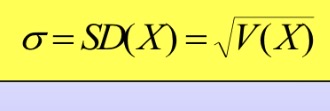
What is the formula for standard deviation?
the square root of the variance
What is the formula for the coefficient of variation?
CV = σ / μ
What are Bernoulli trials?
a sequence of n identical trials with these conditions:
1. Two outcomes: Each trial results in "success" or "failure" (mutually exclusive and exhaustive).
2. Constant probability: P(success) = p remains the same for every trial; P(failure) = q = 1 − p.
3. Independence: The outcome of any trial does not affect any other trial.
What is the binomial random variable?
the number of successes in n Bernoulli trials, X
What is the formula for the probability of a given sequence in binomial probabilities?

What is the formula for the number of different sequences in binomial probabilities?

What is the formula for binomial probability distribution?

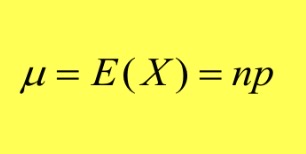
What is the formula for mean of a binomial distribution?
What is the formula for variance of a binomial distribution?

What is the formula for standard deviation of a binomial distribution?

What is the Poisson probability distribution formula?

When do you use the Poisson distribution formula?
• Counting occurrences over a continuous interval of time or space
• As an approximation to the binomial when p is small (p ≤ 0.05) and n is large (n ≥ 20)
Examples of Poisson probability distribution.
number of phone calls per hour
number of accidents per day
number of defects per unit area
For continuous random variables, probabilities are always associated with _______.
intervals not individual points