Cleft palate team / genetic disorders
 Call Kai
 Learn
Learn Practice Test
 Spaced Repetition
 Match
Match Flashcards
 Knowt Play
1/30

There's no tags or description
Looks like no tags are added yet.
Name | Mastery | Learn | Test | Matching | Spaced | Call with Kai | Chat |
|---|
No analytics yet
Send a link to your students to track their progress
31 Terms
Etiologies of Cleft; What causes the embryonic fusion failure in patients with clefting?
genetic disorders
chromosomal aberrations
down syndrome/trisomy 13
teratogenetically induced disorders (environment)
mechanically induced abnormalities (what happened when growing)
Genetic Disorders
clefting associated with 400 multiple anomoly syndromes (combination of symptoms)
Pierre robin sequence
treacher collins
apert syndrome
velocardiofacial
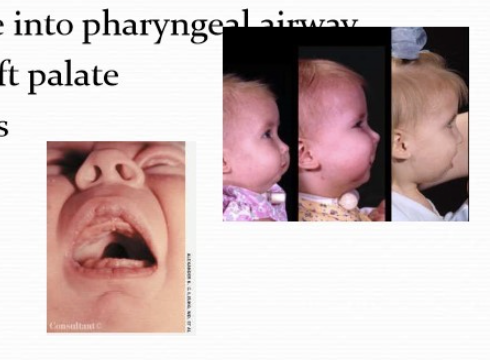
Genetic disorders (pierre robin)
Micrognathia (underdeveloped mandible)
Interferes with the descent of tongue and palatal shelf fusion- 8-9th week
Retracted/elevated tongue into pharyngeal airway
Isolated cleft of hard or soft palate
Congenital heart problems
Digital anomalies
(longer or shorter fingers or webbing)
Conductive hearing loss
malformation of the ear canal
Developmental deficits
language deficits
*notes: artic issues b/c of tongue, tongue interferes with palatal fusion, no lip involvement, webbing/extra digit, malformation of ear canal, lang/speech issues

Genetic Disorders (treacher collins)
Malar hypoplasia (underdevelpment of cheek bones),
Underdevelopment of mandible, external ear and canal
Conductive hearing loss
Cleft palate
Small stature
Broad, flattened nose
Notes* no developmental, mostly aesthetic, hearing loss / cleft palate, pinna smaller / malformed (NO zygomatic arch)

Genetic Disorders (velocardiofacial syndrome)
Heart problems
Broad, flattened nose
Language and learning deficits
cleft of palate

Genetic disorders (apert syndrome)
Craniosynostosis (premature closing of the sutures of the skull)
Syndactyly (webbing of fingers and toes with bone fusion)
Palate is high and narrow (appearance of cleft)
Conductive hearing loss
Expressive language delay
Notes* malformation of the ear canal, expressive lang (oral cavity, palate, hearing), wide set eyes
Chromosomal Aberrations
46 chromosomes arranged in 23 pairs (normal)
Trisomy 13-
Cleft lip with or without cleft palate (60-70% of cases)
Appearance of a third #13 chromosome
Multiple congenital anomalies are present (birth defects)
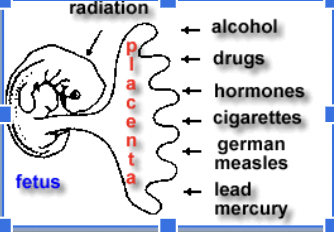
Teratogenically Induced disorders
Agents that interrupt normal development of a fetus and create congenital malformations.
Drugs
Dilantin (anti convulsive)
Thalidomide (sedative)
Aspirin
Nontopical acne medication
X-rays (radiation)
Viruses
Alcohol
Nicotine
Caffeine
*ingested, hormones (birth control etc.,)
Mechanically Induced Abnormalities
Impingement on the embryo directly
Amniotic rupture
Intrauterine crowding (twins)
Uterine tumor
Irregularly shaped uterus
(car accident abuse)
Incidence of clefting
1 in every 750 births
Cleft of lip with or without cleft of palate occur more than cleft of palate alone.
1 in every 1,200 births- submucous cleft
Increasing the genetic pool of clefting?
Adults who have a cleft and are treated successfully
Improved postnatal treatment
sex and racial differences
Sex:
Occurs 2x’s as frequently in males and more severe clefting
Cleft of palate alone- more frequent in females
Submucous clefting- same frequency in males and females
Racial Differences:
Native Americans- Highest incidence
Asian
White
African American- Lowest incidence
Cleft palate team
Craniofacial team
Integration of information among professionals
Family may see several specialists in one appointment
All aspects of care in one setting
One contact for emergency (RN)
Needs of a patient changes with the lifespan
Members of team: physicians/medical
Anesthesiologist
Nurse practitioner
Plastic Surgeon
Oral Surgeon
orthodontist
Audiologist
Otolaryngologist
Endodontist
Periodontist
Pediatrician
Prosthodontist
Geneticist
Anesthesiologist
Concentrate on the care of surgical patients and pain relief.
Audiologist
Assess hearing
Coordinator
Responsible for the coordination of care for the patient in collaboration with other members of the cleft palate team.
Educator
Helps to inform the family throughout the process.
Endodontist
Root canal specialist
Geneticist
Screens patients for craniofacial syndromes.
Genetic Counselor
Talks to parents about having more children with this problem.
Nurse practitioner
Helps with feeding problems.
Oral surgeon
Works closely with our orthodontists and other surgeons to improve facial function and appearance.
Orthodontist
A dentist who evaluates the position and alignment of your child's teeth and coordinates a treatment plan with the surgeon and other specialists.
Otolaryngologist
Ear nose and throat doctor. A physician who will assist in the evaluation and management of ear infections and hearing loss that may be side effects of your child's cleft abnormality.
ENT (endoscopy, surgical intervention, tonsils, adenoid removal)
Pediatrician
A physician who will follow your child as he/she grows and help coordinate the multiple specialists involved.
Periodontist
Diagnosing, preventing and treating gum disease. They can also place dental implants as well as perform cosmetic periodontal treatments.
dentures/molds
plastic surgeon
A surgeon with specialized training in the diagnosis and treatment of skeletal abnormalities of the skull, facial bones, and soft tissue; will work closely with the orthodontists and other specialists to coordinate a surgical plan.
Prosthodontist
Skilled in the replacement of missing teeth and the restoration of natural teeth.
crowns / veneer
psychiatrist
A physician who assesses the psychosocial function and behavioral development of your child. The psychiatrist will assist the family in identifying therapy resources and coordinates referrals with the social services department.
radiologist
a physician who reads and interprets digital images, or x-rays, of patients obtained through a variety of cameras, machines, and imaging equipment. uses this information to help diagnose the patient and consult with the treating physician to develop a course of treatment.
social worker
A professional who provides guidance and counseling for your child and your family in dealing with the social and emotional aspects of a craniofacial.