Intro to African Art
 Call Kai
 Learn
 Practice Test
 Spaced Repetition
 Match
 Flashcards
 Knowt Play
1/59

Earn XP
Description and Tags
UNIT 1
60 Terms

“Statue of Wahibra Holding Shrine of Osiris,” Egyptian, c. 530 BCE, 26th Dynasty, Basalt rock
Frontality: sculpture mean to be affixed to temple wall and only seen from the front
Commissioned to be put in the temple by Wahibra
Wahibra holds a shrine of Osiris with inscription asking for gifts to Osiris so Osiris will bless Wahibra; exemplifies “effectiveness” belief of art
Static: calmness of expression and kneeling gesture with arms and legs still attached to torso (no negative space), black color also indicates life, fertility, and the triumph of life over death
Nose chopped off so that life source/soul can’t get back into the sculpture

“Nebamun Fowling & Fishing,” Egyptian, c.1350 BCE, 18th Dynasty
Intended to give visual form of Nebamun successful transition from this life to the afterlife (effectiveness of art)
Nebamun traversing a body of water (water = chaotic transition through to afterlife)
Nabamun =.largest figure (wife and daughter smaller), not naturalist, abstract-ism
2-dimensionality arrangement more symbolic than naturalistic (scale, body positioning, certain anatomical inaccuracies to present the most important features)
Idealism: Nebamun died likely when he was older but depicted as young and strong with all he needs to get to the other life (effectiveness)

“King Thutmose III Offering Bread to Amun-Ra,” Egyptian, 18th Dynasty
Rigid composition and order of hieroglyphs gives piece order and stability
Right statue = Amun-Ra, literally extended vertically by feather headdress, tells us he is important and a god; iconography of Amun-Ra’s headdress and staff
Left statue = King Thutmose, almost same height as god, indicating that he has the potential to become a god but is giving an offering which is indicative of his lower social status

“King Djoser’s Tomb” and surrounding wall, Egyptian, Architect: Imhotep, c. 2650 BCE, 3rd Dynasty, Old Kingdom
First king to unite upper and lower Egypt
Stacking structure expresses ascendance, expresses significance he had on the material world and the impact he’ll have in the other world (duality
Made of stone, static, stable
Base layer not quite rectangular or square

“The “Bent” Tomb of King Snefru,” Egyptian, c.2570 BCE, Old Kingdom
Just about perfectly square (headed toward pyramid architecture)
Decree of incline changes dramatically halfway up (many theories why, ex. stability)
Very smooth surface, though degradation of the smoothness over time

“Pyramid of Cheops or Khufu”/”The Great Pyramid” (exterior), Egyptian, c. 2550-2530 BCE, Old Kingdom
The largest of the Pyramids of Giza, built for King Cheops
Coated over with limestone painted white, smooth, with stones held together with plaster
2.3 million blocks of locally quarried stones
Capstone missing, thought to be gold and expressing the sun-like creative force rising on a mound of earth in the creation story
Still not known how it was constructed, issues with both major theories of ramp and staircase around
Degradation from trying to dismantle or get inside to loot or explore
Base = square

“Pyramid of Cheops or Khufu”/”The Great Pyramid” (interior), Egyptian, c. 2550-2530 BCE, Old Kingdom
Entry point very hard to access
3 chambers: bottom (subterranean chamber), middle (queen’s chamber, but no queen inside), upper (king’s chamber, mummified body of King Cheops in dramatic red granite sarcophagus
Air shafts leading from chambers to outside for spirit world and material world to interact, allowed workers to get air but also allows spirit of Kind Cheops to excape
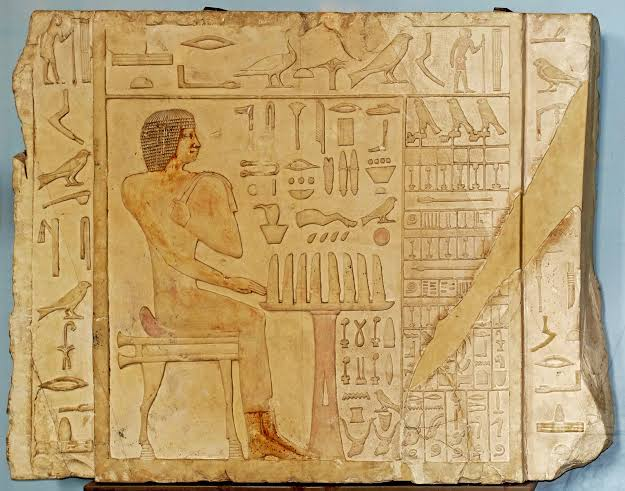
“False Door Panel of Rahotep,” Egyptian, 4th Dynasty, Old Kingdom (featured in Robins' chapter)
Limestone false door panel of Rahotep, the king’s son and high priest of Ra and Heliopolis
Shows Rahotep seated on left before a table of offerings
The high-quality relief indicates it came from a royal workshop and would have once been painted but the color is lost

“Ifa Tray (Opon),” Yoruba, 20th c.
From Ekiti, a specific Yoruba subgroup
Tray sits between diviner and “client”
Repetition of Esu/Elegba creates dynamism, gives eye movement cadence as gaze moves around the circle; at the same time the faces compete for attention like Orisa
Smooth center = the border between Orun and Aye, the crossing over of worlds; divination begins by tapping the center to open communication
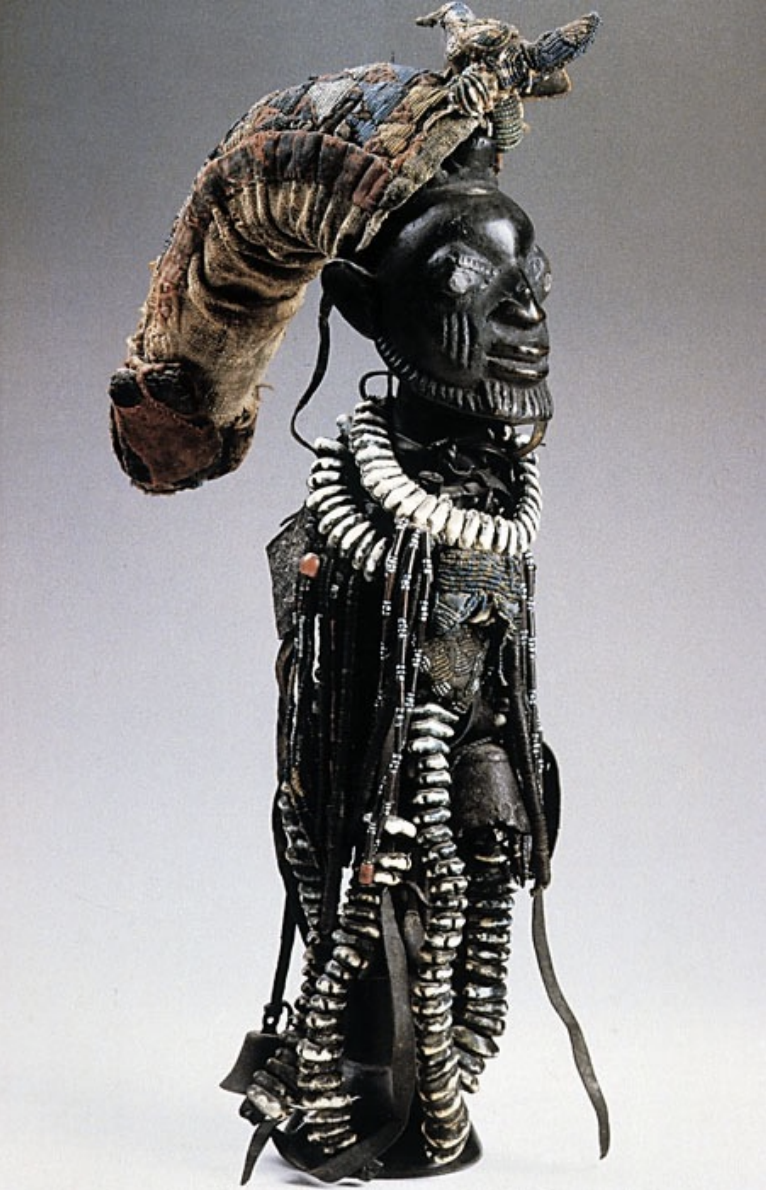
“Esu Dance Staff,” Yoruba [Osogbo sub-group], 19th c.
Iconographic overtly phallic headdress wrapped in beaded cover
Bird on forehead in reference to the female body and the power of elderly menopausal women who are so filled with ase blood that they can turn into birds at night
White cowrie beads indicated broader global significance since they were only found in the east but were in Yoruba art on west of continent
White signifies cool orisa, calm temperament
Inner head in charge of outer head
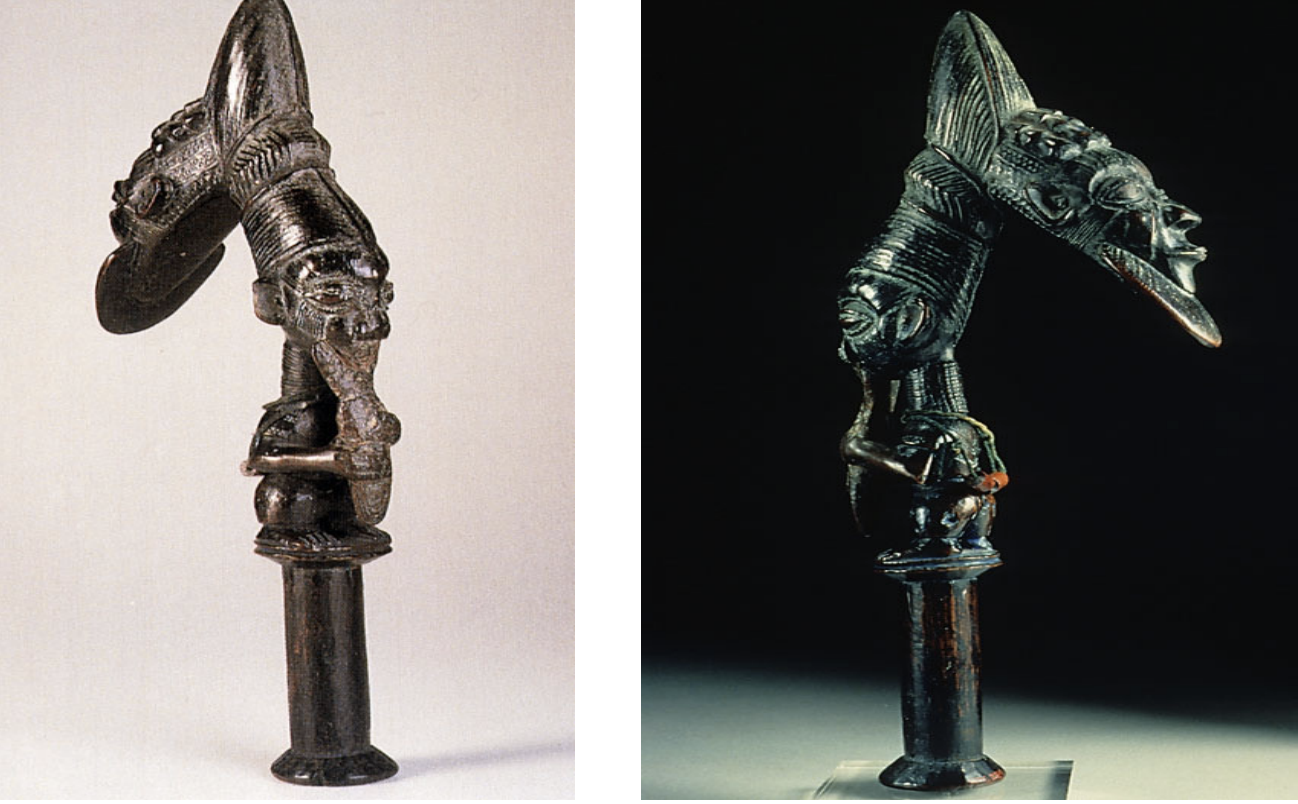
“Janus-Faced Esu Playing a Pipe” (Dance Staff), Yoruba [Ekiti sub-group], 19th c.
Headdress transformed into another face; faces looking both ways connecting both worlds

“Five Esu Figures,” Yoruba [Igbomina sub-group], 19th-20th c.
Cowrie shell beads symbolizing wealth and global nature of Yorubaland since those shells come from east but present in west, traded as money
Esu as a woman three times and man twice. Middle figure of woman was added later, can tell women from men by beards and breasts
Inner heads in charge of outer heads since all appear calm
Would have been sculpture on top of a post as a dance wand

“Ere Ibeji for Deceased Twins,” Yoruba [Saki-style], 19th-20th c.
Saki = subgroup of Yoriba
Shackles to beg deceased twin no tot take the spirit of the living twin to the otherworld

“Female and Male Ere Ibeji for Deceased Twins,” Yoruba, late 19th-early 20th c.
Prominent sexual organs to display vitality and verility (power)

“Ere Ibeji for Deceased Twins,” Sculptor: Akiode [Yoruba], 20th c.
Prominent sexual organs to display vitality and virility (power)

“Terracotta Freestanding Heads,” (there are two: one with facial striations and the other without), Ife, Early Pavement Era, 1000-1200 CE
Naturalistic, realistic
Not portraits, representing important figures, Oba, superhuman
Idealized, blemish-free, long necks with rolls (fat or necklace)
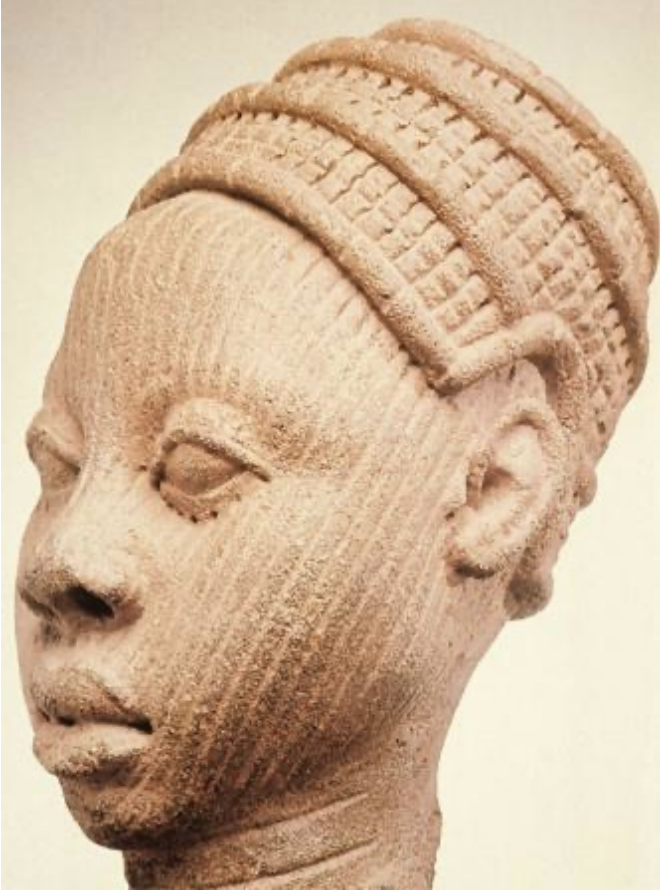
“Terracotta Head (of a Queen?) with Facial Striations,” Ife, Early-Late Pavement Era, 1000-1500 CE
Conical tiered crown, solid, fragment of a larger piece, small (6 inches)

“Terracotta Freestanding Head with Cheek Circles & Pigmentation,” Ife, Early-Late Pavement Era, 1000-1500 CE
Faded pigmentation visible (red, white, and black), hollow + shattered at top from wear, but was some type of hairstyle
Facial markings, vertical striations, horizontal at eyes, petal patterns at mouth, and circles on cheeks; possibly early representation of barrier between Oba eyes/mouth and others (adéńlá)

“Terracotta Head of a Queen(?),” Ife, Early Pavement Era, 1000-1200 CE
Crown, diminutive, fragment of a larger piece, forehead crest (lineage), white pigmentation, striations on lips not face, head tilted up
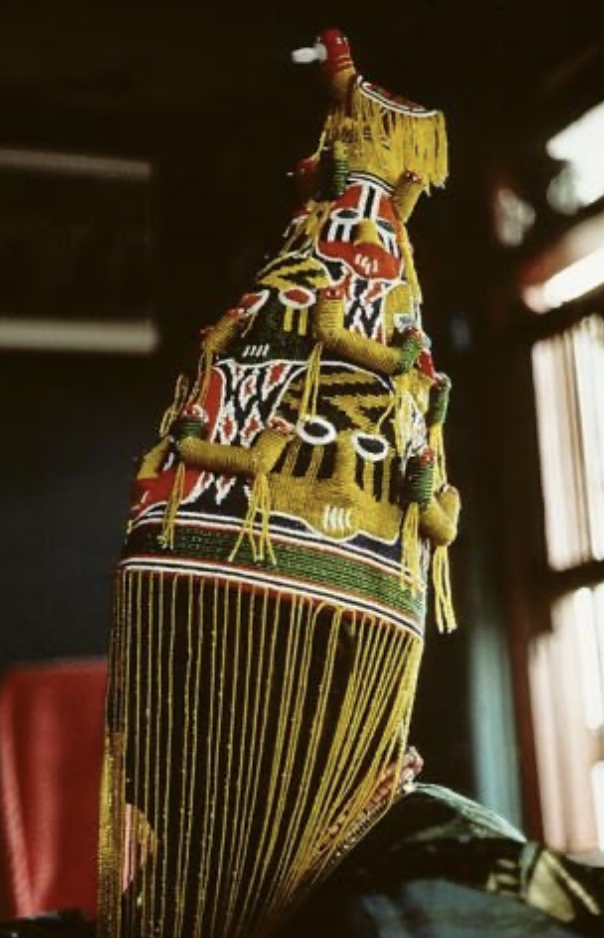
“Adéńlá (crown),” Yoruba, 20th c.
Worn by Yoruba King, protects those in Oba presence from being negatively affected by ase from words and eyes
Beads making veil (beads = currency)
Bird at top for elder post-menopausal women and their powerful ase
Medicines packed into the interior of crown
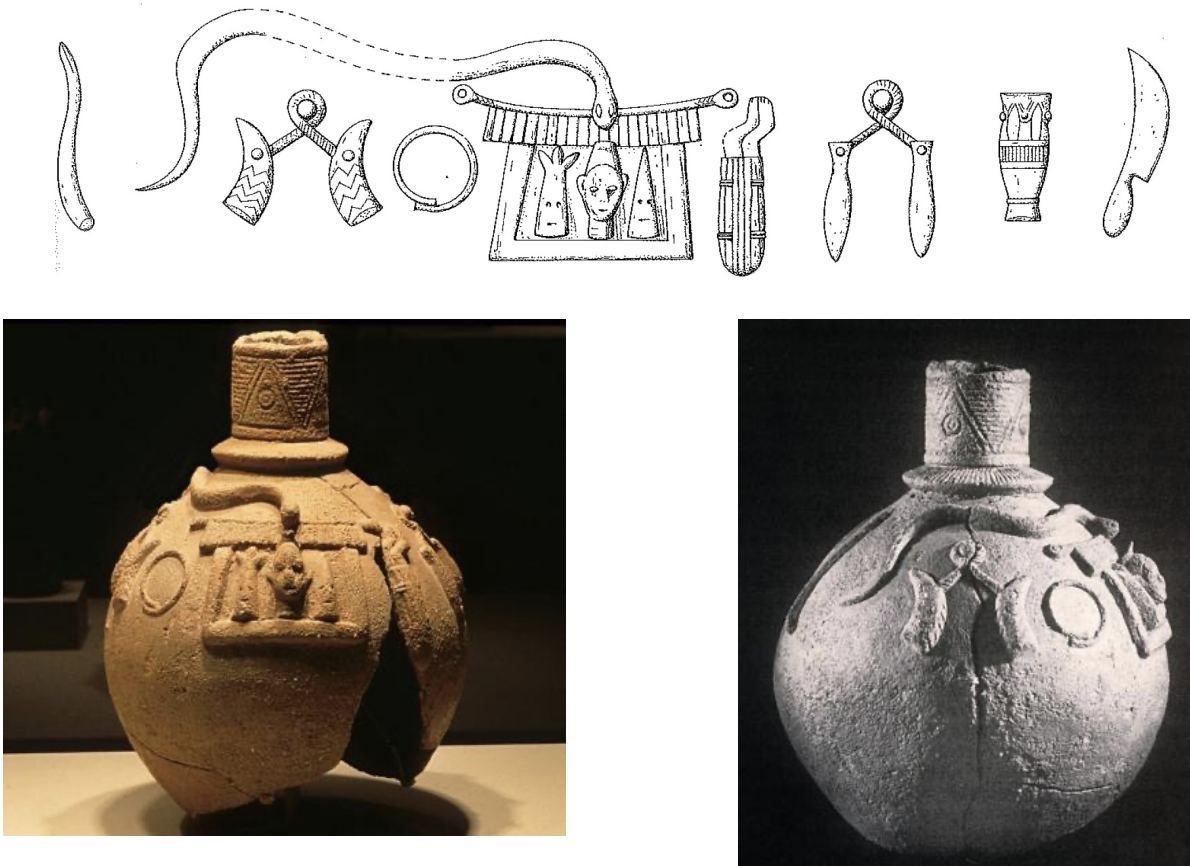
“Terracotta Pot from the Obalara Land Site,” Ife, Late to Post-Pavement Era, 1300-1500 CE
Depicting what was in the shrine room where the pot was buried in the center, terracotta head flanked by stylized heads (representations of inner head)
Snake slipping around top of pot
Used to pour offerings/lubations to whatever Orisa was thought to inhabit the area of the shrine

“Conceptual Representation of a Human (inner?) head,” Ife, Late to Post-Pavement Era, 1300-1500 CE
6.5 inches, found in Obalara Land Site
Thought that the room was a shrine to the inner head
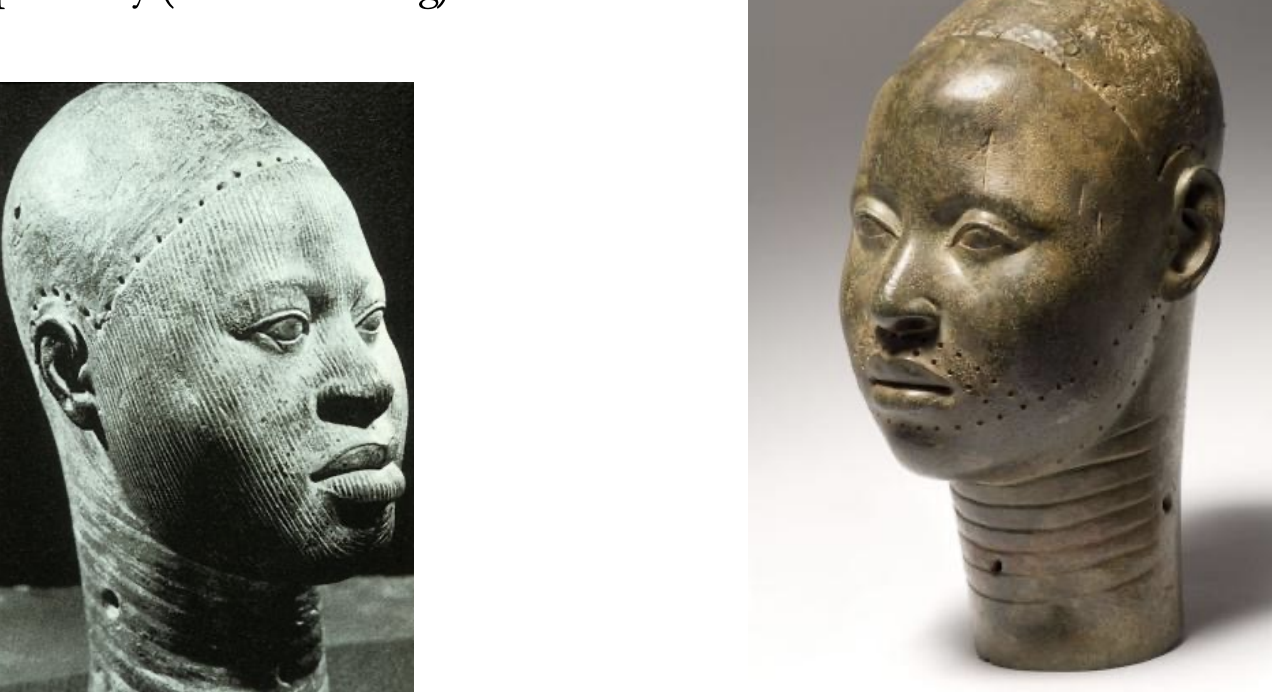
“Free Standing Heads of Obas” (2 of 3 in total), Ife, Late Pavement Era, 1200-1500 CE, Lost-Wax Casting
Tiny holes in forehead or jaw/mouth with beads inside, further reinforcing early representations of adéńlá obas wear now
Incredibly realistic/naturalistic with long necks with folds
Hollow, something thought to be put inside to charge ase
Thought to mabye hold the adéńlá to be brought out and recharged anew

“Free Standing Heads of Obas” (2 of 3 in total), Ife, Late Pavement Era, 1200-1500 CE, Lost-Wax Casting, copper alloy, found in Wunmonije Compound
Rock-Hewn Churches of Lalibela
Site Name: Roha/Lalibela
The site has 11 churches and a river, named the River Jordan, still a place of worship and pilgrimage
Date: built in phases from the 7th to the 13th c.
Architects: Once-known Ethiopian architects, associated with the Zagwe Dynasty/King Lalibela
Material: “living” volcanic basalt
Ancient presence of Christianity on the African continent, pushing against primitivist framings of savagery and the need for missionizing to be saved
African art objects ≠ passive or decorative or purely visual, they are physical manifestations (shapes) of human thought, philosophy, cosmology, spiritual beliefs, internal emotions
Primitivism
Set of underling, often paradoxical, ideologies about non-Western cultures that shaped Europe & America’s perceptions of Africa and African art and those of other colonized “others.”
Primitivist views of Africa are reflected in attitudes towards African art up until today!
Ahistorical & yet lower on the evolutionary ladder
Africans as more primitive or childlike versions of Westerners (Universality Principle)
Shaped by Darwinian and Freudian thinking
Inflected with racist views
Perpetuated by Christianity
Used to justify colonialism
Africans as exotic “others”
“Noble Savage” trope
(see Flam)
Pre-social innocence/pure heart, unburdened by the ills of the world because of lack of “civilization” or the structure of society
Expression of innate purity because of the lack of connection with civilized, industrial society
1884-1885
Dominant European leaders of the time met to divvy up who would colonize where in Africa. There was a sense of urgency (scramble)
The image of Africa changed from semi-equal footing (leaders, artists, people, kings—except for trans-Atlantic slave trade) to othering and dehumanizing and primitivization
Related by family connections and/or location of their seats of power
Dynasties are subsumed under the categories Kingdom + Period
30-31 dynasties total
Denote times of strength and units; as opposed to periods
Denote time of change, foreign rule, or disunity; as opposed to kingdoms
Stylized upright figure of a cobra ready to strike, worn on the brow of pharaohs and gods in ancient Egypt as a symbol of sovereignty, royalty, and divine authority
Worn often by kings because the cobra was dangerous and protective as the king must be to watch over Egypt and maintain order and protect it from outside chaos
Upper vs Lower Egypt
Black (kemet) vs Red land (Deshret)
Creation of the world as triumph of “order” over “chaos”, the battle is ongoing and must be maintained
The first humans were a divine couple, twins, Shu and Tefnet; dualistic personifications of male and female
The second generation were twins Geb and Nut representing the earth and sky respectively
The third generation was quadruplets, the women Nephthys and Isis and men Osiris and Seth
Seth became jealous of the love between Isis and Osiris and killed Osiris. Isis brought Osiris back to life and he became the ruler of the underworld to protect and maintain order. Had a son Horus.
Horus was associated with Kingship, represented the sky and the earth, often falcon headed with cobra on his head (sky + earth animals)
The king was the mediator between the divine and human worlds
The king was the unifier of Upper and Lower Egypt
Charged with maintaining that order wins out over chaos
Made for a purpose, meant to be used, lived with, and engaged with
Museums = european creation
Art as functional was a representation of the continuum of the spirit and physical/material worlds
7 Artistic Principles of Egyptian art
Frontality, lack of pictorial space, composite viewpoints, Hieratic scale, idealism, compositional order and balance, images & texts)
Frontality
Objects meant to be viewed from the front, can’t see certain details unless seeing from front
Especially explicit in 3D works integrated into the architecture, physically only the front of the object
Example of order vs chaos, a performance of order winning over chaos with the staticness of the scupltures
Mausolea of high officials and royal families adjacent to the Pyramid of Cheops
Rectangular with flat roofs, look like benches, mastaba = “bench” in Arabic
Architectural antecedant to the pyramids
The world was a dark and watery chaotic realm. Eventually, order won out the battle over chaos and there was the emergence of a sun-like creative force on a mound of earth that rose from the watery darkness. The battle between chaos and order is ongoing
The Pyramids of Giza with their missing golden capstones are representative of this sun-like creative force rising from the depths. Limestone finish would have made them extremely bright when in the sun and in combination with the golden capstone
Aksumite Dynasty: Descendants of King Soloman (bible) and Queen of Sheba (dynasty), owners of the Ark of the Covenant brought down by some of their love affair
Zagwe Dynasty
Rise and fall of Zagwe Dynasty circa 12th to 13th c.
Renamed the site to “Roha” (future = Lalibela)
Roha = Edessa in Arabic
Edessa, Syria = popular Christian pilgrimage site because it holds many Christian relics
Roha as the site name that “quotes” Edessa and all it stands for
Roha was renamed Lalibela when King Lalibela was transformed to Saint Lalibela
King of the Zagwe Dynasty, credited with the commissioning of the construction of the 11 rock-hewn churches in Ethiopia
Roha = Edessa in Arabic
Former name of Lalibela as given by th Zagwe Dynasty in the 12-13th c.
One endowed an architectural form with meaning by incorporating into the fabric of a structure distinctive features or measurements of a venerated model. The result was a quotation not an exact copy.
A structure that repeated significant, identifiable elements of an earlier, venerated edifice was understood to be endowed with the meaningful associations, even the holiness of its prototype
Ile-Ife
The origin place of all Yoruba speaking people
“Ile-Ife” = home spread, concentric-range expansion, hierarchical spread from inside to outside of rank within the city
Yoruba
Large ethnic group in present day Nigeria and Benin, many smaller city states existed within
Orun = otherworld
Aye = the world, a “marketplace”
Represented the dynamic cosmos, a continuum with a permeable barrier
Inner head =.in center of actual physical head, source of individual ase, should be in control of outer head bc = proper way of being + holding yourself
Outer head = what you see, like a mask, threshold of outer world and inner being
The vital life source that permeates all
Words have ase, eye contact has ase, all objects have ase, people especially full of ase
Rulers have particularly strong ase
A deity, divine messenger in charge of ritual process, crosses from Orun to Aye
Many offerings made to Esu/Elegba, could choose to convey proper message or if wanted to play trickster role, could choose to incorrecetly relay message
Like a king, a “super human” ruler
Olodumare
Genderless creator god of Yoruba culture
Orisa
Ancestors who became deities, temperament could be cool/white (calmer, level-headed) or hot/red (quicker to anger)
Ere = sculpted, Ibeji = twins
A way to honor twins, considered both lucky and dangerous, honored + respected though sometimes birth of twins mean they weren’t allowed to live
Mother of twins take them to market to ask for blessings/gifts to bless twins, the mother and also those who give the gifts get blessed
Adorn sculptures with their nicest objects
One constructed first when one dies, when second dies get the other. Possibly commission both at the same time but only use one ritually until both pass
Treated as the twin would have been treated, dressed, applied with shea butter to make them shine
Depicted as adult bodies (no matter when died), standing with hands on hips or legs (poise, balance), composed faces, African Proportion with elaborate hairstyles or hats
Variation in decoration, hairstyles, and facial scarification (denote lineage)
Present esp on terracotta freestanding heads and freestanding heads of Oba, no blemishes, extreme long necks, creases down along the necks (either necklaces or rolls of fat indicative of fortune to eat, fecundity, fortune with the gods)
Head = ¼ or 1/5 the size of the rest of the body, scaled up
Possible representation of inner and outer head present at once (at least for Yoruba art)
Modernist primitivism
Picasso inspiration in “Les Demoiselles d’Avignon” 1907
Picasso and other artists were trying to break free from the legacy Renaissance styles and the linear perspective (vanishing point)
European and American artists’ and collectors’ “discovery” of African objects (mostly sculptures from West and Central Africa), though many considered them “artifacts” or “ethnographic specimens” rather than “art” until people like Picasso drew stylistic inspiration from them
The assumption that certain discovered artworks “must” have come from the Greeks or someone more “advanced”