FR lecture 12 - brain: brainstem and cerebellum
 Call Kai
 Learn
Learn Practice Test
 Spaced Repetition
 Match
Match Flashcards
 Knowt Play
1/132

There's no tags or description
Looks like no tags are added yet.
Name | Mastery | Learn | Test | Matching | Spaced | Call with Kai | Chat |
|---|
No analytics yet
Send a link to your students to track their progress
133 Terms
Brainstem
Made up of 3 main components: medulla oblongata, pons, and midbrain

Medulla oblongata
Most inferior portion of the brain; connects the brain to the spinal cord

Pons
Enlarged region of the brainstem with a bulge on the anterior side; located superior to the medulla oblongata; means “bridge”

Midbrain
Most superior portion of the brainstem; sits between the pons and the diencephalon

how does spinal cord gray matter relate to the medulla oblongata?
Spinal cord has gray matter in an H or butterfly shape on the inside; as it moves into the medulla oblongata, this pattern starts to change

C1 spinal nerve
First spinal nerve encountered when entering the spinal cord; last spinal nerve when moving upward toward the brain

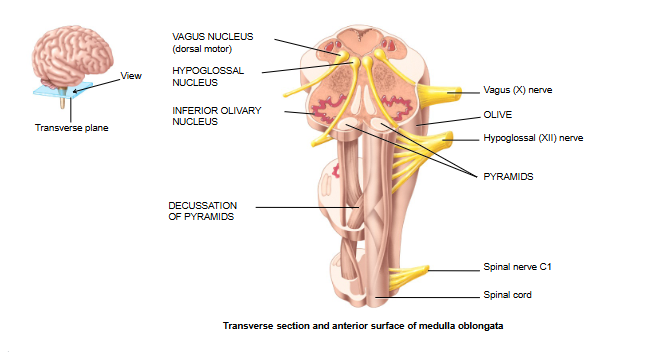
Pyramids
White matter bulges on the interior side of the medulla oblongata; contain descending motor tracts that are part of the somatic motor system

Descending tracts
Carry information from the brain down toward the spinal cord

Pyramids function
carry electrical signals being sent from brain → skeletal muscles down to the spinal cord so they can be sent out to the periphery

Pyramids and skeletal muscle control
Contain motor tracts involved in conscious control of skeletal muscle; only descending; part of the somatic nervous system

the pyramids are ______ structures
Bilateral structures

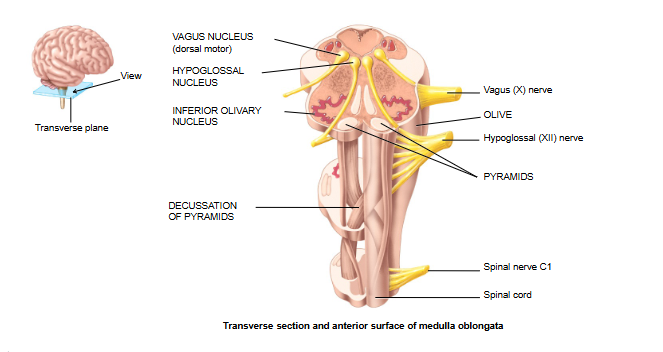
Decussation of the pyramids
Area where the pyramids cross over to the opposite side of the body just before entering the spinal cord
what % of the tracts of the pyramids cross over to left/right?
90% of the tracts cross from the left side to the right and from the right side to the left
Decussation of the pyramids and brain damage
Damage to the right hemisphere or right side of the brainstem can affect muscles on the left side of the body because motor neurons controlling skeletal muscle cross over

Stroke and decussation of the pyramids
Which side of the brain has been affected can often be identified by which muscles are affected because motor control occurs on the opposite side

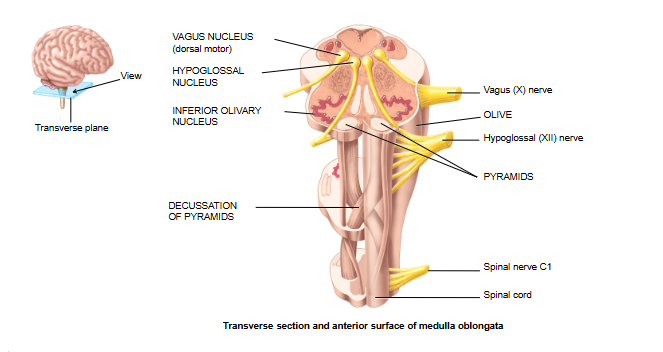
Olives
Bilateral concentrations of nuclei in the medulla oblongata

Inferior olivary nucleus
Nuclear region within an olive

Olives (medulla oblongata) function
Relay information about position of muscles and joints to the cerebellum

Information from the body travels through the _____ ____ synapses at the _____, and is then redirected to the _______ so it can help smooth out motor movements
spinal cord, olives, cerebellum
the _____ are a region involved in sound perception; they help perceive sounds by slightly altering how information is received from the inner ear
olives

Nucleus
Collection of cell bodies in the central nervous system
Hypoglossal nerve # and where it exits
Cranial nerve XII; exits the medulla oblongata

Hypoglossal nucleus + where its located
Region in the medulla oblongata where the cell bodies of the hypoglossal nerve are located

Cranial nerve structure
neuron cell bodies are located in nuclei within the medulla oblongata; axons exit the medulla oblongata and join with other axons to form the nerve

Vagus nerve
Cranial nerve X; exits the medulla oblongata; has a nuclei region in the medulla oblongata

Medulla oblongata function
Transmits both ascending and descending impulses between the brain and spinal cord
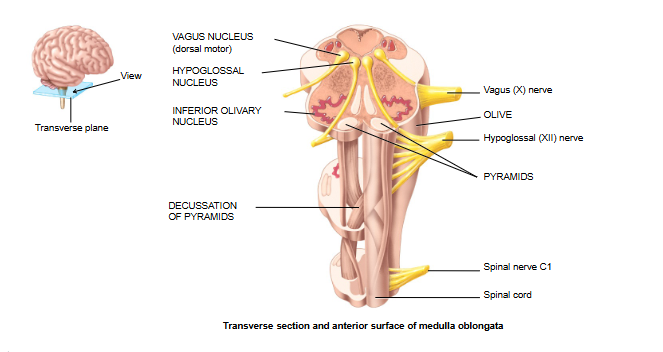
Medulla oblongata white matter contains
pyramids with descending somatic motor neurons

Medulla oblongata vital reflexes
Contains centers for vital reflexes important for keeping the body alive

Cardiovascular control center
Located in the medulla oblongata; controls heart rate and blood pressure

Respiratory control center
Located in the medulla oblongata; controls respiration or breathing
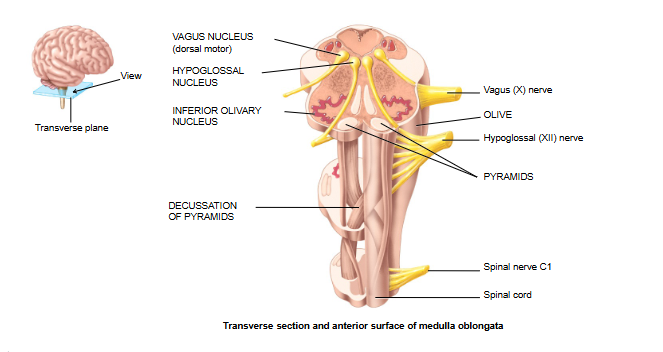
Medulla oblongata reflexes
Reflexes involved in swallowing, coughing, and sneezing

Medulla oblongata and airway
Swallowing, coughing, and sneezing reflexes help keep the airway clear

Medulla oblongata and cardiovascular system
Cardiovascular control center helps keep the cardiovascular system functioning properly

Medulla oblongata and breathing
Respiratory control center helps keep breathing rate going

ignore
ignore
which cranial nerves have nuclei in the medulla oblongata?
V, VII, IX, X, XI, and XII
5, 7, 9, 10, 11, 12
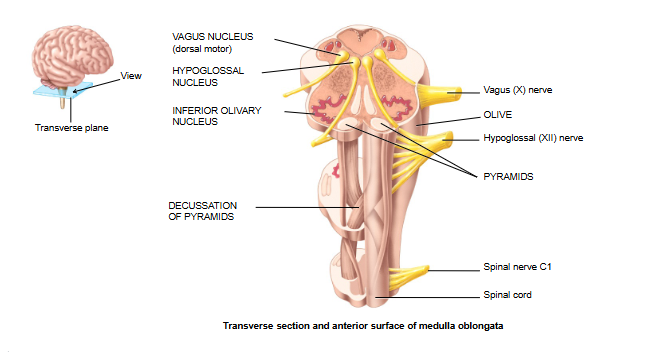
Pons
Located just superior to the medulla oblongata; the word means “bridge”

Pons function
Acts as a connection between different areas of the brain

Does the pons contain only descending, ascending or both nerve tracts?
both

Pons ascending tracts
Carry information from the spinal cord up toward the cerebrum

Pons descending tracts
Carry information from the cerebrum down through the spinal cord

Pons gray matter
Contains several areas of gray matter that contain nuclei

the ____ contains a sleep center involved in the sleep-wake cycle
pons

Pons and REM sleep
Specifically involved in REM sleep, or rapid eye movement sleep

REM sleep
Phase of sleep where the eyes can be seen moving underneath the eyelids

the ____ works with the medulla oblongata to control respiration
pons

Pontine nuclei
Nuclear region in the anterior portion of the pons

Pontine nuclei function
Involved in communication between the cerebrum and cerebellum
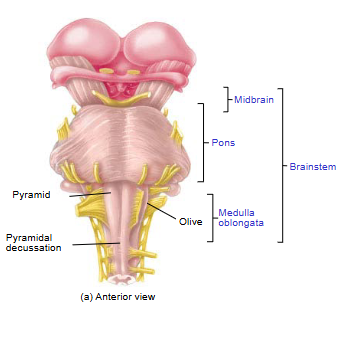
Pontine nuclei and cerebrum/cerebellum communication
Gathers information from the cerebellum and brings it up to the cerebrum or vice versa; area where neurons synapse between the cerebrum and cerebellum

which cranial nerves have their nuclei in the pons?
V, VI, VII, and VIII
5, 6, 7, 8

Cranial nerve V nuclei located where
both the medulla oblongata and pons

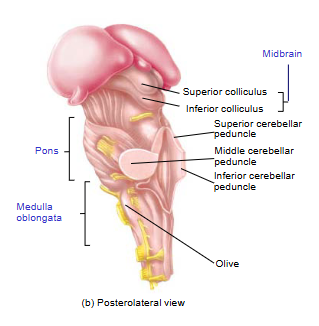
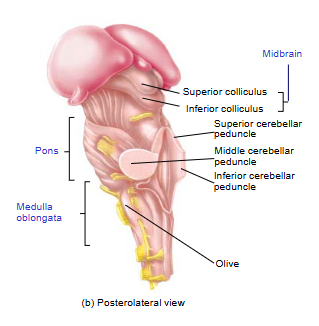
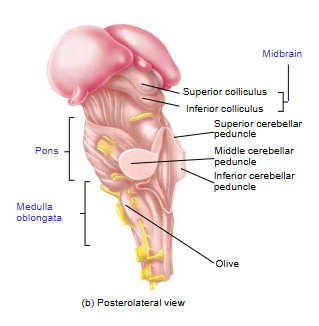
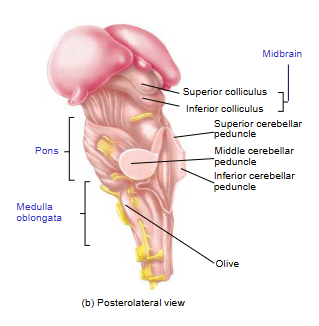
Midbrain
Most superior portion of the brainstem; sits between the pons and diencephalon

Midbrain white matter contains what
Contains nerve tracts carrying sensory information upward and motor information downward
Midbrain gray matter
Contains nuclei
Sensory information traveling from the spinal cord toward the cerebrum travels through the ______
midbrain
Motor information traveling from the cerebrum downward travels through the ______
midbrain

the ______ provides a connection to the thalamus, which is the relay center for sensory information
midbrain
Thalamus
Part of the diencephalon; receives most sensory input

Midbrain reflex centers
Contains visual and auditory reflex centers

which cranial nerves have their nuclei in the midbrain?
III, IV, and V
3, 4, 5

Neurons belonging to cranial nerve _ have cell bodies located in all _____ regions of the brainstem; their axons come together to form cranial nerve _
V, three, V

Tectum
Structure on the posterior portion of the midbrain formed by 4 nuclei

Colliculus
Individual mound of gray matter forming the tectum

Superior colliculi
Two nuclei located on the posterior surface of the midbrain; involved in visual reflexes

Inferior colliculi
Two nuclei located on the posterior surface of the midbrain; involved in auditory reflexes
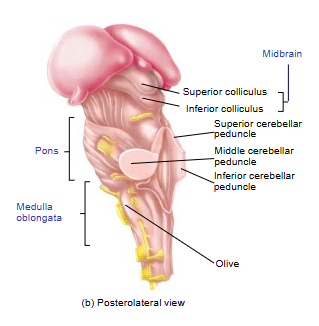
Superior colliculi function
Visual reflex center; involved in visual movements

the ______ _______ in the midbrain controls reflex movements involving both extrinsic muscles of the eye and intrinsic muscles of the eye
superior colliculi

Extrinsic eye muscles
Muscles that move the eyeballs around in their sockets
Intrinsic eye muscles
Smooth muscles that change things such as pupil diameter
the ______ ______ in the midbrain gather visual, auditory, and touch information to help direct where the eyes need to move
superior colliculi

Superior colliculi and auditory information
Auditory information, such as hearing a loud noise, can direct the eyes to look toward where the sound came from
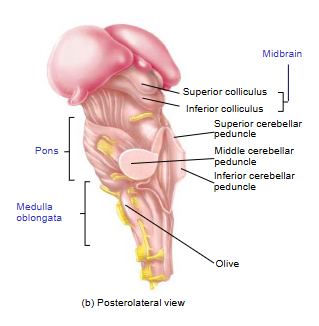
The ______ ______ is involved in tracking and scanning eye movements
superior colliculi
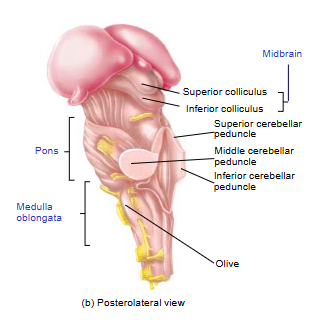
Inferior colliculi function
Auditory reflex center; involved in reflexes such as the startle reflex

Startle reflex
A loud noise can cause the body to jump and move toward the sound; some control is contained in the inferior colliculi
Inferior and superior colliculi relationship
A loud noise can send a signal to the superior colliculi to move the eyes while the inferior colliculi contributes to the body’s startle response

Cerebellar peduncles
structures that come off the brainstem toward the cerebellum
bundles of axons or white matter pathways carrying info from one area to another

Superior cerebellar peduncle
Carries axons to and from the midbrain to the cerebellum

Middle cerebellar peduncle
Carries information from the pons to the cerebellum

Inferior cerebellar peduncle
Carries nerve tracts from the medulla oblongata to the cerebellum

Cerebellar peduncles function
Connection points between the brainstem and cerebellum; white matter connections between the brainstem and cerebellum

Reticular formation
Group of nuclei scattered throughout the brainstem and connected to each other by white matter connections
the __________ _________ forms a cloud-like structure in the brainstem; often referred to as the “reticular cloud”
reticular formation
Reticular formation function
Partly controls the sleep-wake cycle
the _______ _______ maintains consciousness or brings a person into awakening from a sleep phase
reticular formation
the _________ _______ should be activated when a person is awake, such as while listening to a lecture
reticular formation
the ______ ______ is activated when waking up in the morning from a sleeping phase
reticular formation
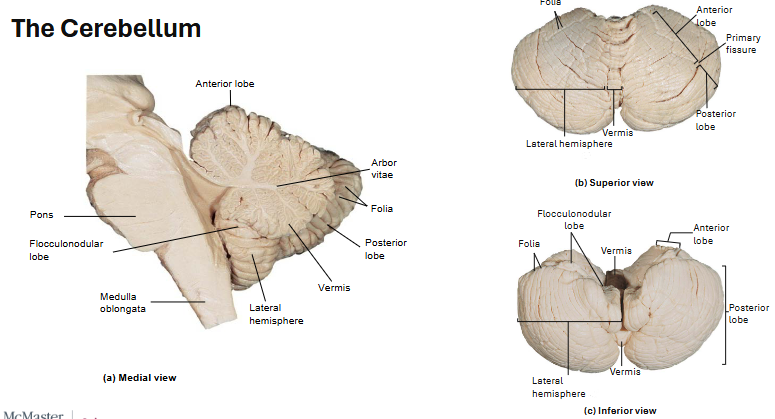
Cerebellum
Second largest part of the brain
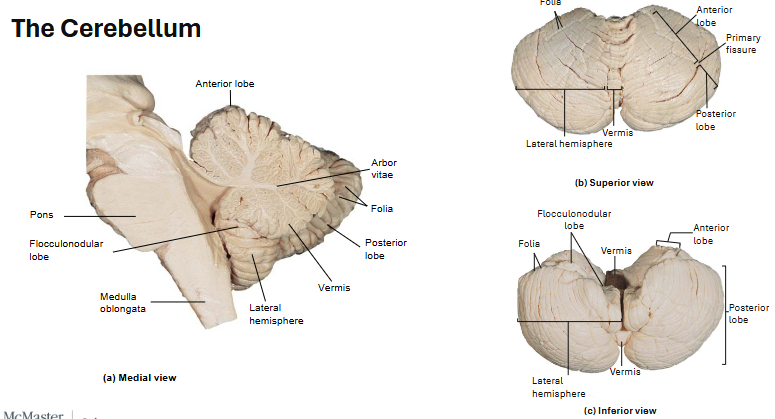
Cerebellum location
Attached to the brainstem on the posterior side

Cerebellum and brainstem attachment
Cerebellum attaches to the brainstem through the cerebellar peduncles

Cerebellar peduncles
nerve tracts connecting the brainstem and cerebellum
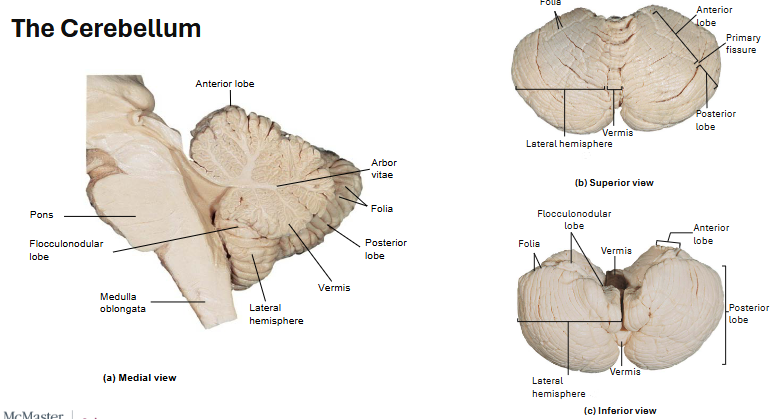
Cerebellar peduncles connections span to the
entire brain stem (midbrain, pons, and medulla oblongata)

Fourth ventricle is a space b/w the ___ and ________
pons and cerebellum

Arbor vitae
White matter regions inside the cerebellum; named because they resemble the trunk and branches of a tree
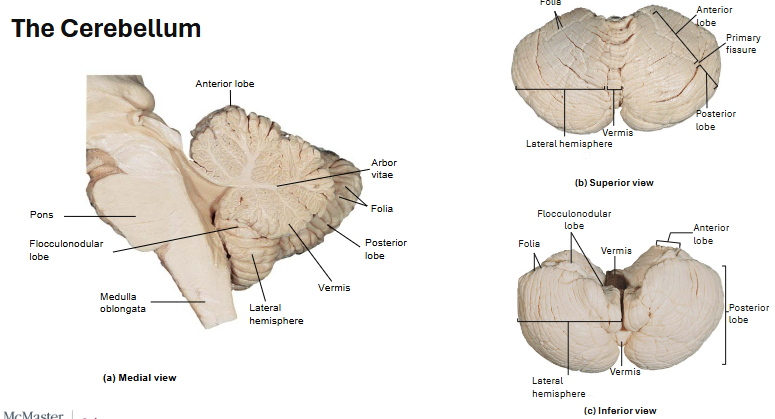
Arbor vitae composition
White matter made of myelinated axons

Arbor vitae function
gathers information from gray matter regions and brings it toward the brainstem via the cerebellar peduncles

Cerebellar cortex
Gray matter region surrounding the arbor vitae

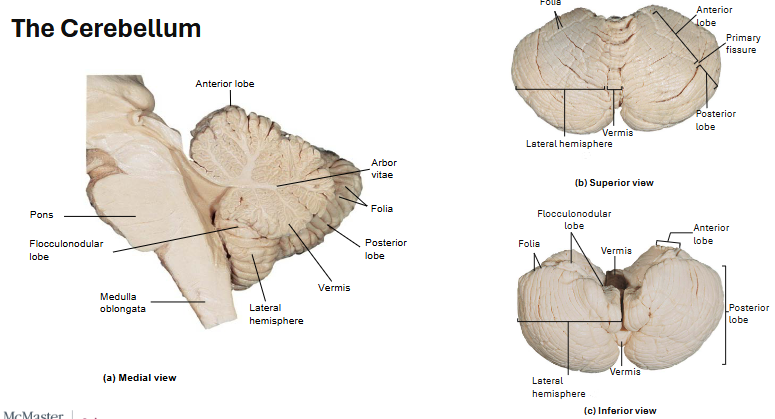
Folia
Folds in the gray matter cortex of the cerebellum

Cerebellar folia appearance
Surface folds that look like ridges or grooves; on superior and inferior views they appear as long groups or folds
Cerebellar neurons
Cerebellum contains many neurons
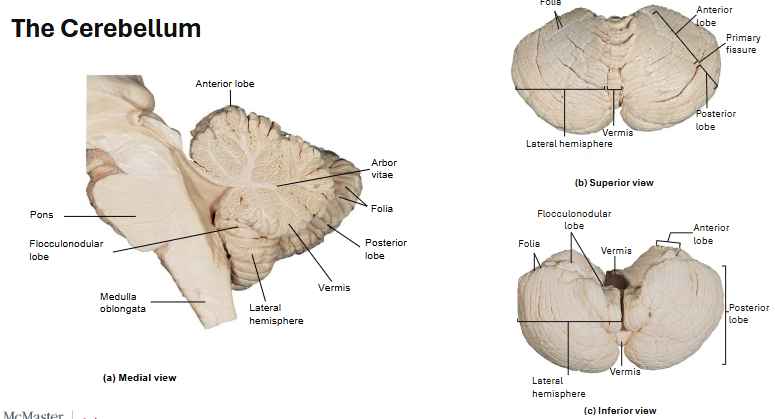
Cerebellar hemispheres
Two hemispheres of the cerebellum; also called lateral hemispheres or cerebellar hemispheres