Exam 3 Cognitive Neuroscience

0.0(0)
Studied by 0 people
call kaiCall Kai
learnLearn
examPractice Test
spaced repetitionSpaced Repetition
heart puzzleMatch
flashcardsFlashcards
GameKnowt Play
Card Sorting

1/110

encourage image

There's no tags or description

Looks like no tags are added yet.

111 Terms

1
New cards

Attention

process by which mind chooses from among various stimuli that strike the senses at any given moment

2
New cards

Balint’s Syndrome

  • lesion of occipitoparietal lobe

  • patients can only perceive one object at a time (simultanagnosia)

    • also exhibits optic ataxia & oculomotor apraxia
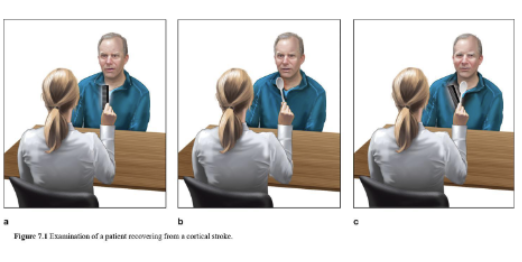

<ul><li><p>lesion of occipitoparietal lobe</p></li><li><p>patients can only perceive one object at a time (simultanagnosia)</p><ul><li><p>also exhibits optic ataxia &amp; oculomotor apraxia </p></li></ul></li></ul><p></p>
3
New cards

Selective Attention

allocation of attention among relevant inputs, thoughts, and actions while simultaneosuly ignoring irrelevant/distracting inputs

(not global brain state)

4
New cards

Top-down processing (goal-driven)

voluntary & uses personal knowledge to drive attention

(EX: looking for your friend in a crowd)

<p>voluntary &amp; uses personal knowledge to drive attention </p><p>(EX: looking for your friend in a crowd) </p>
5
New cards

Bottom-up processing (stimulus-driven)

reflexive & stimulus-driven attention (captured automatically by something noticeable)

(EX: turning towards a sudden loud noise)

<p>reflexive &amp; stimulus-driven attention (captured automatically by something noticeable) </p><p>(EX: turning towards a sudden loud noise) </p>
6
New cards

Voluntary attention (endogenous)

ability to intentionally pay attention to something in particular

(top-down/goal-driven; guided by expectations & rewards)

(EX: choosing to study your notes)

7
New cards

Reflexive attention (exogenous)

sensory event captures attention

(bottom-up, stimulus-driven; unintentional)

(EX: noticing flash of light)

8
New cards

Overt attention

orientating head towards stimulus (obvious, observable)

(EX: looking directly at someone)

9
New cards

Covert attention

attending to something without moving eyes (stealthy)

(EX: watching someone in your peripheral vision)

10
New cards

Hemispatial neglect

  • ignores stimuli on left side of space following stroke in right parietal lobe

    • reduced awareness of side opposite to lesion

    • (EX: patient may fail to eat food on left side/draw left side of image)


<ul><li><p>ignores stimuli on left side of space following stroke in right parietal lobe </p><ul><li><p>reduced awareness of side opposite to lesion </p></li><li><p>(EX: patient may fail to eat food on left side/draw left side of image) </p></li></ul></li></ul><p></p>
11
New cards

Helmholtz’s experiment (Figure 7.9)

  1. participants maintained central eye fixation while briefly illuminated letters appeared at different locations

  2. letters in attended region were perceived more accurately

Attention can shift independently of eye movement (demonstrates covert attention)


<ol><li><p>participants maintained central eye fixation while briefly illuminated letters appeared at different locations </p></li><li><p>letters in attended region were perceived more accurately </p></li></ol><p><strong>Attention can shift independently of eye movement (demonstrates covert attention) </strong></p><p></p>
12
New cards

Cocktail party (dichotic listening task)

  • different messages are presented to each ear

    • participants repeat/shadow message from one ear while ignoring the other

    • remember relatively little about unattended message

Attention limits how much incoming information receives further processing
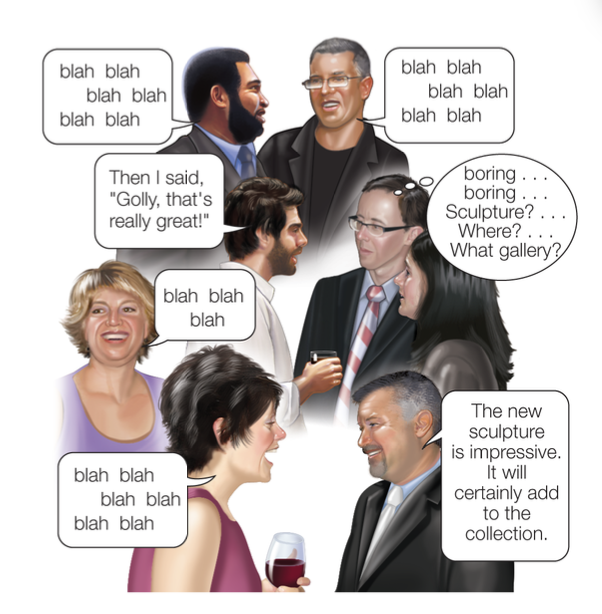

<ul><li><p>different messages are presented to each ear</p><ul><li><p>participants repeat/shadow message from one ear while ignoring the other </p></li><li><p>remember relatively little about unattended message </p></li></ul></li></ul><p><strong>Attention limits how much incoming information receives further processing </strong></p><p></p>
13
New cards

Posner spatial cuing task

participants fixate on central cross while a cue predicts where target may appear

  1. valid cue → faster response

  2. invalid cue → slower response

  3. neutral cue → intermediate response

Attention behaves like a mental spotlight as it’ll enhance processing at attended locations even without eye movements


<p>participants fixate on central cross while a cue predicts where target may appear </p><ol><li><p>valid cue → faster response </p></li><li><p>invalid cue → slower response </p></li><li><p>neutral cue → intermediate response </p></li></ol><p><strong>Attention behaves like a mental spotlight as it’ll enhance processing at attended locations even without eye movements </strong></p><p></p>
14
New cards

Broadbent’s model (early selection)

unattended information is filtered before complete perceptual/semantic processing
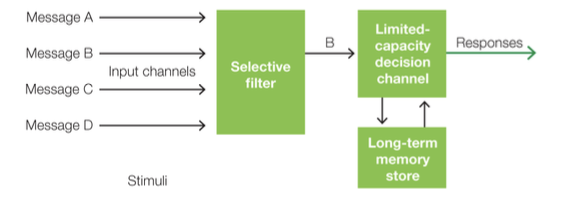
<p>unattended information is filtered before complete perceptual/semantic processing </p>
15
New cards

Late selection

stimuli undergo substantial processing before selection for awareness/response
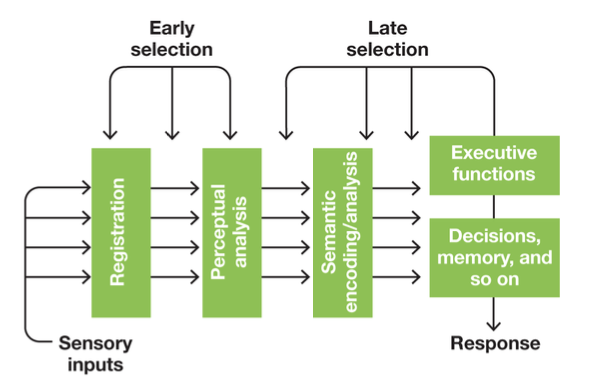
<p>stimuli undergo substantial processing before selection for awareness/response </p>
16
New cards

Treisman’s attenuation account

unattended information is weakened rather than completely blocked
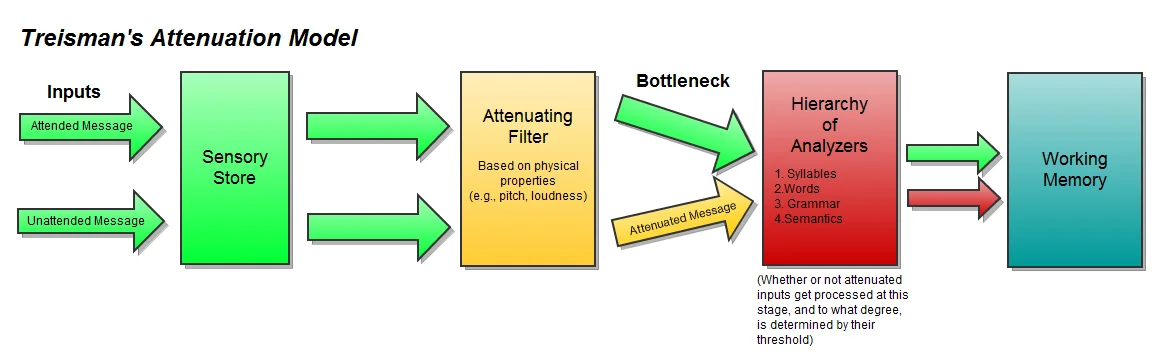
<p>unattended information is weakened rather than completely blocked </p>
17
New cards
<p>Early-selection ERP Experiment </p>

Early-selection ERP Experiment

  • participants covertly attend to one visual field

  • EEG records ERPs over visual cortex

  • attended stimuli produce larger early P1 component


<ul><li><p>participants covertly attend to one visual field </p></li><li><p>EEG records ERPs over visual cortex </p></li><li><p>attended stimuli produce larger early P1 component </p></li></ul><p></p>
18
New cards

Single neuron experiment early-selection

  • researchers record neurons in visual area V4

    • neuronal firing changes depending on which stimulus receives attention

  • Attention selectively enhances sensory representations at single-neuron level


<ul><li><p>researchers record neurons in visual area V4 </p><ul><li><p>neuronal firing changes depending on which stimulus receives attention </p></li></ul></li><li><p><strong>Attention selectively enhances sensory representations at single-neuron level </strong></p></li></ul><p></p>
19
New cards

What happens after 50-200 ms after a sudden peripheral cue?

attention facilitates processing at cued location

20
New cards

What happens after ~300 ms after a sudden peripheral cue?

An inhibitory effect develops → making responses at that location relatively slower

21
New cards

Inhibition of return (IOR)

helps prevent attention from repeatedly returning to previously inspected locations

22
New cards

Tresiman’s feature integration theory

attention binds separate visual features (EX: color & shape) into a single perceived object

23
New cards

Pop-out searches

a distinctive feature is detected quickly (reaction time is relatively independent of set size)

24
New cards

Conjunction search

target requires combining features (reaction time increases with more distractors)

25
New cards

Connection to Helmholtz

spatial attention acts like a spotlight (help binds features at the selected location)

<p>spatial attention acts like a spotlight (help binds features at the selected location) </p>
26
New cards

Dorsal network

supports voluntary goal-directed selection

<p>supports voluntary goal-directed selection </p>
27
New cards

Ventral network

network that responds to novel/salient stimuli & helps redirect attention

<p>network that responds to novel/salient stimuli &amp; helps redirect attention </p>
28
New cards

Object attention

attention can act on higher-order stimulus representations

29
New cards
30
New cards
31
New cards
32
New cards
33
New cards
34
New cards
35
New cards
36
New cards
37
New cards
38
New cards
39
New cards
40
New cards
41
New cards
42
New cards
43
New cards
44
New cards
45
New cards
46
New cards
47
New cards
48
New cards
49
New cards
50
New cards
51
New cards
52
New cards
53
New cards
54
New cards
55
New cards
56
New cards
57
New cards
58
New cards
59
New cards
60
New cards
61
New cards
62
New cards
63
New cards
64
New cards
65
New cards
66
New cards
67
New cards
68
New cards
69
New cards
70
New cards
71
New cards
72
New cards
73
New cards
74
New cards
75
New cards
76
New cards
77
New cards
78
New cards
79
New cards
80
New cards
81
New cards
82
New cards
83
New cards
84
New cards
85
New cards
86
New cards
87
New cards
88
New cards
89
New cards
90
New cards
91
New cards
92
New cards
93
New cards
94
New cards
95
New cards
96
New cards
97
New cards
98
New cards
99
New cards
100
New cards



