Business
 Call Kai
 Learn
Learn Practice Test
 Spaced Repetition
 Match
Match Flashcards
 Knowt Play
1/53

There's no tags or description
Looks like no tags are added yet.
Name | Mastery | Learn | Test | Matching | Spaced | Call with Kai | Chat |
|---|
No analytics yet
Send a link to your students to track their progress
54 Terms
What’s a Mass and Niche Market?
Mass Market- Largest part of market, where there are many similar products offered by competitors.
Niche Market- Smaller Segment of larger market, customers have specific needs and wants
Features of Mass and Niche Market.
Mass Market- Customers needs and wants more general/ less specific, Associated with higher production output, more potential for economies for scale
Niche Market- More Exclusive, less customers and usually more expensive
What’s Market size?
Indicates the potential sales for a firm, measured in terms of both volume (units) and value (sales).
Describe market growth.
Key indicator for existing + potential market entrants, growth rate can be calculated using Value or Volume.
Describe Market Share.
-Explains how overall market is split up between competitors
-Calculated based on market value and volume
What’s product and market orientation?
Product orientation- Business develops product based on what it is good at doing
Market orientation- Business responds to customer needs and wants and designs products according
What’s primary and secondary research with examples?
Primary Research- data collected first-hand for a specific research e.g. Online +postal survey’s, focus groups experiments
Secondary research- Data that already exists + which has been collected for different purpose e.g. Google, government reports, trade associations
Primary + Secondary research Pros.
Primary- Directly focused to research objectives, kept private, more detailed insight
Secondary- free +easy to obtain, good source of market insight, Quick to access and use
Primary and secondary research Cons.
Primary- Time consuming, risk of survey bias, sampling may not be representative
Secondary- became outdated, not tailored to business needs, specialist reports can be expensive
Quantitative + Qualitive research.
Quantitative- Concerned with data and larger sampling e.g. Surveys, Questionnaires
Qualitative- Based on opinions, attitudes and beliefs, explains why e.g. Focus groups, interviews
Quantitative + Qualitative Pros.
Quantitative- Data relatively easy to analysis, allows numerical data-see trends, data can be compared
Qualitative - Essential for new product development, understand customer needs + wants, highlight issues that need addressing
Quantitative + Qualitative Cons.
Quantitative- Focus on data rather than why things happen, no explanation for trends, lack reliability if sample isn’t big enough
Qualitative- Expensive to collect + analyse, based around opinions - may not be representative
What’s sampling in market?
Sampling is the gathering of data from a sample of respondents, should be representative of population as whole.
Sampling pros and cons.
Pros- provide useful research insight, reduce risk + cost of marketing decision, it’s flexible and reliable
Cons- Big risk if sample is unrepresentative meaning incorrect data, risk of bias in research questions, less useful in market segment where customer tastes change
What is a Target Market?
Target Market- specific segment of customers sharing common needs, wants, and characteristics that a business chooses to focus its marketing efforts and products on.
What’s market positioning?
-Perceptions a consumer has about a product to help simplify choice
-Firms will plan marketing activities to shape consumer perceptions therefore
What’s market mapping?
Using consumer perceptions to map all products in the market, maybe accreted through market research.
Market mapping pros and cons.
Pros- Helps spot gaps in market, useful for analysing competitors, encourages use of market research
Cons- Just because there is ‘gap’ doesn’t mean there is demand, not a guarantee success, how reliable is market research?
What is a competitive advantage?
A set of unique features of a company and it’s products that are perceived by customers as significant + superiors to competitors.
Ways to get a competitive advantage.
-Product design
-Product quality
-Promotion
-Customer Service
-Flexibility
Give some positioning strategies.
-Offer more for less
-Offer more for more
-Offer more for the same
-Offer less for less
Give some effective product differentiation.
-Deliver things that are important to customers on time
-Not easily copied by competitors
-Be distinctive
-Communicated + visible to customers
Give the 5 types of goods.
-Necessities
-Complementary
-Luxury
-Substitute
-Habit forming
Influences on demand.
-Price, Incomes, Fashion/taste
-Adverting/marketing, Competitors, social + demographic
-Seasonal, Government action, external shocks
How is demand measured?
Volume (how many things sold) + Value (sales value)
Fully draw + label a demand graph.

Describe Supply.
-Supply refers to the amount that producers are willing to provide at a given price
-Supply is determined by price
Give some factors that change supply.
-Cost of production
-Introduction of new technology
indirect taxes such as VAT
-Government subsides
External shocks
Fully draw + label a supply graph.

Fully draw + label a supply and demand graph.

What’s equilibrium.
-Equilibrium means a state of equality or balance between market demand + market supply
Draw what happens when demand + supply Increases/decreases.

What is Price elasticity of demand?
-Measures the extent to which the quantity of a product demanded is effected by a change is price.
What does elastic and inelastic mean?
Elastic- demand changes a lot >1
Inelastic- demand change isn’t a lot <1
Give formula for price elasticity of demand.

Give a defintion for Marketing
-Identification + Satisfaction of the customers needs and wants
Draw the layer of a product
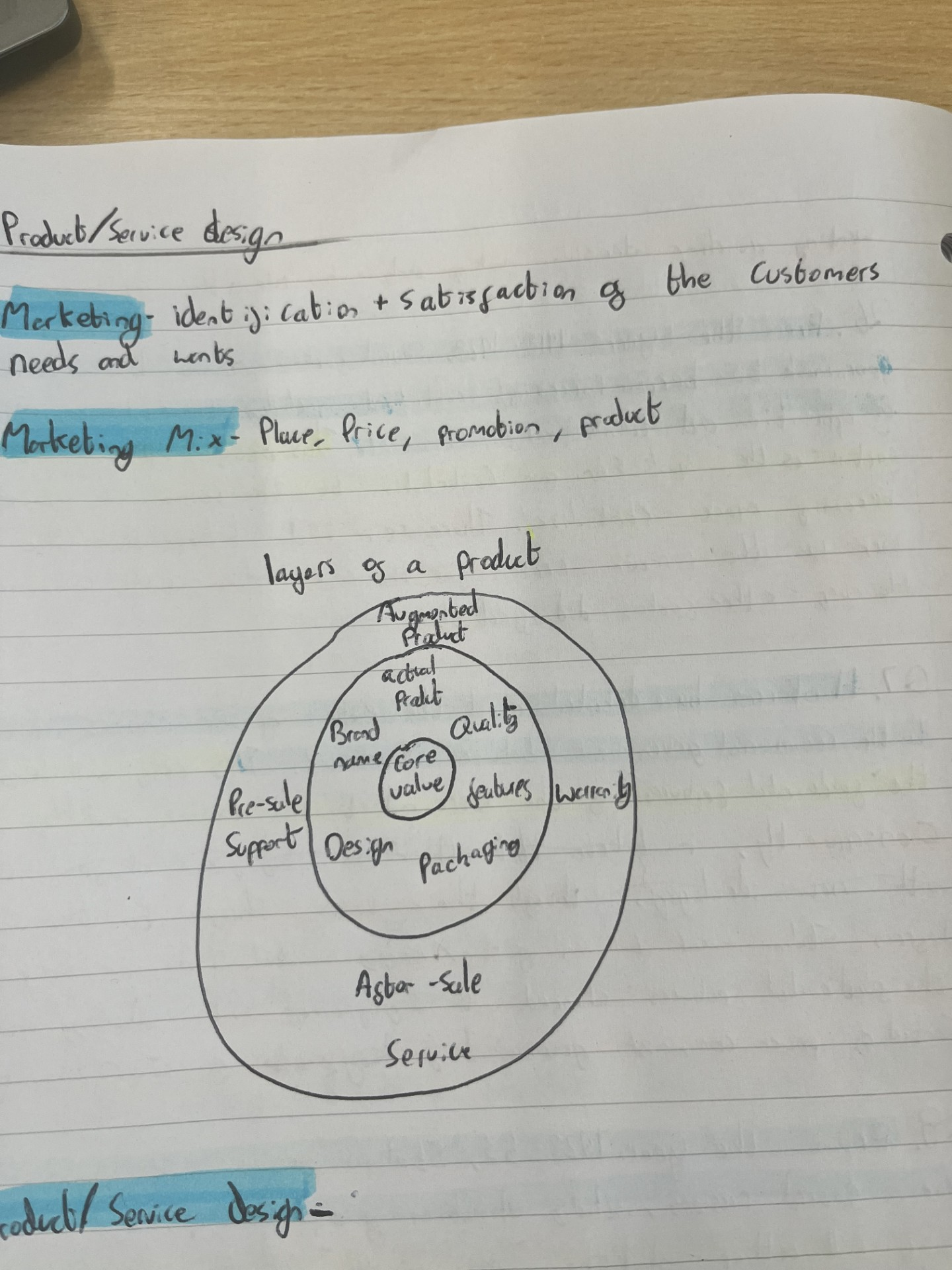
Give considerations for design
-Shape + appearance
-Fits intended use
-Ease + cost effectiveness of production
-Dimensions + preferred materials
-Image when displayed
-Should design create a “corporate identity”
Draw design Mix

Design Mix function
-Fit for purpose
-Convenient + easy for the customer to use
-Safe
Describe Aesthetics.
-A Product or service should provide a sensory stimulation in addition to performing a function
What does Aesthetics include?
-Size
-Appearance
-Shape
-Smell
-Taste
What’s the YED calculation?

What does it mean if answer + or -?
-If answer +, it’s a normal good - Income increase, demand increase
-If answer -, it’s a inferior good - Income increase, demand decrease
What if Answer is less or greater than 1?
-If answer greater than 1, product elastic
-If answer less than 1, product inelastic
Draw the YED Line.

What is above and below the line promotion?
Above the line- Advertising in media, business pay television companies or newspaper’s
Below the line- Any form of promotion which does not involve advertising
What’s three types of advertising?
-Informative advertising
-Persuasive advertising
-Reassuring advertising
Describe three types of advertising
-Informative advertising- Using factual data, features and clear explanation to educate consumers about there product iPhone
-Persuasive advertising-Aims to convince consumers to choose a specific brand by appealing to emotion, desires or beliefs
-Reassuring advertising- To validate past purchases, ease buyer’s remorse and confirm consumer made right choice
Give examples of below the line advertising.
-Sales promotion - Free gifts, coupons
-Public relations- Press releases, Press conference
-merchandising + Packaging- Product layout, display material
-Direct mailing or direct selling
What are aims of promotion?
-Inform customers about a products existence
-Used to persuade customers products better than competitors
What’s branding?
-Aim of many business is to build powerful branding
-Involves names, sign, symbol’s or logo/design
Give types of branding.
-Global branding
-Umbrella branding
-Product branding
-Service branding
-Corporate + own-label brands
Benefits of strong branding.
-Added value
-Competitor’s advantage
-Develop the company reputation
-Reduce PED