ap art history: lap 2 (greece, etruscans, rome)
 Call Kai
 Learn
 Practice Test
 Spaced Repetition
 Match
 Flashcards
 Knowt Play
1/118

There's no tags or description
Looks like no tags are added yet.
119 Terms
If Mesopotamian art was about worship, Egytians the afterlife, what was Greek art about?
humanism - human beings at the center of all art
How would you describe Athens and Sparta and other independent polises c. 900 BCE?
- no centralized gov but individual political and lifestyle systems in each polis
- modern Greek writing develops
- colonized all over Mediterranean
- mythology and Greek polytheistic religion (they don't get along with their gods)
^^ they represented the perfect human body but not personality
- Olympics!
What was the Geometric Period?
- 1000-700 BCE
- founding of independent polises
What was the Archaic Period?
- 700-480 BCE
- Persian Wars (ending in 480 BCE)
- city states evolved into independent competing political entities united in culture and disdain for outsiders
- Athens destroyed at end of Persian Wars, so they rebuild the polis bigger and better than before --> clean slate for Classical Period
an Archaic Greek sculpture of a male youth
kouros
Anavysos Kouros identifications
Artist: n/a
Date: c. 530 BCE
Materials: marble with remnants of paint
Culture/Time Period: Archaic Greece
Location: Greece

What was the function of the Anavysos Kouros?
grave marker for Kroisos - commissioned by family, honored this man's passing in battle/war; not meant to look like Kroisos
Visual analysis of Anavyos Kouros
- archaic smile: pretty bland in emotion
- pie crust hair
- life-size
- rigid and motionless, always standing
- in the round and freestanding
- 1 foot forward like Egyptians
- meant to be timeless
How does the Anavyos Kouros compare to Egyptian sculpture?
- both frontal, rigid, motionless, symmetrical
- 1 foot in front of other
- idealized but not individualized appearance
- clenched fist
- Greek sculpture obviously had no pharaoh dress
- Greeks used negative space in their sculpture: fully separate the original stone from the sculpture
an Archaic Greek sculpture of a female youth
kore
Peplos Kore from the Acropolis identifications
Artist: n/a
Date: c. 530 BCE
Materials: marble, painted details
Culture/Time Period: Archaic Greece
Location: Greece

a garment worn by women in ancient Greece, usually full length and tied at the waist
peplos
What was the function of the Peplos Kore from the Acropolis?
- votive figure giving offering to Athena (acropolis was dedicated to her)
- could've been an offering itself
- maybe represented a goddess
Visual analysis of Peplos Kore from the Acropolis
- pie crust hair
- fully clothed
- holes in her head --> something was originally there
- clenched fist
- negative space
- freestanding and in the round
- missing an arm but must have been holding something
- cylindrical figure
How were these sculptures painted?
encaustic technique
- a type of painting in which color is added to hot wax to affix to the surface
What was the Classical Period?
- 480-323 BCE
- Peloponnesian Wars (in 430s BCE)
- age of theater, philosophy, science/math, democracy, and the arts
- begins w/ end of Perisan Wars
- Athens rebuilt - Age of Pericles shows peak of Classical Greek art, esp. on acropolis of Athens
- internal struggles between Greek city-states resume in form of civil war (Pelop. War)
- Athens defeated by Sparta and left Greece divided, and open to invasion
What are Classical Period stylistic conventions?
- worked in marble and in cast bronze (Romans copied Greek originals in marble that were intially bronze)
- artists have new distinguished status in Greece - many were also mathematicians, theoreticians, etc.
- artists begin signing off on work
- highly idealized anatomy and bodily forms YET natural and realistic
- contrapposto pose
- no more archaic smile or symmetry
- no longer strictly frontal
graceful arrangement of the body based on titled shoulders and hips and bent knees; "S curve" pose
contrapposto
During the Classical Greek period, artists often also made mural paintings and vase painting. Describe them:
- mural paintings were lifelike
- lots of vase paintings have survived from Archaic and Classical periods
- told stories about gods, heroes, myths, and showed scenes of daily life (war, love, fam, drinking)
What are the 2 types of Classical Greek vases?
Amphora = used for storage, had 2 handles at top
Krater = a large ancient Greek bowl used for diluting wine with water, 2 handles at bottom
also had black and red figure vase painting!
Niobides Krater identifications
Artist: anonymous vase painter of Classical Greece known as the Niobid Painter
Date: 460-450 BCE
Materials: clay, red figure technique
Culture/Time Period: Classical Greece
Location: Greece
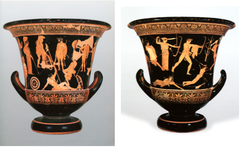
What does the front of the Niobides Krater show?
Apollo and Artemis killing children of Niobe for her hubris (saying she had more kids than the gods)
What does the back of the Niobides Krater show?
Heracles and his soldiers speaking to him before battle
How did the Niobides Krater attempt to create depth? Is it naturalism or idealized?
- tried to make depth by creating figures on different planes
- also tried to replicate the naturalism of the Kritios Boy
- potentially a recreation of a wall painting, but since we have no wall paintings left, it's hard to say with any proof
Doryphoros (Spear Bearer) identifications
Artist: Polykleitos
Date: 450-440 BCE
Materials: Roman copy (marble) of a Greek original (bronze)
Culture/Time Period: Classical Greece
Location: Greece

Visual analysis of Doryphoros
- contrapposto
- counterbalance and asymmetry - there's a contrast in balance between tension in the arm and relaxation in the leg (and vice versa)
- not a portrait
- combination of best features of multiple athletes
- perfection of Classical Greek male nude
- found in Pompeii where athletes would train!
body of rules or laws; in Greek art, it's the ideal mathematical proportion of a figure
canon
What was the canon of Polykleitos?
- he was a mathematician
- wrote famous treatise on human proportions
- set math rules for human sculpture
- head = 1/7 of body
- similar to Egyptian grid
What is the LATE Classical style?
- NEW canon of proportions - NOT by Polykleitos
- 1:8 head to body ratio
- ideal anatomy (perfection)
- realistic: S-curve of body/contrapposto
- nude
- calm expression
- new standard of adult-child interaction

What are the traits of Greek architecture?
- post and lintel temple structure - meant to be earthly homes for the gods
- limited access to deities just like Mesopotamians and Egyptians liked (think of bent axis)
- interior spaces of temple (cella) were not for the masses; people could congregate around the temple, but only a select few were allowed in
- huge statues inside with foreboding presence
- exteriors heavily decorated with painted sculpture
- architecture devloped over time from archaic --> classical, striving for harmony, balance, proportion, symmetry, and order
- ex of architecture: temples and civic, market, and religious structures in agora and theaters
What are the 3 orders of Greek columns? Why was one in particular chosen for the Parthenon?
Doric
Ionic
Corinthian
Doric chosen for Parthenon b/c the Greeks didn't want to add any extra decor that would take away from Athena depictions and celebrations of life

Athenian Agora identifications
Artist: n/a
Date: c. 600 BCE - 150 BCE
Materials: --
Culture/Time Period: Archaic --> Hellenstic Greece
Location: Athens, Greece

lower level marketplace of a Greek city-state; where commercial, social, and civic activities were conducted
- things like voting, gov participation, basically anything except religious rituals (happened on acropolis)
- CULTURAL and edu center
agora
a ceremonial road for a procession to honor Athena during a festival; @ base of acropolis
Panathenaic Way

covered walkway with columns on 1 side and a wall on the other
stoa

Acropolis identifications
Artist: Ilkinos and Kallikrates
Date: c. 447-410 BCE
Materials: marble
Culture/Time Period: Classical Greece
Location: Athens, Greece

(Acropolis continued): What is the Parthenon @ the Acropolis?
- rectangular marble temple dedicated to Athena, maybe also a treasury (w/ statue holding all its wealth)
- located on the Acropolis
- designed by Ilkinos and Kallikrates, the 1st of which created the canons of proportion for archictecture
- construction overseen by Phidias
- huge golden, bejeweled interior statue of Athena that is now gone; depicted her as a warrior w/ weapon and shield in hand
- sculpture in pediment: Elgin Marbles, birth of Athena
- relief narrative on frieze (525 ft long along top of walls)
- built during Golden Age of Pericles using the $$ Pericles took from the Persian War treasury of the Delian League...
- considered PERFECTION of balance btwn height, length, and width - used optical illusions to make it look perfect
- og brightly painted
- everything was specially made handmade for this by artisans

Why was the Parthenon built in the first place?
to honor Athenian victory over Persia with help of Athena; sign of power, money, and cultural/artistic advancement
triangular top of a temple that contains sculpture
pediment

a horizontal band of sculpture
frieze

(Acropolis continued): What do we see on the leftside of the pediment of the Acropolis?
- depicts Helios (sun of the sun god), Horses, and Dionysus (or maybe Heracles?)
- large, life-size sculptures in the round attached to the deep shelf of the East pediment with metal pins
- painted encaustically on marble
- missing center figures probably showed the birth of Athena as a full-grown woman in a suit of armor from the head of Zeus
- aka the Elgin Marbles, located in British Museum

(Acropolis continued): What is the Plague of the Ergastines?
- bas relief of Ergastines in contrapposto pose going to the Acropolis to offer gifts of peplos clothes to Athena
- part of the Panathenaic Procession on the long inner frieze of the Parthenon
group of young women chosen to weave the new peplos for the statue of Athena on the Acropolis
Ergastine
(Acropolis continued): Be able to recognize the statue of Nike Fastening Her Sandal and the Temple of Athena-Nike and tell how it is classical.
- Nike statue is on this small temple, not the Parthenon
- statue in a very natural pose, same sort of wet drapery look
- temple has Ionic columns

female figures used as columns
caryatids

What events have caused the destruction of the Parthenon?
- earthquake after construction
- 1687 Venetian explosion during Venetian/Turkish conflict
- construction of church inside during Byz. Empire
- conversion to mosque under Ottomans
- Victorian period tourism
- 1801-1812 looting and desecration by Lord Elgin
- 1890 faulty reconstruction
- pollution now
Grave Stele of Hegeso identifications
Artist: attributed to Kallimachos
Date: c. 410 BCE
Materials: marble and paint
Culture/Time Period: Classical Greece
Location: Greece

What was the function of the Grave Stele of Hegeso?
part of tradition of marking graves that dates back to Geometric Period
Visual analysis of Grave Stele of Hegeso
- veil over Hegeso's head
- opening a jewelry box seemingly
- shallow relief for the width of the body
- shows genre: a scene of everyday life
- 2 women shown: not citizens, no rights, no role outside of the home
- inscription on it defines Hegeso in relation to her father --> patriarchal society's identity for her
What was the Hellenstic Period?
- 323-30 BCE
- Alexander the Great's Empire
How does the Hellenstic diverge from the Classical Period?
- post-classical change in subject matter and style
- no longer about the 1 perfect, ideal figure in prime of life
- broader age range and body type differences
- shows darker side of life - extreme realism, "warts and all" rather than idealized perfection
- more drama, action, motion, and emotion: suffering, playfulness, flirtation, anguish, etc.
- no longer about control and balance - sometimes wild, chaotic, emotional, and theatrical sculpture
- start to see female nude
How does Hellenistic art contextually fit into the history of Greece?
- the country has been conquered multiple times by this point
- no longer see the world as perfect
- art shows them coming to grips with an imperfect world
What purpose did Greek sculpture serve? What was it like?
- civic and religious function: meant to please their gods but also in public spaces for everyone to worship
- humans at center of sculpture
- unafraid of male nudity - glorified in the perfection of the human body
- worked with marble and bronze, wood and terra cotta occasionally too
- SUBTRACTIVE sculpture - would cut away from a stone behind a figure
- marble ALWAYS painted originally
- evolved over time -- movement towards fluidity in pose, ideal/balanced/harmonious art
Winged Victory of Samothrace identifications
Artist: n/a
Date: c. 190 BCE
Materials: marble
Culture/Time Period: Hellenistic Greece
Location: Greece

Visual and contextual analysis of Winged Victory of Samothrace
- over life-size, very dramatic
- wind-blown and wet drapery shown
- originally in a fountain but resembles smth that would be at the front of a ship
- meant to be seen from all POVs (in the round)
- beyond contrapposto - she's lunging forward into our field of view
Great Altar of Zeus and Athena at Pergamon identifications
Artist: n/a
Date: c. 175 BCE
Materials: marble
Culture/Time Period: Hellenstic Greece
Location: Asia Minor, present day Turkey

What was the function of the Great Altar of Zeus and Athena at Pergamon?
- celebration of victories, both real and mythological
- Pergamon victory over Gauls, Alex the Great over Persians, gods defeat of the giants
- housed a fire to Zeus inside that was designated for sacrifices
- meant to create dialogue w/ Panathenaic frieze on the Parthenon
(Great Altar of Zeus and Athena continued): What narrative of Athena does the frieze tell?
- wraps all the way around the monument and depicts a gigantomachy
- powerful Athena vs. powerless giants - she's seen pulling the hair of the barbaric giant, debasing and humiliating him
- high relief!!
- exaggerated musculature on the giant that negatively exceeds the bounds of an ideal body
- shows lots of drama and chaos, diagonal body positioning

a mythical ancient Greek war between the giants and the Olympian gods over control of the Earth
gigantomachy
How does the high relief frieze depiction of Athena and the giants reflect the historical context of its creation?
- analogy to Alexander the Great conquering the Persians, the ultimate enemy of the Greeks
- also civil war during Peloponnesian Wars
- very different from stable unity of the Classical Period
Seated Boxer identifications
Artist: n/a
Date: c. 100 BCE
Materials: bronze
Culture/Time Period: Hellenistic Greece
Location: Greece
Visual and contextual analysis of Seated Boxer; how is it Hellenistic?
- would be standing if classical - not an idealized image, he's slouched over in defeat
- male athlete, nude, swollen feet, broken nose
- Greek style hair
- looking away from us, potentially at the guy who just beat him
- copper used on lips - makes them look like they're bleeding
- face is scarred - he is not a new fighter
- was found in a Roman bath - potentially a talisman/patron, and some of his toes are shiny and disappearing b/c people were thought to rub them before a match for good luck
Who are the Etruscans: where did they live, what people did they come from, how are they related to the Greeks and Romans?
- made up of a common culture and language associated with a federation of city-states
- people of mysterious origins - might be from Egypt or East Asia, might be displaced Trojans
- settled on Italian Peninsula by 900 BCE
- not much writing left behind by them
- took inspo from Greeks and Romans (religion) but also inspired the Romans themselves (togas, gladiators, etc.)
- had kings (that were eventually overthrown by the Romans and moved them into Republic Era)
How were the Etruscans master builders?
- hilltop and plateau construction: tufa (soft volcanic rock that hardens in presence of air) was used as underground method of construction
- little remains of their architecture b/c of time or being buried under present day cities
- no temples exist, but written sources by Roman arch. Vitruvius describe them - used Greek temple front
- 1000s of sophisticated tombs and necropoli have survived to tell of Etruscan life and art
^ would put personal belongings, art, and body into sarcophogus
Sarcophagus of the Spouses identifactions
Artist: n/a
Date: 520 BCE
Materials: painted terra cotta
Culture/Time Period: Etruscan
Location: Italy

Visual analysis of Sarcophagus of the Spouses
- diverged from Greek and Roman art: not freestanding, male is clothed, not frontal, shows man hanging out with woman in a + way (new concept!)
- held the cremated ashes of the couple inside
- man and woman depicted as the same size --> level of equality between them
- woman might be holding a perfume bottle (wealth symbol) or egg/pomegranate (signs of eternal life)
- bent at the waist, which is not natural; attempt at displaying the spouses as reclining
- loving depiction: celebration of life
Temple of Minerva identifications
Artist: Master Sculptor Vulca
Date: 510-500 BCE
Materials: wood, mud brick, or tufa (Temple) and terra cotta (sculpture)
Culture/Time Period: Etruscan
Location: Italy

volcanic rock
tufa
How is the Temple of Minerva @ Veii, Italy similar and different from Greek temples?
- same post-and-lintel structure
- had a cella - sanctuary dedicated to Minerva
- HOWEVER, blank pediment and sculptures on the roofline
What was the Sculpture of Apollo with respect to the Temple of Minerva? How does it reflect Greek influences?
- made of terra cotta, Italian for "baked earth"
- would've been mounted on roofline of temple (NOT the pediment)
- has the archaic smile and eyes as well as pie crust hair
- HOWEVER, the figure is clothed and moving forward into our space
Tomb of the Triclinium identifications
Artist: n/a
Date: 480-470 BCE
Materials: tufa and fresco
Culture/Time Period: Etruscan
Location: Tarquinia, Italy
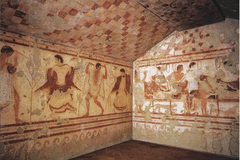
applying water-based paint that bonds with a freshly plastered wall (durable, long-lasting); used in the Cistine Chapel
fresco
dining table in ancient Rome that has a couch on 3 sides for reclining at meals
triclinium
What was the Tomb of the Triclinium? What did it illustrate on its walls?
- part of a large scale necropolis
- convivial (happy, friendly) scenes of banqueting and dancing --> conveys the + nature of Etruscan funeral rites as the deceased transitions to the afterlife
- different from Greeks and Romans whose afterlife was dark and creepy; triclinium was a CELEBRATION of the dead person's life
- also represents the wealth and status of those buried in the tombs: you could afford a sarcophogis, servant labor, funds for a banquet, etc.
What do the colors in the frescos of the Triclinium mean?
- brown figures = men
- white ones = women
^ status symbol b/c showed she didn't have to work out in the sun
What is the context of ancient Rome: its founding, its different periods, important emperors, etc.?
- Rome founded by Romulus and Remus in 753 BCE
- last Etruscan king overthrown in 509 BCE; no monarchy for 500 years to follow
- Roman attitude: bigger is better - art and architecture were the best of the best and were built as propaganda
- different periods: Roman Republic & Roman Empire
Roman Republic (509 BCE - 27 BCE) vs. Roman Empire (27 BCE - 476 CE)
REPUBLIC:
- period of political power sharing between plebeians and patricians; no king
- had 2 consuls, an assembly, and a Senate
- stressed civic responsibility and pride of citizenship
- professional, disciplined military (legions)
- conquered Italian Peninsula
- conquered Carthage in Punic Wars
- devolved into civil war and rise of Julius Caesar, marking the end of the Republic
- offered citizenship to people but would destroy them if they did not agree to become apart of the empire
EMPIRE:
- Augustus Caesar defeat Marc Antony and Cleopatra to become the 1st emperor
- conquered the entire Mediterranean area, spread Roman ideas, and erected symbols of Roman power all over the Empire
- encouraged the exchange of cultural and artistic ideas amongst all people of the Empire
- Pax Romana (27 BCE - 180 CE): ended w/ Emperor Marcus Aurelius
- Emperor Diocletian split the empire in 286 BCE
- Emperor Constantine tolerated Christianity w/ Edict of Milan but also moved capital to Constantinople --> no emperor in Rome leaves the empire vulnerable
- eventually overun by barbarian tribes in the 400s while the Byzantine Empire in the East continues to thrive for another 1000 years
What did the Romans borrow from the Etruscans?
- gladiator spectacles
- alphabet
- religious ideas
- toga
- hydraulic engineering: dams, irrigation canals, drainage, sewer systems - all very important in supplying the many diff parts of the Empire w/ water
- temple form
What did the Romans borrow from the Greeks and the Egyptians?
- alphabet
- religious ideas
- literature
- drama
- philosophy
- sculpture replication
- temple front w/ pediment
- post-and-lintel: columns of the Corinthian order specifically
- obelisks from the Egyptians
What are some uniquely Roman innovations?
** empire was size of the US at its peak
- roads - 50,000 miles worth of them which encouraged trade and cultural diffusion
- aqueducts: carried 22,000 gal of water into cities from melted snow of mountains over 60 mi away
- triumphal arches
- potrait busts
- wall paintings
- monumental interior spaces using arches, domes, and concrete
^ adopted Greek architecture cosmetically, but they wanted to build UP and OUT --> domes allowed them to do that b/c weight redistribution AND concrete is pourable and could be easily molded
Alexander Mosaic from the House of Faun, Pompeii identifications
Artist: n/a
Date: c. 100 BCE
Materials: mosaic
Culture/Time Period: Republican Rome
Location: Pompeii, Italy

Visual analysis of the Alexander Mosaic from the House of Faun
- depicts the Battle of Issus, 333 BCE, where Alexander the Great defeats Persian leader Darius III
- made of 1.5 million pieces of tesserae; went on the floor!
- illustrates Alexander as a calm, cool, and collected leader who is certain in his victory - all the qualities a ruler wants
- b/c Alex was 1/2 Greek, he was portrayed as a barbarian with the typical unruly and long hair
- scene of retreat and chaos
- Darius III looks the exact opposite of Alex - desperate, asking for forgiveness, extending his hand to his dying soldiers, ...
- can see foreshortening in Darius' horse, which has just turned around and is now receding into the space of the art; gives 3D feel
a decoration using pieces of stone, marble, or colored glass (called tesserae) that are cemented to a wall or a floor
mosaic
a visual effect in which an object is shortened and turned deeper into the picture plane to give the effect of receding in space
foreshortening
What are the 3 kinds of Roman sculpture and what are the characteristics of each one?
REPUBLICAN:
- busts of noblemen and politicians, rather than full body sculpture of the Greeks
- extreme, often unflattering, realism of facial features
- inspired by Hellenistic Greece
IMPERIAL:
- not about the virtues of the Roman Republic but instead about the divinity and heroism of the emperors
- inspired by Classical Greece
COMMEMORATIVE SCULPTURE:
- built to celebrate military victories
- triumphal arches
- hollowed out columns with banded narrative relief
- political propaganda to aggrandize Roman Empire and individual emperors
Head of a Roman Patrician identifications
Artist: n/a
Date: 75-50 BCE
Materials: marble
Culture/Time Period: Republican Roman
Location: Italy

Visual analysis of Head of Roman Patrician
- wrinkly, has bulbous nose and long earlobes, bald - not flattering depiction
- old = knowledgeable and experienced in their opinion b/c with age comes wisdom
- this bust came their tradition of making death masks in which they would put plaster on a dead person's face and replicate their features in a bust
sculpture depicting a head, neck, and upper chest of a figure
bust
sculptures from Roman Republic characterized by extreme realism of facial features
veristic
Augustus of Prima Porta identifications
Artist: n/a
Date: early 1st century CE
Materials: marble
Culture/Time Period: Imperial Roman
Location: Italy
Visual analysis of Augustus of Prima Porta
- references the Doryphoros: has perfect figure, over life size, propagandistic
- heroic, grand, authoritative
- idealized youthful body despite being 50 at the time of its commissioning
- served as a power symbol and propaganda piece rather than a portrait
- images of peace on his breastplate in reference to the Pax Romana he initiated
- also had gods on this --> showed he held favor with them
- dolphin and Cupid at his leg: Cupid is son of Venus, so that was a tie to his own divinity AND the dolphin symbolizes his naval victory over Marc and Cleo @ Battle of Actium
- seen to be addressing his troops in this sculpture
- in the contrapposto pose of Classical Greek art
- shown as strong and calm as a leader should be
- Augustus doesn't look at us b/c we are not his equals
Contextual analysis of the Augustus of Prima Porta
- Augustus was the 1st emperor after defeating Marc Antony and Cleopatra, who then killed themselves and left a power vacuum for him to fill
How does the Doryphoros compare to the Augustus of Prima Porta?
- both are idealized and show the perfect model of someone
- used canon of proportion by Polykleitos
- Augustus is fully clothed in a toga (pants were reserved for barbarians)
- Doryphoros is nude
- both are marble and in the round + freestanding
- both have short hair --> they are not barbarians
- Augustus of Prima Porta found in house of Augustus' wife
What is the context for Imperial Roman architecture?
- 27 BCE - 476 CE
- controlled the entire Mediterranean area
- conquered people across the continents and created an empire of people of many cultures and languages and religions
- people were allowed to keep their customs in the Empire so long as they worshipped the Emperor --> what lands Judaism and Christianity in trouble
- master builders who excelled at engineering
- erected 1st bldgs in history w/ huge interior spaces
- moved beyond existing architectural techniques to create solutions: domes, arch, vault, concrete!
- constructed monumental bldgs and public works all over the Empire: forums, arenas, temples, public baths, etc.
- purpose of such magnanimous bldgs: practicality and propaganda
The Colosseum/Flavian Amphitheater identifications
Artist: n/a
Date: c. 70-80 CE
Materials: stone and concrete
Culture/Time Period: Imperial Roman
Location: Rome, Italy

What was the purpose of the Colosseum?
- 16 stories tall and in the shape of an ellipse
- could seat 50,000 which made it the largest arena in existence until the Astrodome was built
- built as part of Rome's Bread and Circuses = programs of food and bloody spectacles to feed and entertain the unemployed, potentially angry masses
^ smaller versions built over the empire to achieve this goal
- built by prisoners of war during the reign of 3 emperors
- amazing feat of engineering but fell into ruin during Middle Ages and continues to be damaged by traffic and pollution
- named an arena from the Latin word "harena" = sand b/c the Col. floor was covered in about 2 ft of sand to absorb blood
Random Colosseum questions:
Why is it nicknamed the Flavian Amphitheatre?
How does it reflect Roman and Greek influences on architecture?
- nicknamed this after the colossal statue of Nero that used to be outside the arena
- reflects Greek influences in the presence of Doric, Ionic, and Corinthian columns in the Col.
- usage of arches = Roman
naval battles in the Colosseum
naumachia

retractable canvas "sunroof" the Colosseum had to block sun and rain (as well as keep the spectators happy when watching the events)
velarium

Forum of Trajan identifications
Artist: Apollodorus of Damascus
Date: 106-112 CE
Materials: brick and concrete
Culture/Time Period: Imperial Roman
Location: Rome, Italy
