ATMO Lab Midterm
 Call Kai
 Learn
Learn Practice Test
 Spaced Repetition
 Match
Match Flashcards
 Knowt Play
1/46

There's no tags or description
Looks like no tags are added yet.
Name | Mastery | Learn | Test | Matching | Spaced | Call with Kai | Chat |
|---|
No analytics yet
Send a link to your students to track their progress
47 Terms
Temperature
Measure of the average kinetic energy of the molecules
measured in Fahrenheit, Celsius, or Kelvin
Pressure
Force per unit area
measured in units of millibars (mb)
Wind
air in motion relative to earth’s surface
measured in mph kph (kilometers per hour), or knots
Humidity
associated with the amount of water vapor in the air
measured in %
Wind Barbs
meteorological symbol used to convey wind speed and direction
Remember:
shows were wind is COMING from (not where its going)
½ line= 5 knots, full line= 10 knots, triangle= 50 knots

Isopleth
A line of equal value (commonly for elevation, temperature, pressure, etc)
Rules:
lines cannot cross or branch off
lines must be drawn on a fixed interval (ex. every four mb)
lines must be smooth
lines should be drawn that all values on one side of the line are less than the value drawn and all values on the other side are greater than the value drawn.
Isobar
lines of equal pressure
drawn using sea level pressure
hint- unit of pressure is millibar and so isobars are lines of equal pressure!

Isotherm
lines of equal temperature
hint- thermal relates to heat/temperature so isotherms are lines of equal temperature!
Steps for drawing Isopleths
identify areas of equal values (start with low/high values)
connect values nearby at FIXED intervals
go to the edge of the map and label on both sides WITH units
if the line can reasonably form a circle DO IT

Radiosondes
device attached to a ballon that collects temperature, pressure, and humidity, and wind
results are plotted on a graph called a sounding
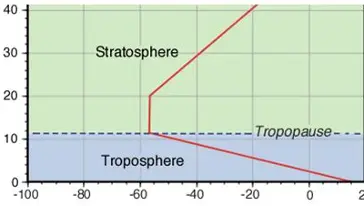
Troposphere
the lowest layer of the atmosphere where majority of the weather happens (and where we live)
temperature usually decreases with height
small inversions can occur in early morning hours
Tropopause
marks the altitude where the temperature stops decreasing with height
height is usually around 11km, but is not constant around earth
Jet stream
narrow band of fast-moving air found near the tropopause
Troposphere Depth (aka height of the tropopause)
IS NOT CONSTANT
height of the tropopause is greater at the equator and lower as you go towards the poles
higher temp= greater depth, lower temp= smaller depth

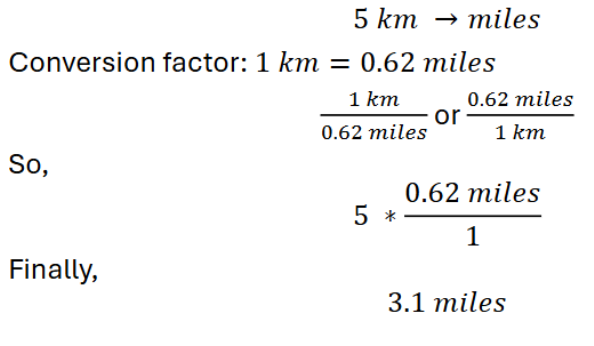
Steps for unit conversions
identify unit type
multiply conversion factor
cancel unwanted unit
solve
Vertical Pressure Changes
Pressure decreases with height in ALL layers of the atmosphere
pressure is the weight of the air above you → as height increases there is less air above you so pressure decreases
Surface pressure
the ACTUAL pressure observed at a location due to the weight of the air above it
Sea level pressure
the surface pressure corrected for altitude
needed because if not then pressure would always be low in the mountains and high at sea level
Conversion from surface pressure to sea level pressure
pressure changes 10 mb for every 100 m (10mb/100m)

Vertical changes in wind
wind speed generally increases with height (less friction)
highest winds are usually found near the tropopause (jet stream)
Lapse rate
decrease of temperature with height
Inversion
increase of temperature with height
Latitude notation
northern hemisphere is considered positive, southern hemisphere is considered negative
if the question asks for a latitude use N or S
if you are calculating use + or -
Solar Radiation
energy from the sun
the amount reaching earth’s surface changes over the year
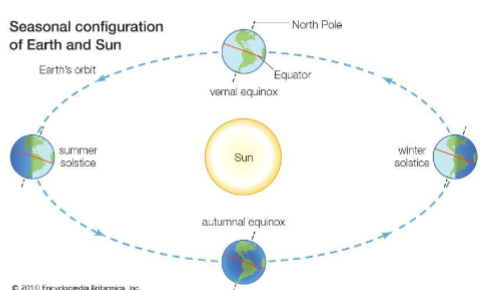
Seasons
Caused by the 23.5-degree tilt in earth’s axis
Solar angle
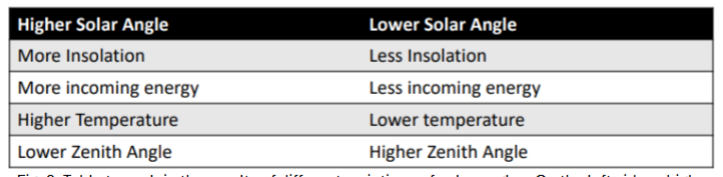
Measures the suns position in the sky from the perspective of someone on Earth
influences the amount of radiation received at any latitude on earth
when comparing solar angles at different locations it is understood that the solar angles are computed for solar noon

Summer solstice
occurs on June 21st
solar declination occurs at 23.5 degrees North

Winter Solstice
occurs on December 21st
solar declination occurs at 23.5 degrees South

Fall/Spring Equinox
Fall= occurs September 21st
Spring= occurs March 21st
solar declination occurs at 0 degrees (because the sun is directly over the equator)

Calculating the solar angle
Solar Angle= 90 degrees - (the latitude of a location) +(solar declination)

Solar declination
the latitude at which the Sun appears directly overhead at solar noon
its value will vary between +23.5 and -23.5 (never above or below)
Insolation
amount of incoming solar energy during the daylight hours at a location
largely dependent on the solar angle!
higher the solar angle the more insolation
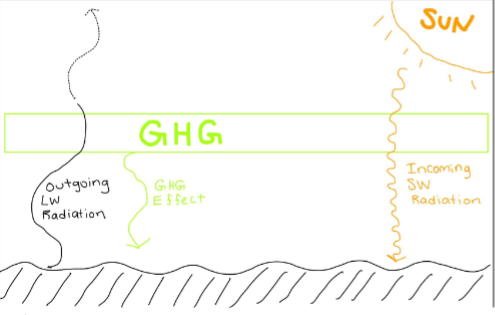
Greenhouse gas effect
greenhouse gasses absorb outgoing long-wave radiation and re-radiate the infrared energy back to earth
problem= if there are to much GHGs in the atmosphere then our planet will get too warm
Greenhouse gases (three of them)
water vapor, carbon dioxide, and methane
water vapor= most abundant
radiative equilibrium temperature
when the absorption of incoming shortwave solar radiation equals the emission of longwave radiation
Water Vapor effect on nighttime temperature
more water vapor= temperatures will remain higher vs less water vapor= temperatures will drop lower
a cloudy night will be warmer than a clear sky night
Pressure Gradient
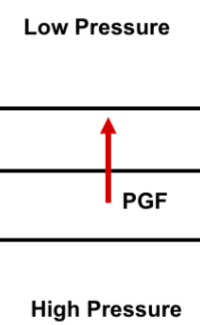
a change or difference in pressure between two locations
Pressure Gradient Force (PGF)
A force that causes air to travel from HIGH to LOW pressure
drawn perpendicular to isobars
strength is affected by the spacing of isobars (closer together= stronger PGF and stronger winds)
Coriolis Force (COR)
a force due to the rotation of earth which causes air to move to the right in the NH and the left in the SH relative to its original motion
always points to the right of the direction of motion (in NH)
faster winds= stronger force
higher latitudes= stronger force
COR changes the direction of ALREADY moving air but not the speed

Frictional force
force resisting the relative motion of the air
only present at the surface
points the opposite direction of the wind

Convergence
air flowing inward towards a point; associated with rising motion
Divergence
air flowing outward from a point; associated with sinking motion
Direction of wind above the surface
PGF and COR are balanced (equal length) and arrows point in opposite directions
wind direction is PARALLEL to the isobars
friction is ignored
if isobars are closer together → faster wind speeds

High and low pressure centers ABOVE the surface

Direction of wind at the surface
PGF stays the same
Friction IS included (opposite direction of wind)
PGF and COR are not in balance (COR is weaker than PGF)
Winds travel ACROSS the isobars towards low pressure

High pressure centers at the surface
wind is in a clockwise direction
divergence (air flowing away from high pressure center in different directions) at the surface leads to sinking air from above

Low pressure centers at the surface
winds flow in a counterclockwise direction
convergence (air flowing inward towards low pressure from different directions) leads to rising motion
**** associated with cloud formation
