Carbohydrates
 Call Kai
 Learn
Learn Practice Test
 Spaced Repetition
 Match
Match Flashcards
 Knowt Play
1/38

There's no tags or description
Looks like no tags are added yet.
Name | Mastery | Learn | Test | Matching | Spaced | Call with Kai | Chat |
|---|
No analytics yet
Send a link to your students to track their progress
39 Terms
Monomer
= The smaller units from which larger molecules are made
Polymer
= Molecules made from a large number monomers bonded together
Examples of monomers
Monosaccharides, amino acids, nucleotides
Condensation reaction
Joins two molecules together with the formation of a chemical bond and involves the elimination of a molecule of water
Hydrolysis reaction
Breaks a chemical bond between two molecules and involves the use of a water molecule
Condensation reaction diagram

Hydrolysis reaction diagram

What do carbohydrates do?
Store energy
Provide structural support to plant cells
What elements to carbohydrates contain?
Carbon
Hydrogen
Oxygen
Monosaccharides
= Monomers of larger carbohydrates
Sugars that are soluble in water
Disaccharides
= 2 monosaccharides bonded by a glycosidic bond, formed by a condensation reaction
Polysaccharide
= polymers made up of many monosaccharides through many condensation reactions
Groups of carbohydrates

Alpha glucose

Beta glucose
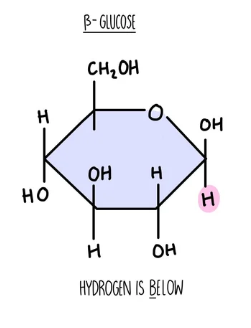
What type of bond forms between two monosaccharides during a condensation reaction?
Glycosidic
What monosaccharides are the 3 disaccharides are made up of?
glucose + glucose --> maltose + water
glucose + fructose --> sucrose + water
glucose + galactose --> lactose + water
How to write glycosidic bond
Type of glucose, between which carbons the bond is between, glycosidic bond.
E.g. α 1-4, glycosidic bond
Isomer
= compounds that have the same formula but the atoms are arranged differently
Chemical formula for glucose
C6H12O6
3 things glucose can be polymerised into
cellulose - structural support
glycogen - energy stores
starch - energy stores
About starch
found in plants
made from the excess glucose created during photosynthesis
excess glucose is converted to starch for storage
Structure of starch
polymer made up of alpha glucose joined together by condensation reactions
Chains are branched → larger surface area faster → release of glucose by hydrolysis
held in place by 1,4 glycosidic bonds and 1,6 GB at branching points
made up of two polymers: amylose and amylopectin
Amylose
all monomers joined by a 1,4 glycosidic bond so unbranched
spiral-shaped polymer, helix shape

Amylopectin
glucose monomers joined by both 1,4 and 1,6 glycosidic bonds
1,6 bonds creating branches

Diagram of branch points

Properties of starch
Insoluble so will not change the water potential of a cell and osmosis will not occur
Amylopectin is branched →large surface area for enzymes to attach to
About glycogen
carbohydrate store in animal cells
glycogen stored in liver and muscle cells
made from excess glucose taken up by the digestive system that is not used for respiration so is converted to the polymer glycogen
liver cells remove toxins, muscle cells are for movement so glycogen is stored there so there is ready access to glucose for respiration and release energy
Structure of glycogen
made up of α glucose joined by condensation reactions
held in place by 1,4 and 1,6 glycosidic bonds
more highly branched than starch

Properties of glycogen
insoluble so can be stored in cells without dissolving, won’t change water potential or cause osmosis which would cause cell lysis
highly branched → large surface area → quickly hydrolysed to release glucose
animals have high metabolic rate so need more glucose for respiration
About cellulose
provide structural strength
prevents cells bursting if they have excess water due to osmosis
Structure of cellulose
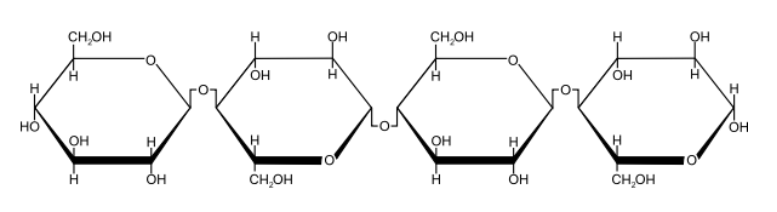
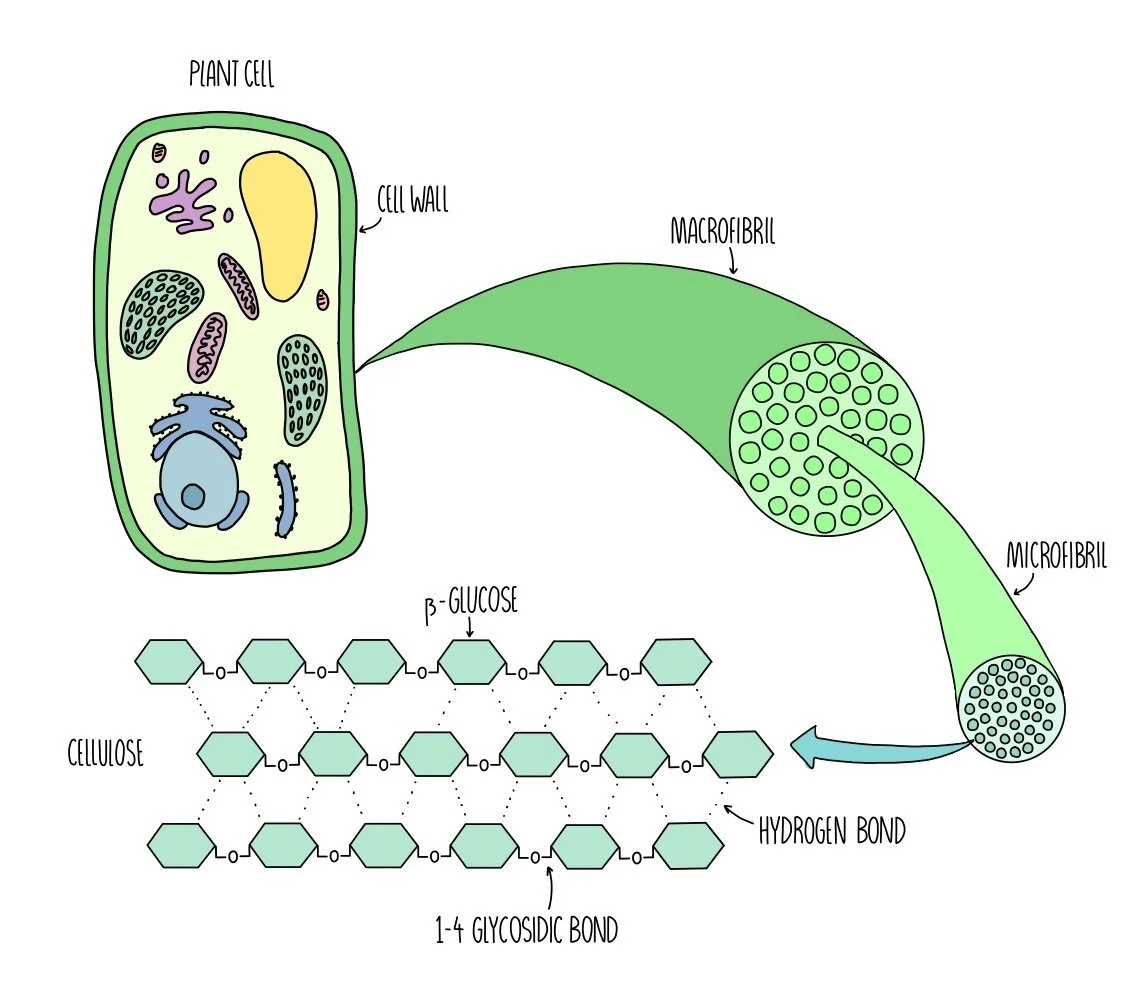
Unbranched polymer made up of beta glucose joined by 1,4 glycosidic bonds
Every other beta glucose is inverted 180° relative to the previous one to group the hydroxides (OH) so the bonds can form
Long straight chains lie parallel to each other held together by hydrogen bonds
Microfibrils
= Chains of beta glucose bonded together
Macrofibrils
= Microfibrils bonded together
Microfibrils →macrofibrils →cell wall
Properties of cellulose
Insoluble as its a large molecule → won’t change water potential or cause osmosis
Very strong due to the number of hydrogen bonds between fibrils
Cellulose is very strong to give plant cell wall strength so when turgid, contents push on cell wall, it does not burst
Test for reducing sugars
Add 1 drop each of the sample and Benedict’s reagent into the Eppendorf tube
Heat in a water bath for 2 mins
Observe colour changes
RS present if the colour changes from blue to green/orange/brown/brick red depending on concentration (green suggests a low concentration).
RS absent if there is no colour change.
Test for non-reducing sugars
Proceed if a negative result for RS
Add 1 drop each of sample and 2M HCL into Eppendorf tube
Place in a hot water bath for 2 mins (stage when acid hydrolysis may occur)
When cool, add a small amount of sodium hydrogen carbonate powder with a spatula (about ½ vol of liquid in the tube)
Add 1 drop of Benedict’s reagent, heat in hot water bath for 2 mins
Observe colour changes
NRS present if the colour changes from blue to green/orange/brown/brick red depending on concentration (green suggests a low concentration) AT THIS STAGE ONLY.
NRS absent if there is no colour change.
A negative result for reducing sugars does not necessarily mean non-reducing sugars are present