Week 6: The Antibody Response
 Call Kai
 Learn
 Practice Test
 Spaced Repetition
 Match
 Flashcards
 Knowt Play
1/14

There's no tags or description
Looks like no tags are added yet.
15 Terms
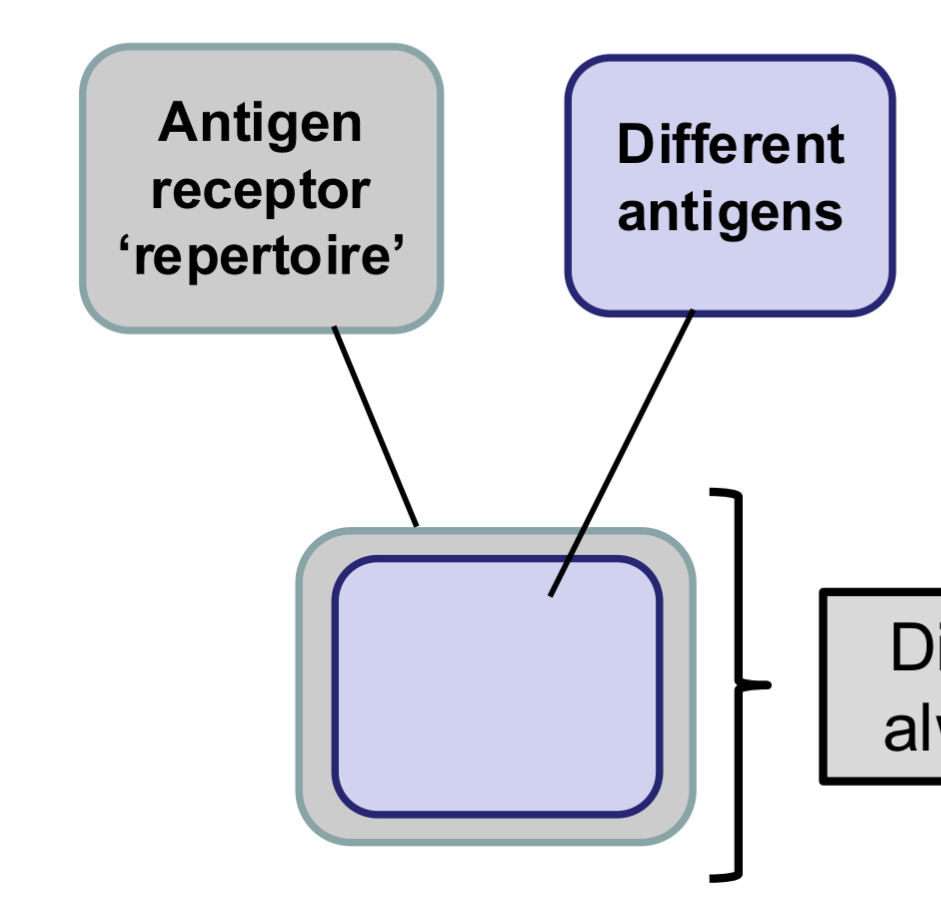
Repertoire: What is it
repertoire vs antigen diversity
The different BCR specificities in the B cell or the different TCR specificities in the T cell population
The diversity of a repertoire is always greater than the diversity of the antigens present (so they are always better prepared)
Side note: (for BCR there is about 100 million specifies)
What genes contribute to the diversity of heavy chain proteins
What is VDJ recombination
In which chromosome is the heavy chain located? Explain the gene rearrangement for this chromosome.
V (variable), D (diversity), and J (joining) genes from the immunoglobulin gene loci form the complete V (heavy chain)
However is choices of V, D, and J are random
The VDJ recombination contributes to the diversity of the heavy chain once transcribed and translated into its corresponding protein
Heavy chain is located on Chromosome 14: only one allele undergoes heavy rearrangement, the other is left unarranged

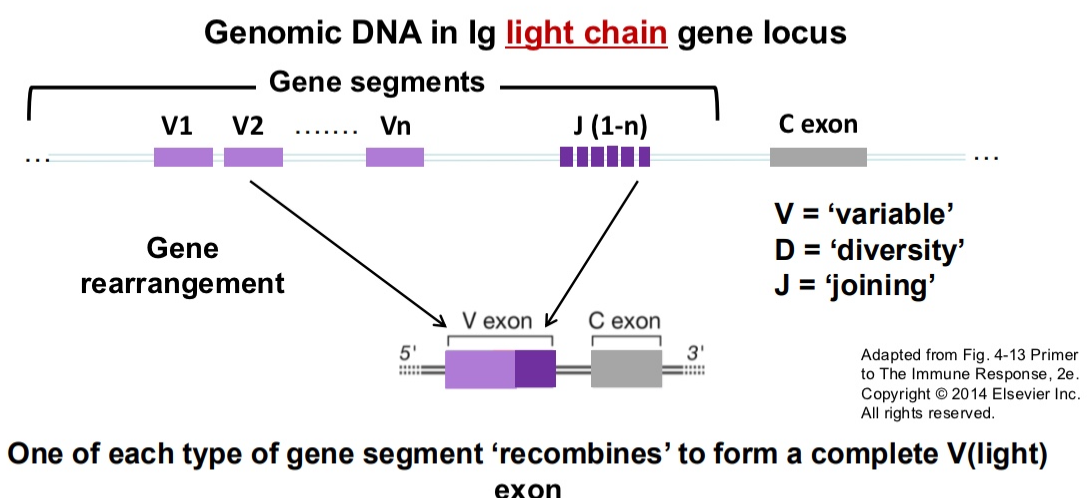
Explain what genes from the immoglobulin gene loci is involved in the diversity of light chain proteins
V and J gene segments form the complete V (light chai) exon (however the choices for V and J are random)
VJ recombination creates the diverse light chain that is transcribed and translated into the light chain protein
The kappa light chain is located on Chromosome 2, and the lambda light chain is located on chromosome 22 (only one of them is found on one type)
Diversity of the B cell receptor
explain the components of the BCR, and what regions contribute to diversity (level 1, 2, and 3)
Pairing of a unique heavy chain with its unique light chain
One antibody will be composed of 2 identical light and heavy chains
This binding results in 2 identical binding sites for antigen
The Ag (antigen) binding site = the variable (V) region
The Fc regions / Ab (antibody) molecule = the constant site
At the binding sites, you have specific regions of the V region at where there is CDRs (complementarity determining regions)
These are the hotspots of protein variability (the lumps coming out of the antigen binding sites) in the V domains and these lumps bind to the antigen on the surface

Clonal selection
explain the process of the immune response
Explain the colonial selection hypothesis
1. Establishment of infection
2. Induction of adaptive response
3. Adaptive immune response
4 immunological memory (at this point the pathogen is fully cleared)
Colonial selection hypothesis
Once an antigen binds, the rest of the future immune cells will remember the antigen and produce similar antibodies for future infections (all immune cells will remember)
