Lecture: Connective Tissue derived from HSC
 Call Kai
 Learn
 Practice Test
 Spaced Repetition
 Match
 Flashcards
 Knowt Play
1/98

There's no tags or description
Looks like no tags are added yet.
99 Terms
HSC and MSC
____ of CT come from the . . .
fibers of CT
collagen type I
collagen type III
elastic fibers
hydrated proteoglycans
ground substance of CT
electron microscopy
Specimens typically are stained with heavy metals (Pb, U). Uses an electron beam to detect electron-dense and electron-lucent regions
"scanning" (SEM)
beam bounces off surface giving a 3- D view of it
"transmission" (TEM)
beam passes through the thin- sectioned sample similar to LM slides
"freeze fracture" EM
a rapidly- frozen section is then cracked.
Separation of cell membranes tends to occur on the hydrophobic (inner) portion, allowing separate images of the E-face (extracellular) and P- face (protoplasmic, intracellular)
CT cells from MSC
fibroblast
myofibroblast
unilocular adipocyte
multilocular adipocyte
CT cells from HSC
mast cell
eosinophil
macrophage
neutrophil
lymphocyte
plasma cell
(basophil (!)
inflammation
function of mast cells and eosinofils
mast cell
pro-inflammatory HSC-derived cell
eosinophil
inflammatory modulation, allergy
innate immunity
macrophage, neutrophil
macrophage
phagocytic and APC
neutrophil
phagocytic and NETosis
adaptive immunity
lymphocyte, plasma cell
lymphocyte
pathogen recognition
plasma cell
antibody production
immune defenses other than cells
surface secretions
junctional complex
basement membrane
fiber matrix
proteoglycans
cytokines
cytokines
are molecules that communicate in a paracrine manner with other cells
interuleukins
type of cytokine
a large, diverse group of molecules that communicate between leukocytes.
type 1
pro-inflammaory cytokines
type 2
anti-inflammatory cytokines
calor
cardinal signs of inflammation (Celsus tetrad): heat
dolor
cardinal signs of inflammation (Celsus tetrad): pain
rubor
cardinal signs of inflammation (Celsus tetrad): redness
tumor
cardinal signs of inflammation (Celsus tetrad): swelling
increased blood flow
Inflammation:
vasodilation of arterioles
edema
inflammation:
increased fluid & cell movement out of vasculature
resident immune cells
inflammation:
cytokine signaling by . . .
diapedisis
the process by which leukocytes leave the circulation and enter the connective tissue
intravasation
leukocyte moves from CT to vessel
rare, generally limited to primary lymphoid organs
extravasation
leukocyte goes from the vessel into the connective tissue
paracellular diapedesis
migration between endothelial cells, requires breaking of endothelial tight junctions
transcellular dipedesis
migration through a pore in an individual endothelial cell
selectin
a (lectin-like) CAM that mediates "rolling adhesion", "the grass"
chemokines
(small MW cytokines) are secreted at the site of inflammation and form a gradient which cells can use for chemotaxis.
ligands
each leukocyte uses unique but overlapping constellation of ______, ensuring responses can be general or specific, local or widespread
stromal cells
chronic inflammation involves ___ ____
resolved
inflammation should get _____. off switch
apoptosis
resolution of inflammation:
leukocytes die by ____ and are cleared
macrophages
clear dead cells in inflammation resolution
lymphatics
resolution of inflammation:
lymphocytes migrate to
NETosis
resolution of inflammation:
granulocytes may die by
intravasate
resolution of inflammation
in some tissues (especially those that lack lymphatics), leukocytes may reverse migrate and _______ back to vasculature
remember
cells can _____ an infection- Breg, Treg
acute inflammation
cytokines produced by macrophages, neutrophils, lymphocytes
chronic inflammation
cytokines produced by stromal cells, e.g. fibroblasts
mast cell
has histamine and heparin granules
binds IgE antibodies
metachromatic granules
granule contents change color of stain- interact chemically with dye
compound exocytosis
secretory vesicles dock with each other
to speed degranulation
basophil
distinct from mast cell
mast cell for blood? has histamine and heparin granules, expresses IgE receptor
eosinophil
mediator of inflamation, anti-parasitic, mediator of allergic response
internum
eosinophil granules:
electron-dense crystalloid body containing major basic protein and
eosinophilic cationic protein and parasitic neurotoxins
externum
eosinophil granules:
aryl sulfatase, histaminase, acid phosphatase, ...
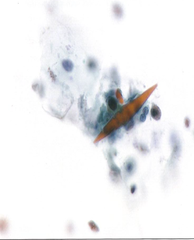
charcot-leyden crystal
The product of eosinophil degranulation has a characteristic pathological appearance (usually indicate hyper-eosinophilia)
mononuclear phagocyte system (MPS)
systemic macrophages
organ specific macrophages
professional phagocytes
the cells of the innate immune system are the " "
marrow
Neutrophils are born in
maringal pool in marrow
Neutrophils are stored in ____ ____ __ _____
usually adult form, also as pre-mature band cells
band cell
neutrophil is released in circulation, usually in adult form, but possibly as
rolling adhesion and diapedesis
neutrophil enters the connective tissue via
die
neutrophils get "activated" and ____ upon use
primary granules
types of neutrophil granules:
lysosomes, lysosomal enzymes digest bacteria
secondary (specific)
types of neutrophil granules:
antimicrobial
kill bacteria with enzymes and reactive oxygen compounds
tertiary (gelatinase)
types of neutrophil granules:
gelatinase, cathepsin, collagenase
facilitate migration to target
pus
Neutrophil dies; semidigested material and tissue fluid form _____
venules
Neutrophils can be stored in the vasculature by adhering to vessel walls, usually those of
phagocytosis, apoptosis
neutrophils have 2 strategies to kill
phagocytosis
neutrophils
up to 10-12 foreign bodies (bacteria) before neutrophil commits apoptotic cell death
apoptosis
neutrophils die en masse, releasing granules extracellularly which can kill larger invaders
NETosis
neutrophil extracellular traps
expulsion of stranded chromatin traps
bacteria, promotes clotting
chemokine signaling
Cells of the immune system trigger a migration of other appropriate cells via ____ ____. Basis of specificity of the immune system
marrow
macrophage is born in ___ as monocyte then released to circulation
spleen
there is a " reserve pool" of macrophages (stored as monocytes) in the . . .
macrophage
when a monocyte enters CT compartment, it becomes a . . .
resident macrophages
seed organs during fetal development
many "name" named cells are these
systemic macrophages
type of macrophages that circulate throughout life
macrophage functions
1. phagocytosis
2. antigen-presenting cell (way to communicate with adaptive immune system)
3. recruitment (cytokine production)
M1
type of macrophage responsible for phagocytosis
M2
type of macrophages involved in tissue modeling/ repair (resolution of inflammatory response)
macrophage syncytia
bunch of macrophages come together to form one big one
foreign body giant cell
macrophage syncytia with clumped nuclei
langhans cell
macrophage syncytia with horseshoe-ring nuclei
neutrophils
in response to infection/ damage, ____ peak around 24 hours (get called first)
local macrophages
in response to infection/ damage, ______ _______ release cytokines
36-48 hours
in response to infection/ damage, monocytes enter CT and become macrophages at ________ ______
B-lymphocyte
for extracellular pathogens
antigenic proteins -> antibodies (Ig)
T-lymphocyte
for intracellular pathogens
viruses -> MHC signaling
ILC
"innate lymphocyte cells" - a diverse
group not reliant on antibodies nor MHC
lymphoid follical
has a cortex of B cells and a germinal center of plasma cells then there are T-cells in the paracortex
marrow
B-lymphocyte is born in the . . .
marrow
T-lymphocyte is born in the . . .
marrow
innate lymphocyte is born in the . . .
marrow
B-lymphocyte matures in the _____. expresses Ig molecules
thymus
T-lymphocyte matures in the _____. expresses TCRs, MHCs
all lymphocytes
leaves circulation, enters connective tissue - potentially re-enters circulation via lymphatic system
plasma cell
mature for of B-lymphocyte, produces specific antibodies + secretes them
(there are also long lasting Bmem cells)
Tmem
T-lymphocyte that may last the entire lifetime