Week 11a-2 — Sentence Structure & Parsing (Nov 16)
 Call Kai
 Learn
 Practice Test
 Spaced Repetition
 Match
 Flashcards
 Knowt Play
1/15

There's no tags or description
Looks like no tags are added yet.
16 Terms
Why do "The dog chased the cat" and "The cat chased the dog" mean different things?
Both sentences use the same words, but sentence structure assigns the words different grammatical roles, so the structure — not just the words — specifies who did what to whom.

What is the hierarchy of language units? [Figure: hierarchy-tree.png]
Language is hierarchically organized from sentence to phrase to word to morpheme to phoneme, as in "The umpires talked to the players," where the sentence splits into a noun phrase ("The umpires") and a verb phrase ("talked to the players").
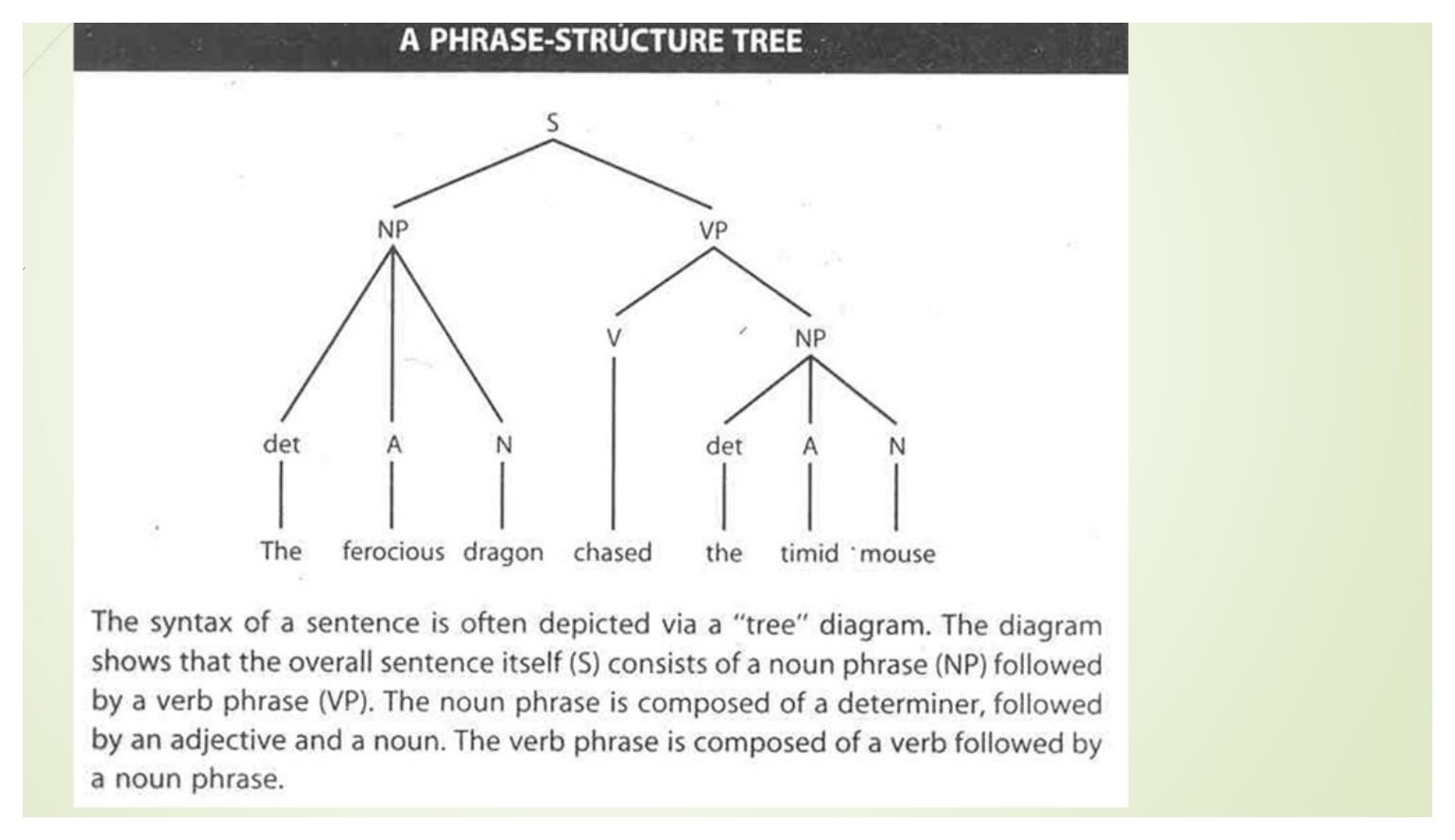
What is a phrase-structure tree? [Figure: phrase-structure-tree.png]
A phrase-structure tree shows how a sentence (S) splits into a noun phrase (NP) and a verb phrase (VP), as in "The ferocious dragon chased the timid mouse," where the NP is determiner + adjective + noun and the VP is verb + noun phrase.

Why is "The shooting of the hunters bothered him" ambiguous? [Figure: shooting-hunters-trees.png]
Its two tree structures give two readings — "The hunters shoot someone" (hunters as subject of shooting) versus "Someone shoots the hunters" (hunters as object) — so word meanings alone cannot resolve it.
How does grammatical structure differ from plausibility?
"The sandwich chased the student" is grammatically well-formed but implausible, showing that syntax can describe unusual events and that world knowledge normally helps comprehension while concealing how hard the grammatical work is.
What three properties show that words in sentences are not just a linear string?
Sentences allow embedding of one structure inside another (recursion), discontinuous elements, and long-distance dependencies that must be held in working memory until they are resolved.
What is embedding and recursion?
Embedding puts one structure inside a larger one, as in "This is the house that Jack built" growing into "the cat that killed the rat that ate the malt that lay in the house that Jack built," and each added clause increases the working-memory load.

What is center embedding, and why is it harder than right-branching? [Figure: center-embedding-trees.png]
In "The juice that the child spilled stained the rug" the main-clause verb "stained" is interrupted by an embedded clause, so "the juice" must be held in working memory until it can be linked to "stained," unlike the right-branching "The child spilled the juice that stained the rug."
How does agreement work across intervening words?
The verb must agree with the distant subject, not the nearest noun — "The dog [who ate the bone] chases the cat" vs. "The dogs [who ate the bone] chase the cat" — so the subject must be maintained across the intervening clause.
What is a long-distance dependency?
A phrase cannot be interpreted where it appears until later in the sentence, as in "John ate the ice cream, didn't he?" (he = John) and "The car that the old lady was selling needed many repairs" (the car, not the old lady, needed repairs).
What three kinds of evidence show that syntactic structure guides processing?
Memory studies (which words are remembered together), click studies (where listeners report a brief sound), and parsing studies (difficulty when an initial interpretation must change) all show structure influencing behavior.
What did the constituent-structure memory study find?
Participants remembered two contiguous words better when they came from the same phrase than when they came from different phrases, e.g. "marrying Anna" in "Your hope of marrying Anna was surely impractical" vs. "marrying" and "Anna" split across phrases in "In her hope of marrying, Anna was surely impractical."

What did the click-localization study find? [Figure: click-localization.png]
When clicks were played at positions −2, −1, +1, +2, or +3 words from a clause boundary in "That he was happy was evident from the way he smiled," listeners perceived them as closer to the phrase boundary than they actually were, showing speech is organized into phrasal units.
What are garden-path sentences?
Garden-path sentences lead readers to build one interpretation that later information proves wrong, forcing reanalysis — "While Anna dressed the baby played in the crib," "The old man the boats," and "The florist sent the flowers was pleased."
What are parsing and reanalysis?
Parsing is assigning grammatical relationships as a sentence unfolds, and because readers build an interpretation before all the words are available, later information can require reanalysis when the first structure fails.
What are the four takeaways about words, structure, and interpretation?
Understanding language requires more than recognizing words: related word knowledge influences lexical access, multiple meanings are activated before selection, sentence structure specifies relationships among words, and interpretations develop and sometimes change over time.