Permeability of Membranes
 Call Kai
 Learn
 Practice Test
 Spaced Repetition
 Match
 Flashcards
 Knowt Play
1/50

There's no tags or description
Looks like no tags are added yet.
51 Terms
what kinds of molecules can easily move across plasma membrane
hydrophobic molecules (O2, CO2, N2, steroid hormones)
small uncharged polar molecules (water, urea, glycerol)
what kinds of molecules can not easily move across plasma membranes
large uncharged polar molecules (glucose and sucrose)
ions
_____ (polar/non-polar) molecules are strongly prevented from diffusing across plasma membrane
polar
what are the four main types of transport
simple diffusion
facilitated diffusion via channels
facilitated diffusion via carriers
active transport
what type of transport requires energy to proceed
active transport
what types of transport does not require energy to proceed
passive transport (simple diffusion, osmosis, facilitated diffusion)
what is simple diffusion
unassisted movement of solute molecules from areas of high concentration to low conentration
what is osmosis
solvent (ex water) moves from area of high solvent (low solute concentration) to low solvent (high solute concentration)
when does osmosis occur and not simple diffusion
osmosis occurs when the solute itself cannot move across the membrane but water (solvent) can
compare hypertonic vs isotonic vs hypotonic solutions
hypertonic - Water flows out of the cell and into the surrounding solution because higher solute concentration (lower water concentration) outside the cell
isotonic - Water flows in and out at the same rate because there’s equal solute and water concentration inside and outside the cell
hypotonic - Water flows into the cell from the surrounding solution because lower solute concentration (and higher water concentration) outside the cell.

what happens to animal cells in isotonic, hypertonic, and hypotonic solutions?
hypertonic - shriveled cell
isotonic - normal cell
hypotonic - lysed cell
what happens to plant cells in isotonic, hypertonic, and hypotonic solutions?
hypertonic - plasmolyzed cell
isotonic - flaccid cell
hypotonic - turgid cell
what drives simple diffusion
entropy (concentration gradient - ie disorder)
what kinds of molecules is simple diffusion limited to
non polar molecules and steroid hormones
why does water flow slower through membrane via simple diffusion
water is a polar molecule trying to pass through the hydrophobic (water-fearing) lipid core of the phospholipid bilayer
what is facilitated diffusion
a type of passive transport where substances move across a cell membrane from an area of high concentration to an area of low concentration with the help of specialized transport proteins
can most substances diffuse across the membrane at a reasonable rate? why?
no - The interior of the membrane blocks polar and charged molecules from passing freely
what are uniporters
integral membrane proteins (carriers or channels) that transport a single type of molecule across a cell membrane down its concentration gradient through facilitated diffusion
why is simple diffusion linear and facilitated not
Simple diffusion - linear because molecules pass directly through the lipid bilayer without a limit on how many can cross at once
facilitated diffusion - not linear because it relies on a fixed number of proteins that can become saturated (ie have a set rate of transport)
what are the three types of carrier proteins
uniports
symports
antiport
compare uniports, symports, and antiports
uniport - Binds and moves a single specific solute down its concentration gradient that relies on passive transport
symport - Moves two different solutes simultaneously in the same direction across the membrane that relies on ion gradients (secondary active transport)
antiport - Moves two different solutes in opposite directions—one enters the cell while the other exits that relies on ATP hydrolysis or ion gradients

what are carrier protein also known as
permeases
explain how the passive glucose transporter works
A glucose molecule binds to a specific binding site on the exterior-facing conformation of the carrier protein
The binding of glucose triggers a physical shape change in the protein
this shape shift opens the binding pocket toward the inside of the cell, releasing the glucose molecule into the cell
After releasing the glucose, the protein returns to its original shape, ready to bind another molecule

what kind of channels do channel proteins form
hydrophilic channels
are protein channels passive or active
passive
what are three stimuli that can act as gated protein channels
voltage gated channels
light gated channels
ligand gated channels
what happens to an ions hydration shell as it moves along a channel protein
As an ion enters and moves through a channel protein, its surrounding hydration shell is partially or completely stripped away and replaced on the other side of the membrane
what are porins
specialized channel proteins forming hydrophilic channels that allow water and large molecules in and out of cell
how are porins important for antibiotic resistance
allow hydrophilic molecules, like many antibiotics, to cross into the bacteria cell, the porins mutate leading to antibiotic resistance
compare direct and indirect active transport
direct - Uses ATP hydrolysis directly to transport ions across membrane
indirect - Uses the stored energy of an ion gradient across membrane

what is the direction ions are pushed in active transport
against their concentration gradient—moving from an area of lower concentration to an area of higher concentration
compare P-type ATPases, V-type ATPases, F-type ATPases
P-type ATPases
does form a temporary phosphorylated intermediate
consumes ATP to pump protons
V-type ATPases
Does not form a phosphorylated intermediate
consumes ATP to pump protons
F-type ATPases
Does not form a phosphorylated intermediate
produces ATP to pump protons

what is an example of P-type ATPases
sodium-potassium pump (3 Na+ and 2 K+)
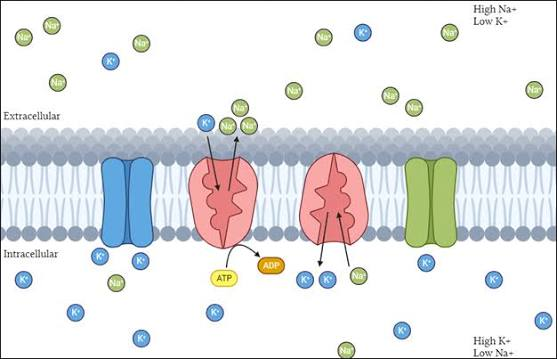
how many molecules of ATP are required to move 3 Na+ ions in P-type ATPases
1 molecule of ATP to transport 3 Na+ ions
compare the pH level inside and outside the cell via V-type ATPases
lowers the pH inside the cell (pH 5) compared to outside the cell (pH 7)
describe the F-type ATPases
rotary molecular engines that primarily synthesize ATP from ADP and inorganic phosphate using a proton-motive force
what type of ATPase is ATP synthase
F-type ATPase
what is a function of F-type ATPase
uses proton gradient to drive ATP synthase
what is a function of V-type ATPase
keeps pH of compartments low = activates enzymes
what is a function of P-type ATPase
potassium/sodium pump
what are ABC transporters
membrane proteins that use energy from breaking down ATP to move a wide variety of molecules across cell membranes
describe the four domains of ATB transporters
2 ATP binding cassettes
2 membrane spanning domains
what transporters play an important rule in multidrug resistance of cancers
ABC transporters
what is an important kind of ABC transporter
CFTR (Cystic Fibrosis Transmembrane Conductance Regulator)
how does CFTR work
channel that moves negatively charged chloride ions out of cells
When chloride moves outside the cell, it attracts a thin layer of water. This keeps mucus thin and freely flowing.
The watery layer allows cilia to sweep back and forth, clearing mucus and trapped germs out of the lungs
is CFTR a passive or active transporter
passive
what are three consequences of mutations in CFTR
pancreatic ducts get clogged so digestive enzymes can’t reach gut
bacteria accumulate in airways
skin CFTR reabsorbs salt before reaches skin (overly salty sweat)
what are two types of CFTR mutations
pores not working - Cl ions cannot pass through the channel
the protein is made but doesn’t embed into the membrane (just free floating)
what is indirect active transport
the energetically unfavorable transport of one solute is linked to the energetically favorable transport of another
what kind of transporter is the Na/glucose system
symporters - secondary active transporters
compare Bacteriorhodopsin vs channelrhodopsin vs halorhodopsin
Bacteriorhodopsin
Light-driven proton pump
channelrhodopsin
Light-gated ion channel
halorhodopsin
Light-driven chloride pump