Genetics Chapter 8: Chromosome Variation
 Call Kai
 Learn
 Practice Test
 Spaced Repetition
 Match
 Flashcards
 Knowt Play
1/110

There's no tags or description
Looks like no tags are added yet.
111 Terms
chromosome in which the two chromosome arms are approximately the same length
what is a metacentric chromosome?
chromosome in which the centromere is located toward one end, producing a short arm and a long arm
what is a submetacentric chromosome?
chromosome in which the centromere is near one end, producing a long arm at one end and a knob, or satellite, at the other end
what is an acrocentric chromosome?
chromosome in which the centromere is at or very near one end
what is a telocentric chromosome?
metacentric
what type of chromosome is shown?

submetacentric
what type of chromosome is shown?

acrocentric
what type of chromosome is shown?

telocentric
what type of chromosome is shown?

the complete set of chromosomes possessed by an organism
what is a karyotype?
actively dividing cells, such as white blood cells, bone-marrow cells, or cells from meristematic tissues of plants
what are karyotypes prepared from?
treated with chemical that prevents them from entering anaphase
what must be done to cells to prepare to be karyotyped?
chromosome rearrangements, aneuploidy, polyploidy
what are the three types of chromosome mutations?
the structure of chromosomes
what is altered in chromosome rearrangement
a piece of a chromosome may be duplicated, deleted, or inverted
what are chromosome rearrangements?
the number of chromosomes is altered, where one or more individual chromosomes are added or deleted
what is aneuploidy?
the number of chromosomes
what is altered in aneuploidy
when one or more complete sets of chromosomes are added
what is polyploidy?
duplications, deletions, inversions, translocations
what are the four basic kinds of chromosome rearrangements?
a part of the chromosome has been doubled
what happens in chromosome duplication?
in chromosome duplication, when the duplicated segment is immediately adjacent to the original segment
what is tandem duplication?
in chromosome duplication, when the duplicated segment is located some distance from the original segment, either on the same chromosome or on a different one
what is displaced duplication?
in chromosome duplication, when the duplicated segment is inverted
what is reverse duplication?
tandem duplication
what chromosome duplication is shown?
AB•CDEFEFG
displaced duplication
what chromosome duplication is shown?
AB•CDEFGEF
reverse duplication
what chromosome duplication is shown?
AB•CDEFFEG
duplications greater than a thousand base pairs in length
what are segmental duplications?
intrachromosomal
most segmental duplications are ___
the two copies are found on the same chromosome
what are intrachromosomal duplications?
the two copies are found on different chromosomes
what are interchromosomal duplications?
duplication
what kind of chromosome rearrangement is shown?

deletion
what kind of chromosome rearrangement is shown?

chromosome inversion
what kind of chromosome rearrangement is shown?

translocation
what kind of chromosome rearrangement is shown?

one or both chromosomes loop and twist so that these regions are able to line up
what must happen in order for chromosomes with duplications to pair and synapse?
appearance of loop structures in meiosis
what is one way to detect duplications?
unbalanced gene dosage, can produce developmental defects
what do chromosome duplications produce?
unequal crossing over
how do duplications and deletions normally arise?
misalignment of the two DNA molecules during crossing over, resulting in one DNA molecule with an insertion and the other with a deletion
what is unequal crossing over?
unequal crossing over
what does red-green color blindness result from?
gene families via divergence
what did duplications produce in terms of evolution?
the number of copies of its corresponding gene
what is the amount of a particular protein synthesized by a cell often directly related to?
a duplicated gene that gains mutations and no longer functions
what is a pseudogene?
the loss of a chromosomal segment
what is a chromosomal deletion?
the chromosome is noticeably shortened
how are large deletions detected?
the chromosome without a deletion must loop out during the pairing of homologs in prophase I of meiosis
what must happen in order for chromosomes with deletions to pair and synapse?
the chromosome will not segregate in meiosis or mitosis and will usually be lost
what happens if deletion includes the centromere?
they are often lethal
what is true about deletions in the homozygous case?
expression of a normally recessive allele due to a deletion on the homologous chromosome
what is pseudodominance?
heterozygous condition may produce imbalances in the amounts of gene products, pseudodominance, haploinsufficiency
what are the three reasons why individuals heterozygous for a deletion may have multiple defects?
gene that must be present in two copies for normal function, if one copy of the gene is missing, a mutant phenotype is produced.
what does it mean if a gene is haploinsufficient?
a deletion on the short arm of chromosome 5
what is responsible for cri-du-chat syndrome?
a chromosome segment is inverted—turned 180 degrees
what is chromosome inversion?
chromosome inversion that does not include the centromere in the inverted region
what is a paracentric inversion?
chromosome inversion that includes the centromere in the inverted region
what is a pericentric inversion?
dependence of the expression of a gene on the gene's location in the genome
what is the position effect?
example of position effect
what does it mean if a gene's expression is altered as a result of an inversion?
could be masked by highly condensed chromatin, even if gene is dominant
what commonly happens if a gene is close to the centromere?
they must loop and twist
what must be done in order for chromosomes with inversions to pair and synapse?
reduced recombination among genes located in the inverted region
what do individuals heterozygous for inversions exhibit?
one dicentric chromosome and one acentric chromosome
what results from crossing over within a paracentric inversion?
chromatid that has two centromeres
what is a dicentric chromatid?
chromatid that lacks a centromere
what is an acentric chromatid?
the two centromeres are frequently pulled toward opposite poles, breaking the chromosome
what happens to a dicentric chromosome during mitosis/meiosis?
does not attach to a spindle microtubule and does not segregate, so it is usually lost after one or more rounds of cell division
what happens to an acentric chromosome during mitosis/meiosis?
structure produced when the two centromeres of a dicentric chromatid are pulled toward opposite poles, stretching the dicentric chromosome across the center of the nucleus
what is a dicentric bridge?
as chromosomes separate during anaphase I of meiosis
when does the dicentric bridge break?
2 with original, nonrecombinant chromosomes and 2 with recombinant chromosomes missing genes, non-viable
what gametes do chromosomes with inversions produce?
no, they are not viable
are recombinant progeny produced when crossing over takes place within a paracentric inversion?
2 normal nonrecombinants and 2 recombinants with missing and extra genes, non-viable
what gametes are produced in recombination within a pericentric inversion?
chromosomes mutation
what is lack of recombinant gametes evidence of?
suppression of recombination allows alleles adapted to a specific environment to remain together, unshuffled by recombination
what is the importance of inversion in evolution?
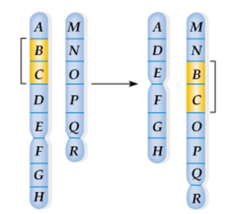
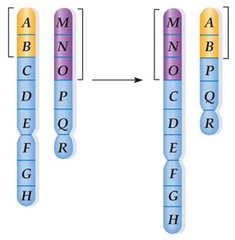
the movement of genetic material between nonhomologous chromosomes or within the same chromosome
what is a translocation?
movement of a chromosome segment to a nonhomologous chromosome or chromosomal region without any (or with unequal) reciprocal exchange of segments
what is nonreciprocal translocation?
nonreciprocal translocation
what is shown?
reciprocal exchange of segments between two nonhomologous chromosomes
what is reciprocal translocation?
reciprocal translocation
what is shown?
1. can physically link genes that were formerly located on different chromosomes
2. the chromosome breaks that bring about translocations may take place within a gene and disrupt its function
how can translocations affect a phenotype?
position effect may change their expression
what can happen when translocations move genes to new locations?
deletions
___ can accompany translocations
translocation in which the long arms of two acrocentric chromosomes become joined to a common centromere, generating a metacentric chromosome with two long arms and another chromosome with two very short arms
what is a Robertsonian Translocation?
chromosome with two short arms is lost, therefore chromosome number is reduced
what often results from a Robertsonian Translocation?
it lacks sufficient mass to segregate properly
why is the chromosome with two short arms often lost in a Robertsonian Translocation?
abnormal homologous chromosome alignment
what do individuals heterozygous for a reciprocal translocation produce?
a crosslike configuration
what forms in prophase I in an individual heterozygous for a reciprocal translocation?
alternate segregation, adjacent-1 segregation, adjacent-2 segregation
what are the 3 ways a chromosomes may segregate with a reciprocal translocation?
adjacent-2
which segregation is rare with a reciprocal translocation?
viable gametes
what does alternate segregation produce?
nonviable gametes
what does adjacent-1 and adjacent-2 segregation produce?
change in the number of individual chromosomes
what is aneuploidy?
possession of more than two sets of chromosomes
what is polyploidy?
nondisjunction
what produces aneuploidy?
nullisomy, monosomy, trisomy, tetrasomy
what are the types of aneuploidy?
the loss of both members of a homologous pair of chromosomes (2n-2)
what is nullisomy?
the loss of a single chromosome (2n-1)
what is monosomy?
the gain of a single chromosome (2n+1), where there are three homologous copies of one chromosome
what is trisomy?
the gain of two homologous chromosomes (2n+2), where the 2 chromosomes gained are homologous, resulting in 4 copies of one chromosome
what is tetrasomy?
2 trisomic zygotes and 2 monosomic zygotes
what does nondisjunction is meiosis I produce?
2 normal zygotes, 1 trisomic, and 1 monosomic zygote
what does nondisjunction in meiosis II produce?
1 monosomic cell and 1 trisomic cell, all somatic clones that arise from them are also either monosomic or trisomic
what does nondisjunction in mitosis produce?
50-80%
what percentage of conceptions result in spontaneous abortion?