QUIZ 1 Questions Module 1,2,5,6,7
 Note
 Call Kai
 Learn
 Practice Test
 Spaced Repetition
 Match
 Flashcards
 Knowt Play
1/46

There's no tags or description
Looks like no tags are added yet.
47 Terms
What is the likely cause of wrist bending when working on the maxillary right posterior teeth, lingual aspect?
You are seated at 9:00 if right-handed or 3:00 if left-handed.
True or False: It is easy to maintain neutral positioning when seated at 8:00 or 4:00.
False; it's not always easy to maintain neutral positioning at these angles.
What is the incorrect positioning practice for the mandibular anterior teeth, facial surfaces?
Place the instrument handle in front of the first knuckle.
What is the best adjustment for excessive wrist bending while working on the facial aspect of mandibular anterior teeth?
Raise the height of your chair.
Which statement about neutral position is false?
A repetitive task involves the same movement for more than 25% of the work cycle.
What is the incorrect statement regarding a dominant-hand finger rest?
The patient’s cheek provides a stable location for a finger rest.
What is the incorrect description of a neutral seated position for the clinician?
Shoulders lifted toward the ears.
What likely causes visibility issues when working on mandibular posterior teeth, facial aspect?
You are using the mirror for retraction and indirect vision.
What should you avoid for neutral clinician position?
Position the dental light directly over the mouth whenever working on the maxillary arch.
What improper position results from the patient’s chair being too high?
Shoulders raised and elbows held away from the body.
Which statement about neutral hand position is false?
The index finger and thumb are flattened against the handle.
Which clock position indicates the clinician is seated behind the patient’s head?
12:00 for both right-handed and left-handed clinicians.
What is the correct step for periodontal instrumentation of anterior teeth?
Divide each tooth in half at the midline and begin instrumentation at the midline.
When viewing shaded tooth surfaces, what should the clinician's position be?
Sit at 10:00–11:00 for a right-handed clinician.

What is the correct order to establish a finger rest?
2, 5, 4, 1, 6, 3. Establish the patient’s chair and head position.
Adjust the unit light and equipment.
Assume the correct clock position.
Grasp the mirror and establish its finger rest.
Grasp the instrument with the dominant hand.
Establish a finger rest near the first tooth.
Which does NOT describe a correct neutral seated clinician position?
The back is held in a rounded position.
When having difficulty seeing the facial surfaces of the mandibular posterior teeth, which action would NOT improve visibility?
Bending and leaning across the patient.
What clock position has the clinician facing the side of the patient’s head?
9:00 if right-handed and 3:00 if left-handed.
Which is an unacceptable positioning practice?
Sitting with your weight on one hip.
What is NOT a characteristic of an intraoral fulcrum?
It allows the hand and instrument to move independently of each other.
What is the best adjustment for wrist improvement when working on the facial aspect of mandibular anterior teeth?
Raise the height of your chair.
What is the answer regarding maintaining neutral positioning seated at 8:00 or 4:00?
The first statement is false; the second is true.
What statement about the dominant ring finger in an intraoral finger rest is incorrect?
It remains in one exact spot while working on every tooth in a sextant.
A right-handed clinician is working on the lingual aspect of the maxillary right posterior teeth. The clinician’s wrist is excessively bent. What is the most likely cause?
The clinician is seated at 9:00. The lingual aspect faces away from the clinician, so a right-handed clinician should sit at 10:00–11:00.
It is easy to maintain neutral positioning when seated at 8:00 or 4:00. The goal of clinician positioning is to minimize postural abnormalities whenever possible.
The first statement is false; the second is true.
All are correct positioning practices for the mandibular anterior teeth, facial surfaces toward, EXCEPT:
Place the instrument handle in front of the first knuckle.
While working on the facial aspect of the mandibular anterior teeth, your wrist is excessively bent. What is the BEST adjustment?
C. Raise the height of your chair.
All statements about neutral position are true EXCEPT:
D. The patient’s cheek provides a stable finger-rest location.
Which does NOT describe the correct neutral seated clinician position?
D. Shoulders lifted toward the ears.
RIGHT: You are working on the mandibular left posterior molars, facial aspect, and are having difficulty seeing the surfaces. LEFT: You are working on the mandibular right posterior teeth, facial aspect, and are having difficulty seeing the surfaces. What is most likely causing the problem?
C. You are using the mirror for retraction and indirect vision.
To maintain a neutral clinician position, do all of the following EXCEPT:
D. Position the dental light directly over the mouth whenever working on the maxillary arch.
Which improper clinician position can result from the patient’s chair being too high?
A. Shoulders raised and elbows away from the body.
All are true of neutral hand position EXCEPT:
C. The index finger and thumb are flattened against the handle.
The clinician is seated behind the patient’s head. Which clock position is this?
A. 12:00 for both right-handed and left-handed clinicians.
What is the main purpose of maintaining a neutral wrist position during instrumentation?
D. To decrease the risk of musculoskeletal injury
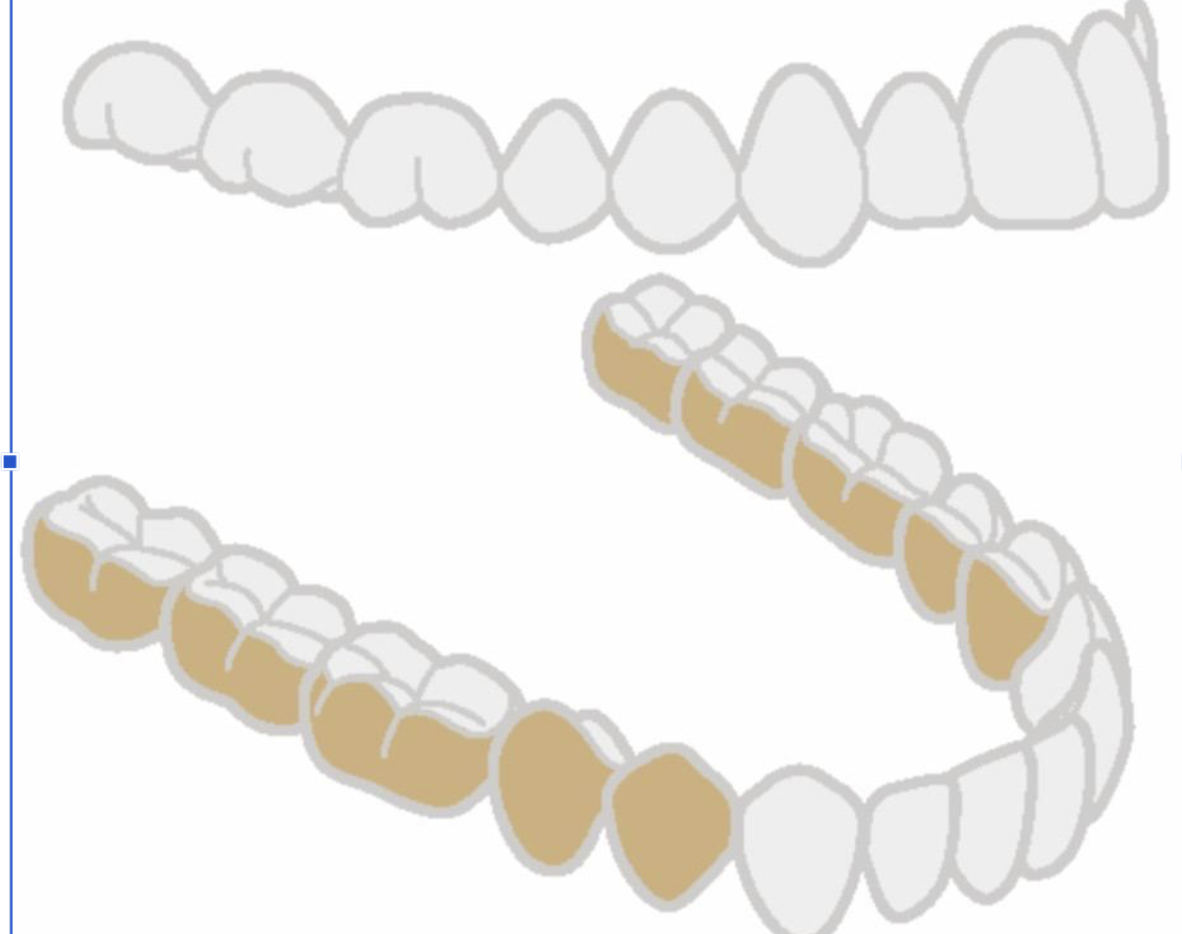
Look at the shaded tooth surfaces in the picture. For a right-handed clinician, the correct position is 9:00 with the patient chin-down. For a left-handed clinician, the correct position is 2:00–1:00 with the patient chin-down.
A. Both statements are true.
For the best vision and access to the teeth, how should the patient’s head be positioned on the headrest?
B. The top of the patient’s head should be even with the upper edge of the headrest.
A clinician is seated near the corner of the patient’s headrest. The midline of the clinician’s torso is even with the temple area of the patient’s head. Which clock position is this?
C. 10:00–11:00 if right-handed or 2:00–1:00 if left-handed.
A clinician is seated in front of the patient with the clinician’s hip in line with the patient’s upper arm. Which clock position is this?
D. 8:00 if right-handed or 4:00 if left-handed.
hen working on the facial aspect of the mandibular anterior teeth, it is customary to retract the patient’s lip with a finger of the nondominant hand. When working on the lingual aspect of the maxillary right posterior teeth, it is acceptable to place the dominant-hand finger rest on a tooth in the maxillary left posterior sextant.
A. The first statement is true; the second is false.
To be correctly positioned for viewing the mandibular teeth, the patient’s mouth should be approximately level with which part of the clinician’s body?
B. Elbow.
All are correct positioning practices for working on the lingual surfaces of the maxillary anterior teeth that face away from a right-handed clinician EXCEPT:A right-handed clinician should sit around 11:00–1:00 for anterior surfaces facing away.
Sit at 8:00.
A clinician is having difficulty seeing the tooth surfaces while working. Which condition is most likely causing the visibility problem?
D. The patient is positioned too low, with the tip of the nose below the clinician’s waist.
Establishing a finger rest directly on the facial or lingual surface of a tooth provides stability. The dominant-hand finger rest should be established before the nondominant-hand finger rest
C. Both statements are false.
What is the most common positioning error made by clinicians during periodontal instrumentation?
A. Leaning too far over the patient.
What is the best location for the dominant ring finger when establishing an intraoral fulcrum?
B. On the same arch and one to four teeth away from the tooth being instrumented.