Cardiovascular pt. 1
 Call Kai
 Learn
 Practice Test
 Spaced Repetition
 Match
 Flashcards
 Knowt Play
1/59

There's no tags or description
Looks like no tags are added yet.
Name | Mastery | Learn | Test | Matching | Spaced | Call with Kai | Chat |
|---|
No analytics yet
Send a link to your students to track their progress
60 Terms
SBP is affected by…
cardiac output.
Cardiac output (SBP) is determined by…
stroke volume + heart rate.
Increasing preload + contractility = increased SV. Increasing afterload = DECREASED SV
DBP is affected by
vascular resistance.
Vascular resistance is determined by…
vasomotor tone of arteries, volume/viscosity of the blood. (If the arteries cannot dilate well, the volume of blood increases and/or is thicker and the afterload increases, which will decrease SV)
how is map determined/equation
-MAP is determined by SBP and DBP. [(2x DBP) + SBP] /3
4 functions of cardiovascular dugs:
-Cardiotropic drugs (effect how heart works)
-Vascular drugs (effects diameter of the vasculature)
-Fluid regulation drugs (reduce amount of fluid in the blood)
-Coagulation drugs (prevent blood clots)
Cardiotropic drugs will provide ______, _______, _______ effects
Inotropic(cardiac muscle contractibility), Chronotropic ( HR), Dromotropic (velocity of conduction) (or a combination of these)
Inotropic effects:
contractility of the cardiac muscle fibers.
Chronotropic effects:
heart rate.
Dromotropic effects:
velocity (speed) of electrical conduction in the heart.
Congestive Heart Failure (CHF)
The heart is not able to pump the blood effectively.
Congestive Heart Failture (CHF) Left ride
The blood backs up into the lungs resulting in PULMONARY edema
Congestice Heart Failture (CHF) right side
The blood backs up into the veins resulting in PERIPHERAL edema and jugular distention.
Treatment for CHF:
-Reduce the volume of blood
-Reduce venous return of blood to the heart by dilating the vessels
-Increase stroke volume by improving contractility of the heart
Medications for CHF: Diuretics
reduces excess fluid
Medications for CHF: Vasodilators
reduces venous return, which decreases preload
Medications for CHF: Cardiac Glycosides
increase contractility of the heart muscle which makes the heart contract more efficiently
Cardiac Glycosides are forms of _______ compounds
digitalis, Digoxin (Lanoxin), Digitoxin
Characteristics of Cardiac Glycosides:
-Positive inotropic effect: increases contractility of heart
-Negative chronotropic effect: reduces heart rate (useful for atrial arrhythmias)
-Negative dromotropic effect: reduces velocity of conduction (good for arrhythmias, undesirable for CHF)
-Low therapeutic index: TOXIC effects can be seen with small increases of the medication
Why is increasing contractility useful for treating CHF?
Increasing contractility increases stroke volume and the heart can pump the blood better to prevent the back-up of the blood.
Why is reducing conduction (negative dromotropic) undesirable for CHF?
Because reducing the electrical activity in the heart will reduce the effectiveness of the contraction of the heart.
Why is Digitoxin rarely used in the U.S.?
Due to the low therapeutic index and long half-life
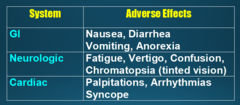
Side effects of digitalis compound drugs:
GI, Neurologic, Cardiac.
Limit epinephrine due to arrhythmias
-Increased salivation is also an effect
Neuroconduction: pathway.
(The SA node fires which causes contraction of the atria) → The AV node then fires which causes contraction of the ventricles.
Neuroconduction: Contraction of the heart muscle occurs
when sodium enters the neurons that are are controlling the cardiac muscle cells.
-The SA node is considered the…
pacemaker of the heart.
Anti-Arrhythmic drugs treat arrhythmias by...
-Reducing the rate + sympathetic activity (Negative chronotropic)
AND/OR
-Reducing conduction by slowing electrical impulses in the heart. (Negative dromotropic)
Different mechanisms of anti-arrhythmic drugs:
Slows conduction and prolongs repolarization- (VERAPAMIL- by blocking calcium)
Different mechanisms of anti-arrhythmic drugs: Sodium channel blockade
prevents sodium from entering cell (LIDOCAINE- negative dromotropic effect)
Different mechanisms of anti-arrhythmic drugs: Calcium channel blockade,
prevents calcium from entering cell. The nerve depolarizes but the depolarization is not maintained. (VERAPAMIL- negative dromotropic)
Different mechanisms of anti-arrhythmic drugs: Beta-1 receptor blockade,
(PROPRANOLOL- negative inotropic and chronotropic)
True or False: All calcium channel blockers are anti-arrhythmic drugs.
False
What is the most common sodium channel blocker?
Lidocaine -Provides a negative dromotropic effect
What is the most common calcium channel blocker?
Verapamil -Provides a negative dromotropic effect., Direct effect on myocardium, SA and AV nodes
Beta blockers are used for their ____-_ blocking effect.
Beta-1
Coronary Artery Disease (CAD): Ischemic heart disease
An imbalance between myocardial oxygen supply (amount received) and demand (amount needed).
Coronary Artery Disease (CAD): Ischemic heart disease -Supply can be decreased by:
Atherosclerosis, Vasospasm, Thrombogenesis in coronary arteries.
Coronary Artery Disease (CAD): Ischemic heart disease, -Increased demand occurs when:
the heart rate increases, or wall tension increases.
(Increased tension reduces contractility of the heart and the heart has to work harder to pump the blood)
Physiological considerations of CAD:
-Want to lower HR which will effect cardiac output and ultimately SBP.
-Reducing the arterial wall resistance + volume of blood = lower afterload and ultimately DBP.
-Reducing afterload = increase SV and the heart does not have to work as hard to pump blood.
Nitrates (Nitroglycerin)
Used to treat CAD.
Action: Causes vasodilation, primarily of the veins. Vasodilation of the veins returning to the heart will reduce preload and thus reduce cardiac workload -treats angina pectoris.
Precautions: Hypotension
Anti-Anginal Drugs provide:
-Vasodilation
-Reduce cardiac workload
-BOTH vasodilation and reduce cardiac workload
Anti-anginal drugs: Vasodilators
-Nitrates/Nitrites: Nitroglycerin, Isosorbide
-Ca++ channel blockers (some): Nifedipine (Procardia), Amlodipine (Norvasc)
-Alpha blockers/ACE inhibitors
Anti-anginal drugs: Drugs that reduce cardiac workload
-Beta blockers: Propranolol (Inderal), Metoprolol (Toprol)
Propranolol: non-selective
Metoprolol: selective
Anti-anginal drugs: Drugs that are BOTH vasodilators and reduce cardiac workload
-Calcium channel blockers: Verapamil, Diltiazem (Cardizem)
Dilating veins will decrease ______, Dilating arteries will decrease _____
preload, afterload
Lowering blood pressure:
Done by lowering SBP, DBP, or both.
-Lower SBP by reducing preload or HR.
-Lower DBP by reducing afterload
(reduce afterload by reducing the arterial resistance and volume of blood).
True or False: Most anti-hypertensive drugs lower both SBP and DBP.
True
Diuretics:
*Purpose: Water loss- reduce blood volume
*Prevents: re-absorption of Na+ from kidney (water follows sodium)
*Uses: CHF, Hypertenstion
*Precautions: Hypokalemia--> arrhythmias
-Carbonic Anhydrase Inhibitors: glaucoma
-Loop diuretics, Thiazides, Potassium sparing
Loop diuretics:
Cause loss of water in the loop of henle. -Lasix (Furosemide)

Thiazide diuretics:
Cause loss of water in the distal convoluted tubule. Also loss of electrolytes like potassium. -HCTZ
Potassium sparing diuretics:
Cause loss of water, but saves potassium. -Triamterene
Why is losing too much potassium dangerous?
If potassium is lost, the depolarization of the neurons will not stop, resulting in arrhythmias.
(remember potassium leaving the cell is repolarization)
What are two combination diuretics containing HCTZ and Triamterene?
Dyazide, Maxzide
Which diuretic causes the most K+ loss?
Thiazides
Which diuretic causes the least K+ loss?
Triamterene
Which diuretic would you want to give someone in order to reduce blood volume the fastest?
Lasix (loops)
Beta-Blockers:
Used for: Beta-1 antagonist action (reduce HR and FOC)
Indications:
-Hypertension
-Arrhythmias (ventricular)
-Angina
Patient taking non-selective beta blockers:
Beta-1 and Beta-2 are both blocked.
If this individual is given epinephrine, there is no Beta-2 effect so there is no vasodilation in the skeletal muscles.
-Instead, the epinephrine binds to all alpha receptors causing a lot of vasoconstriction.
-This in turn will cause the BP to rise and could trigger MI or stroke

4 Calcium channel blockers used for hypertension:
-Verapamil (Calan)
-Diltiazem (Cardizem)
-Nifedipine (Procardia) (Peripheral smooth muscles)
-Amlodipine (Norvasc)
Mechanisms of action of calcium channel blockers:
(1) Slows calcium influx to SA and AV nodes and myocardium (use: angina (CAD), HTN, arrhythmias)
(2) Blocks calcium influx to smooth muscles (use: HTN, CAD)
