Calc midterm flashcards
 Call Kai
 Learn
 Practice Test
 Spaced Repetition
 Match
 Flashcards
 Knowt Play
1/129

There's no tags or description
Looks like no tags are added yet.
130 Terms
derivative of sinx
cosx
derivative of cosx
-sinx
derivative of tanx
sec²x
derivative of secx
secxtanx
derivative of cscx
-cscxcotx
derivative of cotx
-csc²x
sin2x?
2sinxcosx (the same as the derivative of sin²x)
cos2x?
2cos²x-1
1-2sin²x
cos²x-sin²x
cos²x-sin²x?
cos2x
cos²x+sin²x?
1
sin²x-cos²x?
-cos2x
ln(1)?
0
e0
1
e1
2.7
derivative of ln(x)?
1/x
derivative of sin^-1
1/sqrt(1-x²)
derivative of cos^-1
-1/sqrt(1-x²)
derivative of tan^-1
1/(x²+1)
derivative of of tan^-1(x²)?
Implement chain rule
1/((x²)²+1) * 2x
derivative of e^x
e^x
derivative of logbx?
1/xlnb
^Notice the b comes out
How to rewrite logbx in ln?
ln(x)/ln(b)
domain and range of ln
domain: [1, +inf)
range: (-inf, +inf)

Domain and range of e?
Domain: (-inf, +inf)
Range: (0, +inf)

Domain and range of logbx?
domain: (0, +inf)
range: (-inf, + inf)
What is the exception of logbX?
b > 0, and b ≠ 1
cos(0)?
1
cos(pi)?
-1
cos(2pi)?
1
cos(-pi)?
-1
cos(3pi/2)?
0
3pi/2 in degrees?
270
sin(0)?
0
sin(pi)?
0
sin(3pi/2)?
-1
sin(-pi)?
0
what is the formula for reference angle in quadrant IV?
2pi - reference anglewhat is the formula for reference angle in quadrant
what is the formula for reference angle in quadrant I?
reference angle
what is the formula for reference angle in quadrant II?
pi - reference angle
what is the formula for reference angle in quadrant III?
pi + reference angle?
What should you do if you have a negative angle?
Add 2pi, until posiive
sinx = 1/2
x = pi/6
cos x = √(2)/2
x = pi/4
cos x = 1/2
x = pi/3
cos x = √(3)/2?
x = pi/6
sin x = √(2)/2
x = pi/4
sin x = √(3)/2?
x = pi/3
180/3?
60
180/6?
30 degrees
√a*√a = ?; what about √a/a
a,
becase a1/2a1/2= a1/2 + 1/2 =a1
when √a/a, the answer is 1/√a
If I have x² ≥ 2, what are my two answers from that (remember inequalities are involved)
x < -√2 AND x > √2
WHENEVER YOU HAVE x² > a (a > 0) → x < -√a AND x > √a
If I have x² ≤ 2, what are my two answers from that (remember inequalities are involved)
-√2 < x < √2
tan2x?
2tanx/1-tan²x
sec²x?
tan²x+1
csc²x?
1+cot²x
tan²+1?
sec²x
1+cot²x?
csc²x
What is the reference angle for -pi/3?
5pi/3
-pi/3 + 2pi (6pi/3) = 5pi/3
What do I put in an answer if I’m meant to find ALL the solutions?
You add “+ 2kpi”
If I have cos (x + 3pi/3) = √2/2 and I want to find ALL the solutions, what is my FIRST step?
Make u = x + 3pi/3 AND u = x - 3pi/3
If i have a*b ≤ 0, what does that mean for a and b?
either 1. a = (-) and b = (+). or 2. a = (+) and b = (-)
If I have cos ≤ 1/2, what is my strategy?
Try to draw out when cos 1/2?
What is cos graph?

sin graph

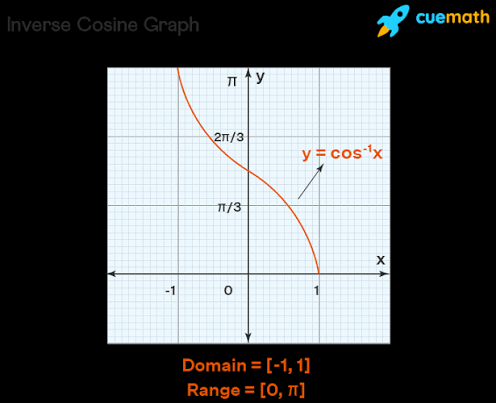
Restrictions for cos^-1?
domain: [-1,1]
range: (0, pi)
restrictions for sin^-1?
domain: [-1,1]
range: -pi/2, pi/2

tan-1 restrictions?
domain: (-inf, +inf)
range: [-pi/2, pi/2]

tanx restrictions?
In plain words: All real numbers except odd multiples of pi/2 (such as pi/2, 3pi/2, -pi/2
Why: The tangent function is sinx/cosx It is undefined wherever cos(x) = 0

tan x = 0
x = 0 → because sinx/cosx = 0/1 = 0
tan x = 1/2
around 26 degrees, what matters is tan x = ½ is NOT a special valueSp
Special values of tan?
√3
1
√3/3
tan x = √3/3
pi/6
tan x = 1
pi/4
sin(pi/4)/cos(pi/4)?
1 → because at pi/4, sin and cos are the same value
tan x = √3
x = pi/3
b0?
1

bx, domain and range?
domain: (-inf, +inf)
range: [0, +inf)

how to do change base to e trick?
bx= exln(b)
domain and range of √x
domain: [0, +inf)
range: [0, inf)
what is special about xx
Has a variable base and exponent, neither are a constant
how to make 5cos(x) into change base to e trick?
ecos(x)ln(5)
how to derive xx
xx(1+ln(x))
lim of 00
This limit DNE
range and domain of ln(x+1)
domain: (-1, + inf)
range: (-inf, + inf)
Range of bx
range: [0, +inf)
ln(e)?
1
what is a natural domain
When it’s only + numbers
When is something a function?
If it passes the vertical line test (only 1 y value per x); one to one
When is a function invertible?
If it passes the horizontal line test (only 1 x value per y)
What is a common function that is NOT invertible
X2
if I have function f(x) = √x+2) + 5, is there an x-intercept (when y = 0)?
NO, because the range of y is y >= 5 (look at domain and range rules if confused)
When are functions parallel
If they share the same slope
Definition of a power function
xn, where n is a CONSTANT
When is cotangent undefined?
at 0, and pi. Whenever sin = 0. Because cotangent = cosx/sinx
what is the natural log?
ln(x) = logex
The inverse of e?
ln
how to find the domain of an inverse function?
The domain of an inverse, will be the range of the original and vice versa!
Why is the definition of a domain important in inverses?
because in inverse function you need to be able to reverse, every single INPUT of the function as an inverse. REMEMBER the range of the og needs to match the domain of the new, vice versa. So the domain is important, it will tell you if a function is actually the inverse
If lim x→a f(x) exists, then is f(x) defined at a?
No it doesn’t have to be. Example is removeable discontinuity
If lim x→ a f(x) = +inf, then does that mean the limit exists and it is an infinity?
No because this is short hand for the limit DNE, because in the definition of a limit, for a limit to exist it MUST be approaching a finite number