Feeding and digestion
 Call Kai
 Learn
 Practice Test
 Spaced Repetition
 Match
 Flashcards
 Knowt Play
1/29

There's no tags or description
Looks like no tags are added yet.
30 Terms
What is heterotrophy
The ingestion of food in order to satisfy energy requirements (Unlike heterotrophs)
Give types of ways to feed off of Small particles
Pseudopodial: Protozoa
Ciliate: bivalve molluscs, marine invertebrate larvae
Tentacular: cnidarians/annelids/bryozoa
Mucoid: tunicates
Setous: crustaceans, baleen whales, flamingos etc.
Deposit: annelids
Give types of ways to feed off of Large particles
Scraping/boring: gastropod molluscs
Seizure of prey: carnivores
Traps: spiders webs, pits etc.
Give types of ways to feed by Fluid feeding
Sucking without penetration: honey bees, humming birds
Sucking with penetration: leeches, ticks etc.
Describe direct absorption
Absorption across body surface: endoparasites, aquatic invertebrates etc.
Absorption from symbiotic partners: corals, ruminants etc.
What is the simplest form of food capture?
Phagocytosis
Describe the mechanism of phagocytosis
Form pseudopodia and then create a food vacuole or phagosome.
Lysosomes fuse to create a phagolysosome.
Waste excreted via the anal pore.
Describe ciliate feeding
Bivalves (mollusks) use cilia on their gills to trap suspended particles.
Particles transported down to the food groove.

Name the Three types of cilia
Frontal
Lateral
Laterofrontal
Describe Mucous nets
Tunicata use an iodine rich mucus nets secreted by their endostyle.
Describe Setae
Used by arthropods
Projections of the exoskeleton.
Trap particles are suspended in the water column and pass to the mouth.
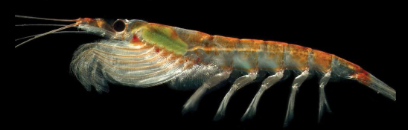
Describe Gill Rakers
Used by fish
Water drawn into the buccal cavity and over the gills particles are trapped on the rakers.
Not involved in gaseous exchange.

Describe Baleen Plates
Composed of keratin.
The inner edge frayed to form a fibrous mat.
Water taken in from the front and out laterally.
Tongue wipes the plates.

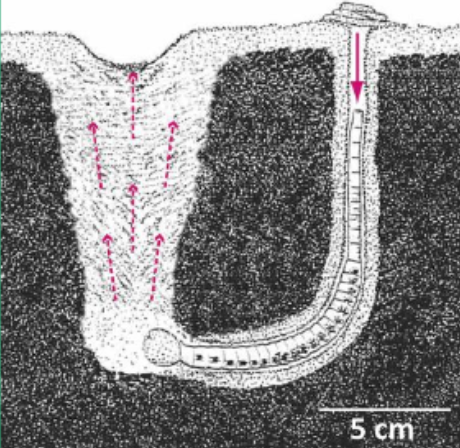
Describe Deposit Feeding
Deposit feeding is the ingestion of organic matter from the sea floor/soil.
Bioturbation.
Gain nutrition from POM and microorganisms.
Subsurface or surface feeders.
Non-selective or selective feeders.
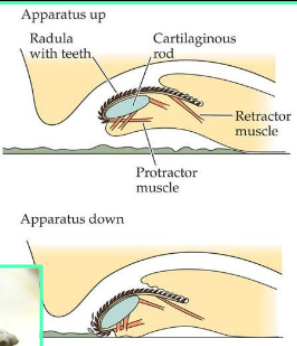
How do Gastropods feed on large particles?
have a radula which is used to scrape/rasp the surface of their food.
Modified into drills or harpoons
What are chelate legs
arthropod limbs ending in a pincer or claw
What is pedipalps
A second pair of forward appendages on chelicerate found in arthropods subclass chelicerates
What are Dorsal dactylus and ventral propus.
describe the anatomical orientation of the two terminal segments that form the pincer (chela)
What traps can invertebrates use?
Slime: Turbellaria
Silk: Chelicerata
Pits: Myrmeleontidae
Describe how hagfish feed on large particles.
Tentacles surround the mouth for detecting prey.
2 plates in mouth that bear sharp tooth-like structures.
When the mouth is open they spread apart, mouth closed, fold together and teeth interdigitate.
Tie a knot in tail and pass forward to assist in leverage.
Elasmobranchs have evolved an array of feeding
strategies: filter feeding to carnivory.
Cranial kinesis: motility within the head skeleton enables the consumption of large prey items.
Hyostylic jaw suspension:allows the jaw to be placed into multiple positions and protrusion of the upper jaw.
Palatoquadrate: upper jaw
Mandible: lower jaw
Teeth on palato quadrate large, serrated and recurved.
Teeth sunk into prey by protruding upper jaw.
Lateral undulations of the body moves the head and rips flesh.
Electroreceptors: ampullae of Lorenzini.
How do Actinopterygii consume large particles
• Evolution of specialisation of the jaw directly related to diet.
• Protrusible pharyngeal jaws are very important in this group.
• Diversity of feeding methods from simple prey grabbing to specialised suction devices.
• Evolved 3 or 4 times in different teleost clades.
What are two types of fluid feeding?
Feeding without penetration: hummingbirds, bees, butterflies, some bats etc.
Feeding with penetration: flies, leeches, ticks, aphids etc.
Define symbiosis
Symbiosis is a (beneficial) relationship between two closely associated organisms.
What are the two forms of symbionts?
Autotroph
heterotroph
What are the two forms of Photoautotrophic symbiosis
Zooxanthellae: dinoflagellate
Zoochlorellae: green alga