Chapter 21: Proton Motive Force
 Call Kai
 Learn
 Practice Test
 Spaced Repetition
 Match
 Flashcards
 Knowt Play
1/13

Earn XP
Description and Tags
Exam 3
14 Terms
Why is an electrochemical gradient created?
Membrane is impermeable to H+ ions so they must go through the ATP synthase (powers synthesis of ATP)
How is the proton-motive force converted to ATP?
proton gradient generated by oxidation of NADH and FADH2 (proton motive force powers synthesis of ATP)
How do you get ATP out of the mitochondria to use ATP?
ATP is transported out of the membrane in exchange for ADP (synthesizes more ATP)
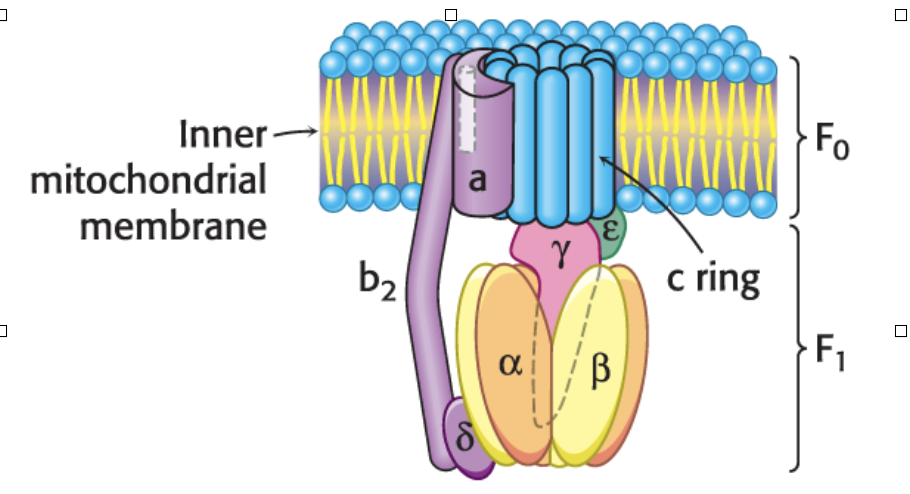
What does the F1 component do?
contains active sites and goes into the mitochondrial matrix

How do the cristae form the electron transport chain/what do they do?
to increase surface area
What are the three catalytic subunits of the confirmations of the F1
O (open) Nucleotides bind or released from beta subunit
L (loose) nucleotides trapped in beta subunit
T (tight) form ATP synthesized from ADP and Pi
How is there a release of tightly bound ATP?
no two subunits are ever in the same conformation, each subunit cycles through the three conformations (nucleotide binding sites are not equiv)

What amino acids power ATP synthesis?
glutamate binds to the c ring, then protons leave c subunit once they roate around.
What do the number of c rings determine?
the number of protons required to synthesize a molecule of ATP
How does NADH enter the mitochondria?
Electrons from cytoplasmic NADH enter ETC by glyceral phosphate shuttle
What is the difference between NADH and FADH2 as an electron donor?
in muscle FADH2 produced, and in cytoplasm NADH