Learn: Brain and Behavior Week 3 & 4
 Call Kai
 Learn
Learn Practice Test
 Spaced Repetition
 Match
Match Flashcards
 Knowt Play
1/83

There's no tags or description
Looks like no tags are added yet.
Name | Mastery | Learn | Test | Matching | Spaced | Call with Kai | Chat |
|---|
No analytics yet
Send a link to your students to track their progress
84 Terms
Neuron Hypothesis
neurons are the units of brain function
-Santiago Ramón y Cajal: the nervous system is made of discrete cells
Three Main Subdivisions of a Neuron
sensory neurons, interneurons, and motor neurons
sensory neurons (afferent)
-Bring information to the central nervous system
Interneurons (association neurons)
-Associate sensory and motor activity within the central nervous system
Motor Neurons
-Send signals from the brain and spinal cord to muscles
Neurons ("nerve cells") functional units of the brain
-The information-processing element of the nervous system
-Gather information, process it, and transmit it to other neurons or to muscles
Neurons are secretory cells they send messages by...
secreting neurotransmitter chemicals
Dendrites
•extensions of a neuron that receive chemical information from other neurons
-Each neuron usually has many dendrites
-Dendrites increase the surface area of the neuron so that it can receive more inputs from a wider variety of sources
General rule about dendrites
àthe more dendrites and the more complex their branching patterns, the more complex and diverse information converging on that neuron
cell body
(core region) of a neuron is also called the soma
-Contains the nucleus and much of the machinery that provides for the life processes of the cell
- integrates information
Axon
•(Fiber) extension of each neuron that sends information to other neurons
-Tracts: bundles of axons in CNS
-Nerves: bundles of axons in PNS
Difference between dendrites and axons
dendrites receive information, axons sends it out
Dendritic Spine
protrusions from a dendrite that greatly increase the surface area and are the usual point of contact with axons of other cells
Axon Hillock
juncture of soma and axon where the action potential begins
Axon Collaterals
small branches of an axon
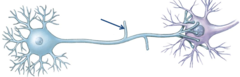
Terminal Boutons
little swellings at the very end tip of each axon branch (axon terminals) that actually deliver neuronal messages to next neurons
Synapse
gap between one neuron and another neuron
What cell structures form the most typical synapse?
terminal bouton of axon and dendritic spine of another neuron
Information Flow in a Neuron
dendrite -> cell body -> axon -> axon terminal
excitatory neuron
a type of nerve cell that fires chemical signals to activate downstream cells and increase the chance that they will generate an electrical impulse
Inhibitory Neurons
neurons that reduce activity in their neighbors
Cytoplasm
all the fluid inside the neuron (intracellular fluid)
-Including all the fluid inside the soma, inside the dendrites, and inside the axon and axon terminal (called axoplasm)
Organelles
microscopically small structures housed within the cytoplasm that are made out of protein
-Present in every neuron and are critical to the functions of neurons
list of organelles
-Mitochondria
-Neurofilaments & Microtubules
-Nucleus
-Golgi Apparatus & Endoplasmic Reticulum; Ribosomes
-Plasma Membrane
mitochondria
"powerhouses" of the cell (energy converters)
-Break down nutrients such as glucose to provide cell with energy (ATP) to perform its functions
-Located everywhere inside the neurons: scattered throughout neuron's soma, also in dendrites, axon, and axon terminals
Neurofilaments
(microfilaments) made of long, very thin protein fibers; located just under the outer membrane of soma, dendrites, and axon
-Form an internal skeleton for each neuron
-Necessary because the outer membrane is soft/floppy; provides shape for the neuron, helps it maintain its unique neuronal architecture
Microtubules
•thicker and much longer than neurofilaments
-Unique function: act as conveyor belts for vesicles and proteins to attach to and be transported from place to place inside the neuron
- located in cytoplasm
Nucleus
•cell's "executive office" in center of soma's cytoplasm
-Contains cell's chromosomes (DNA) which hold the recipes for making proteins
•Genetic blueprint to make all of the proteins and chemicals that the neuron needs to stay healthy and communicate with other neurons
- stores DNA and that is where genes are located
endoplasmic reticulum (ER)
The transportation system of the cell. It moves materials around the cell
- connected to the outer membrane and in cytoplasm
- Parts of the nuclear membrane that extend away from the center
- Smooth ER & Rough ER
Rough ER
studded with protein structures called ribosomes
Ribosomes
read genetic codes off of RNA and assemble the proteins/chemicals that are coded for
- bound to ER, in cytoplasm, inside mitochondria
Golgi apparatus
- proteins travel here
- wraps up large numbers of proteins inside small bags (vesicles) and large bags (cisterns)
- Protect the proteins inside from being degraded by enzymes within the cell
Axoplasmic Transport
•some axons are extremely long; because the axon and its terminal need some proteins/chemicals that can only be produced in the soma, there must be a system that can transport these things rapidly and efficiently through the axonal cytoplasm
•In order to move things around inside the neuron, things are transported on microtubules
- can take 3-4 days for new proteins made
Plasma Membrane
- surrounds the cytoplasm and axoplasm; forms the soft wall of the neuron, including the soma, dendrites, and axon
- Made out of two layers of lipids (fat molecules), arranged feet-to-feet in a double layer -> PhospholipidBilayer
Why can't water pass through the plasma membrane?
the membrane's interior is hydrophobic (water-fearing) due to nonpolar fatty acid tails; The plasma membrane's lipid bilayer acts as a barrier to water and, thus, to all the chemical particles that are dissolved in that water
-Since all the particles inside and outside the neuron are dissolved in water, nothing inside the neuron can get in through the lipid wall
What neuronal organelles are built from lipid bilayers?
vesicle and cistern bags made by the Golgi
Different ways for substances to cross the membrane
by channels, gates, or pumps
channel
opening in a protein embedded in the cell membrane that allows the passage of ions
Gate
-protein embedded in the cell membrane that allows substances to pass only when open
pump
-protein embedded in the cell membrane that actively transports a substance across the membrane
What organelles help with protein transport?
golgi apparatus and microtubules
Anions
negatively charged ions
Cations
positively charged ions
Ions
single atoms of elements that have a positive or negative electrical charge when dissolved in water
Example of cations
Ex: Sodium [Na+], Potassium [K+]), calcium (CA+)
Example of Anions
(Ex: Chloride [Cl-], protein molecules [A-])
The neuron's plasma membrane is a lipid bilayer that separates...
•intracellular fluid from extracellular fluid
Concentration gradient
differences in concentration of a substance among regions of a container allow the substance to diffuse from an area of higher concentration to an area of lower concentration
Voltage gradient
•difference in charge between two regions that allows a flow of current if the two regions are connected
-Opposite charges attract; similar charges repel
-Ions will move down a voltage gradient from an area of higher charge to an area of lower charge
Ungated channels
•allow the passage of ions (K+ channel)
Voltage-gated channels
open or close only at specific membrane voltages (Na+ channel)
Ligand-gated channels
-open when chemical binds (neurotransmitter gated)
What is the function of the Na+ -K+ pump?
It moves 3 Na+ ions out of the cell and 2 K+ ions into the cell using 1 ATP; to maintain electrochemical gradient across cell membrane
Why does the pump require ATP?
Because it's moving things against their concentration gradient.
Resting Membrane Potential
the separation of charge (caused by separation of + and - ions) that exists across the plasma membrane
-Exists across entire plasma membrane (dendrites, soma, axon, axon terminal)
Typical resting membrane potential for many neurons
-70mv
-70mv means...
•The fluid inside of a resting neuron is about 70 millivolts (mV) more negative than the outside fluid
what ions create resting membrane potential?
potassium and sodium and chloride
Depolarization
•the membrane by making the intracellular fluid more positive than it was at rest à less separation of charge across membrane
-Promotes neuron excitation
Hyperpolarization
•the membrane by making the intracellular fluid more negative than it was at rest à more separation of charge across membrane
- Promotes neuron inhibition
Action Potential
a neural impulse; a brief electrical charge that travels down an axon
-Large depolarization of the membrane ("spike")
-All-or-nothing; doesn't stop until it reaches axon terminal
-Summation of signals at axon hillock reaches threshold for activation
- Decision point is at the axon hillock
Threshold for activation
point at which voltage-gated ion channels in the axon hillock open
Special role of Axon Hillock in Action Potential
where action potential is initiated
Phases of Action Potential
-Depolarization
-Repolarization
-Hyperpolarization
Depolarization (AP)
•Massive influx of Na+ ions through voltage-gated Na+ channels
Repolarization (AP)
•Massive efflux of K+ ions through voltage-gated K+ channels
Hyperpolarization (AP)
•Na+ gates close, K+ efflux reduces membrane potential
•Undershoot - becomes more negative than at rest
•Pumps kick in to "reset" to resting potential
What always happens after an action potential begins?
rapid depolarization and a sharp rise in the membrane voltage
Saltatory Conduction
Action potential spike jumps from node to node; speeds up action potential
Role of myelin sheaths
•fatty insulating covering for axons
‒Produced by oligodendrocytes in the CNS; Schwann cells in the PNS
‒No ion channels across plasma membrane of an axon that is covered by myelin
- allows faster travel from nodes of ranvier
Node of Ranvier
•gaps along an axon not covered by myelin
‒Where voltage-gated ion channels are clustered
‒Enable saltatory conduction
Multiple sclerosis
A chronic disease of the central nervous system marked by damage to the myelin sheath. Plaques occur in the brain and spinal cord causing tremor, weakness, incoordination, paresthesia, and disturbances in vision and speech
What happens when action potential reaches axon terminal?
releases chemical neurotransmitter to next neuron
Difference btw chemical and electrical synapse
Chemical and electrical synapses differ mainly in speed and flexibility. Chemical synapses use neurotransmitters to send messages across a small gap, allowing for flexible and complex communication. Electrical synapses pass signals directly through gap junctions, enabling much faster but less modifiable transmission.
role of presynaptic Ca2+ channels
•Ca2+ enters the terminal and binds to the protein calmodulin, forming a complex
-Causes some vesicles to empty their contents, and others to get ready to empty
EPSP (excitatory postsynaptic potential)
depolarizing graded potential in postsynaptic neuron in response to activation of excitatory synapse
IPSP (inhibitory postsynaptic potential)
an inhibitory hyperpolarization of the postsynaptic membrane of a synapse caused by the liberation of a neurotransmitter by the terminal button
What happens when neurotransmitter binds to postsynaptic receptors?
it opens transmitter gated ion channels
4 different ways of neurotransmitter deactivation
1)Diffusion away from synaptic cleft
2)Degradation by enzymes in the synaptic cleft
3)Reuptake into the presynaptic neuron for subsequent re-use
4)Taken up by neighboring glial cells
Where are multiple ESPS and IPSP integrated in a neuron?
axon hillock
How does an inhibitory neuron send and deliver its inhibitory message to another neuron?
by releasing specialized chemical messengers called inhibitory neurotransmitters (such as GABA or glycine) into the synapse
- hyperpolarizes receiving neuron to stop it from firing
All brain neurons are surrounded by:
extracellular fluid
Organelles important for transporting materials in the neuron include __________ for packaging; and __________ for shipping.
Golgi apparatus; microtubules
The microtubules act as "conveyor belts" to transport proteins to the axon terminal.
true