Cell bio exam 4
 Call Kai
 Learn
 Practice Test
 Spaced Repetition
 Match
 Flashcards
 Knowt Play
1/24

There's no tags or description
Looks like no tags are added yet.
25 Terms
Mutations in Brca1 increase the chance of developing breast cancer to 80%. Which of the following best describes the function of the Brca1 gene?
Brca1 is a DNA repair protein that uses homologous chromosomes to repair double-strand breaks.
Checkpoint controls are essential for proper mitosis. During which phases of the cell cycle to checkpoint controls occur? Select ALL that apply.
S phase
Which of the following best describes what mitogens do?
Growth factors that encourage the cell to divide
Which of the following statements about CDKs is FALSE?
CDKs are unresponsive to other biochemical manipulations, such as phosphorylation and ubiquitination.
Cells with damaged DNA are always scheduled to self-destruct via apoptosis.
False
Cyclin is primarily regulated through transcription and ubiquitination.
True
The basal lamina is the foundational layer of the ECM on which the rest of the ECM is built; it is the layer of the ECM that is furthest from and has the least contact with epithelial cells.
False
Junctions can transmit signals in and out of the cell whereas adhesions cannot.
False
The ECM is primarily composed of soluble proteins that form a jelly-like consistency which provides a soft barrier from pathogens and regularly flushed out to carry waste and cellular debris away from healthy tissues.
False
The presence of calcium ions (Ca2+) can strongly disrupt and break apart cadherin networks.
False
Cell-matrix receptors are primarily responsible for binding signaling molecules in the ECM and carrying them to membrane-bound receptors.
False
Connections between cells made of cadherin that give strength and rigidity to cells
Anchoring junctions
Binds to the ECM and to the cytoskeleton to hold cells to a basal surface.
Cell-matrix adhesions
Connections between cells made of rings of connexon that permit small molecules to diffuse
Gap junctions
Connections between cells made of occludin and claudin that prevent the diffusion of water and solutes between cells
Tight junctions
Binds to one another and to the cytoskeleton to hold cells together
cell-cell adhesions
Cancer tumors become more heterogenous over time.
True
Which of the following are therapeutic targets for cancer treatments? Select ALL that apply.
Addition of monoclonal antibodies for immune checkpoint activation, such as PD-1 and PD-L1 AND Addition of CAR T cells
Which of the following mutations is least responsible for oncogeny?
Deactivation of NOTCH
Which of the following best explains why cancer cells use aerobic glycolysis instead of aerobic phosphorylation?
Intermediates of the TCA cycle can be utilized for cell growth by cancer instead of energy.
Which of the following cellular changes would be most likely to facilitate the epithelial-to-mesenchymal (EMT) transition of metastisizing cancer?
Switching from E-cadherin (epithelial-cadherin) to N-cadherin (neuro-cadherin)
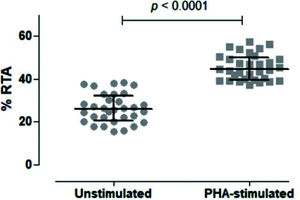
Pinto et al (2021) measured the relative telomerase activity (% RTA) of a new qPCR methodology. To do so, they compared healthy cells with PHA-stimulated healthy cells. Which of the following statements is true based on the results shown above?
PHA is a likely carcinogen (cancer-causing chemical).
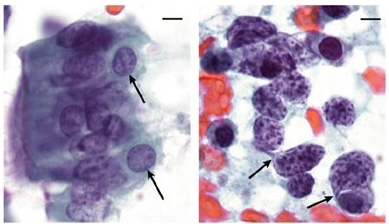
Below are two images of lung cells taken by Zink, Fischer and Nickerson (2004) using a Papanicolaou stain technique. The arrows are pointing to the nuclei of the lung cells that are either normal and healthy or cancerous and mutated. Based on the morphology and density of the chromatin in the nuclei, which image is of normal lung tissue?
The left image is of normal lung tissue.
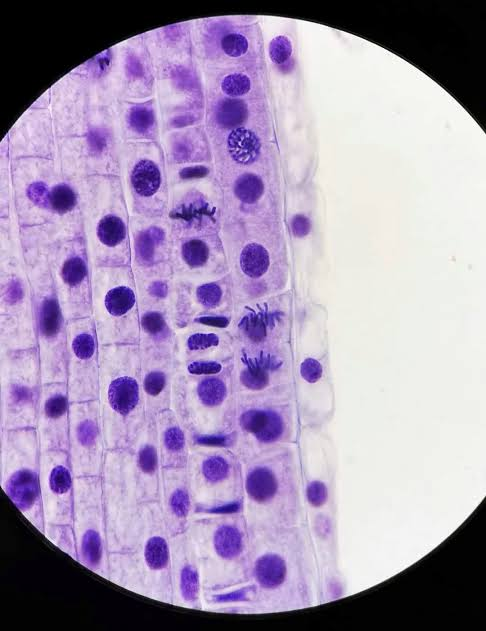
The majority of cells in this slide of mitotically active onion cells are in which phase?
Interphase