lec 12 - diversity
 Call Kai
 Learn
 Practice Test
 Spaced Repetition
 Match
 Flashcards
 Knowt Play
1/34

There's no tags or description
Looks like no tags are added yet.
35 Terms
Rem. I said last lec that every antibody is unique for one antigen. Which means that every B cell is unique.
i.e. Each B cell has only one antibody protein sequence.
….

T/F: Each B cell has only one antibody protein sequence but has MULTIPLE copies of that antibody.
true! see pic

What is germline theory?
it argued that antibody diversity is entirely inherited from your parents; entirely dictated by genes.

Who invented germline theory?
Elvin Kabat!

Why is germline theory not plausible?
Cuz rem. we can recognize EVERY possible antigen. There’s 1 trillion antigens.
Whereas we only have ~19K genes, and 3 billion nucleotides.
What is Somatic Diversification Theory?
Antibodies are generated dynamically through the alteration and rearrangement of some gene segments (V, D, and J)
This happens DURING our lifetime (hence “somatic”)
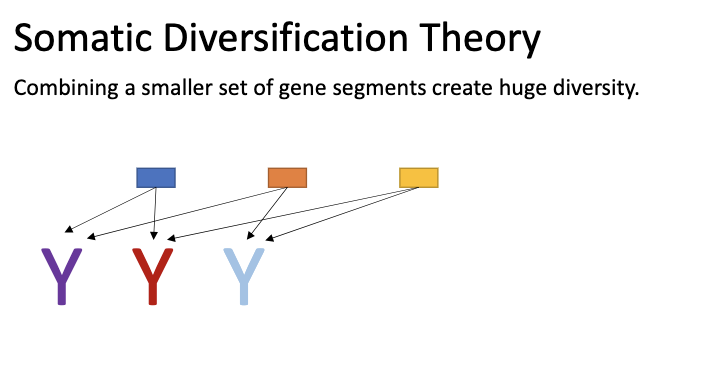

Who invented Somatic Diversification Theory?
Melvin Cohn and Susumu Tonegawa

Which is today’s accepted mechanism? Germline Theory or Somatic Diversification Theory?
Somatic diversification is the true mechanism
Most of the B and T cell receptor is a CONSTANT region. The diversity happens in the variable regions.
…

The B cell has 4 peptide chains: 2 identical heavy chains, 2 identical light chains.
How can I remember where each is?
heavy is the longer one on the inside; light is the short one on the outside!
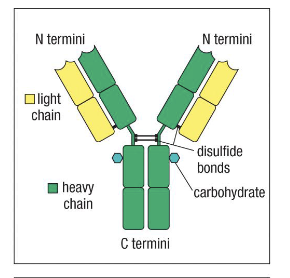

T/F: The constant regions are what define the 5 TYPES of anitbodies (immunoglobins IgA, D, E, G, M).
true!

Specificity is purely defined by the [constant / variable] region of an antibody.
Specificity is purely defined by the variable (red) region of an antibody.
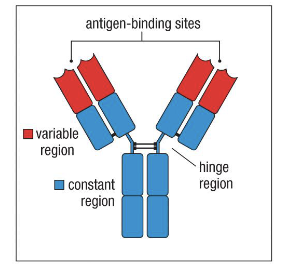
Ok now what about the TCR…. Does it also have a constant and variable region?
yes!


What are the 2 classes of TCRs?
The alpha-beta TCR
The gamma-delta TCR
Unlike antibodies, which look like a "Y," a TCR looks like a straight line or ___ shape embedded in the cell membrane.
Unlike antibodies, which look like a "Y," a TCR looks like a straight line or "I" shape embedded in the cell membrane.
So Somatic Diversification Theory is the mechanism, but what is the actual process called?
VDJ recombination!
Each BCR or TCR’s variable region is made up of 3 gene segments. What are they?
Hint: _ _ _ recombination
V - variable (encodes most of the variable region)
D - diversity (extra sequence variation)
J - joining (joins variable region to constant region)
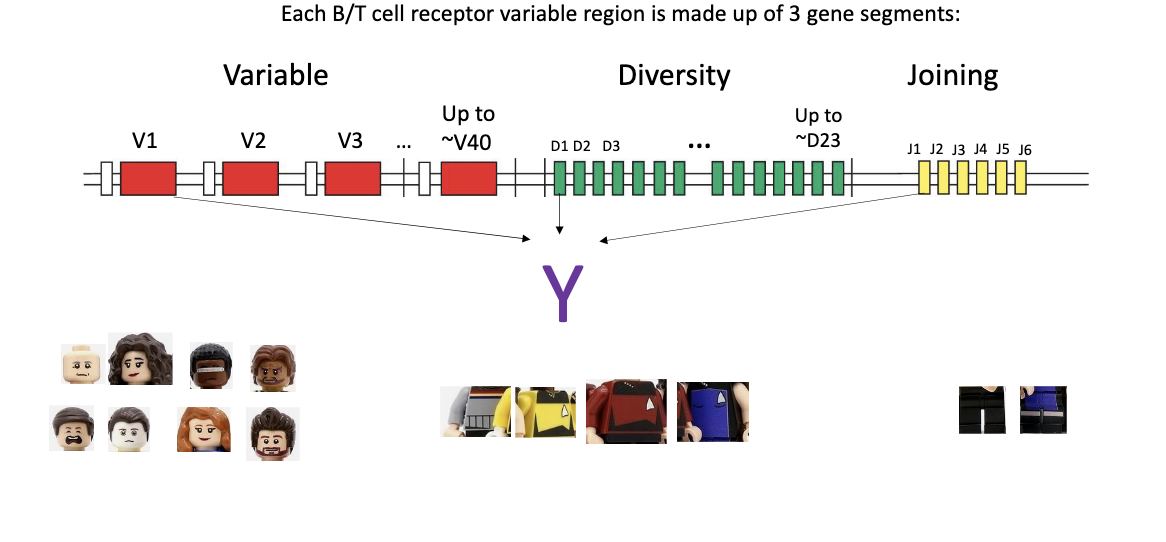

VDJ recombination:
V - there are 46 choices
D - there are 23 choices
J - there are 6 choices
the cell randomly picks exactly one red V segment, one green D segment, and one yellow J segment to form the functional variable region!
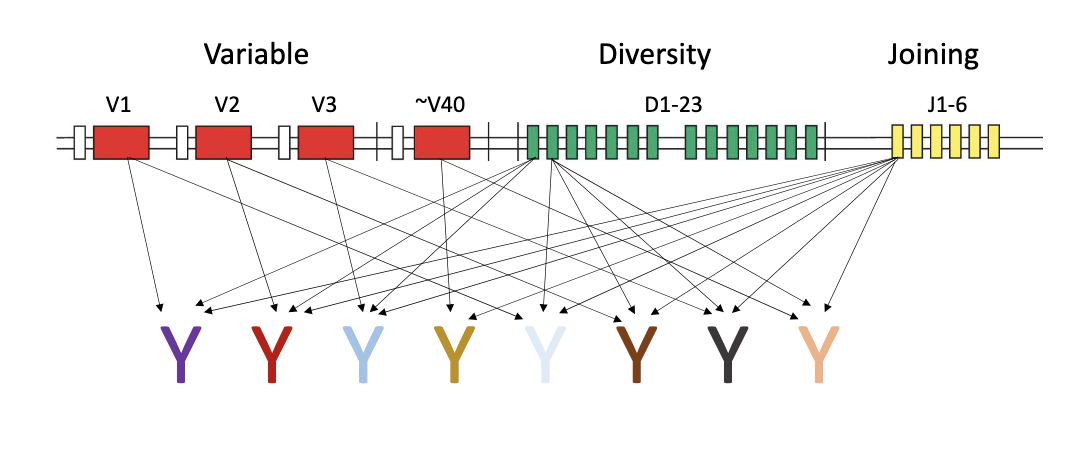
DNA is permanently cut and rearranged before the gene can be read to make a protein.
i.e. before translation
picture shows VDJ regions being spliced and joiend

Wait…
V - there are 46 choices
D - there are 23 choices
J - there are 6 choices
46×23×6 = 6348 possibilities!?
But we know we’re capable of a lot more than that… What part of the picture are we missing?
For one: This 6348 number is only for the heavy chain. To make a full antibody, this heavy chain must pair up with a light chain (which has its own thousands of V-J combinations).
For another: When the cell cuts and pastes V, D, and J together, enzymes randomly chew away DNA letters or add completely random bits —> ~infinite combos.

Heavy chains have VDJ recombination, whereas light chains only have VJ recombination?
yup.
T/F: Light chains lack the D in VDJ.
true!
T/F: There are 2 types of light chains.
true!

Heavy chain: one type
Light chain: two types (Kappa and Lambda)
…
Does the TCR also undergo VDJ and VJ recombination?
yup!
The beta chain is similar to the BCR heavy chain as in it undergoes VDJ recombination.
The alpha chain is similar to the BCR light chain as in it undergoes VJ recombination.
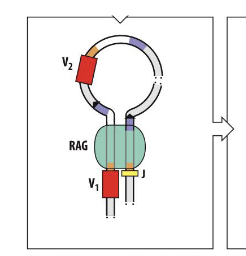
HOW exactly do gene segments get cut up… The _ _ _ complex is the enzyme responsible for doing so!
The RAG complex is the enzyme responsible for doing so!!
HOW exactly do gene segments get cut up?
The RAG complex is the enzyme responsible for doing so!!
The RAG protein complex binds to special DNA tags right next to V1 and J. It folds the chromosome, pulling the two targeted segments close to each other —> causes all the unneeded, intermediate DNA to "loop out"
The loop is excised. The V1 and J borders are spliced together.


The RAG protein complex binds to special DNA tags right next to V1 and J. It folds the chromosome, pulling the two targeted segments close to each other —> causes all the unneeded, intermediate DNA to "loop out"
The loop is excised. The V1 and J borders are spliced together.
But now we’re left with unmatching jagged ends…. What has God implemented to fix this?
A special enzyme called TdT acts like a biological random letter generator. It adds random nucleotides to both ends UNTIL they can match (“anneal”).

Since TdT adds a bunch of random nucleotides in at the junction, this is called …
… junctional diversity!

The RAG protein complex binds to special DNA tags right next to V1 and J. It folds the chromosome, pulling the two targeted segments close to each other —> causes all the unneeded, intermediate DNA to "loop out"
The loop is excised. The V1 and J borders are spliced together.
But now we’re left with unmatching jagged ends….
TdT enzyme adds random nucleotides to both ends UNTIL the DNA can anneal.
More matching nucleotides are added to fill the gaps retroactively.
…

Now do the numbers make sense?
yup!
So I lied earlier… Antibodies aren’t black and white. Antibodies can be low or high affinity for any antigen.
….

After a B cell encounters its antigen, it progressively IMPROVES its affinity for said antigen over time. This is called..
affinity maturation AKA somatic hypermutation!

Summary what are the three types of diversifiers diversifying BCRs and TCRs?
combinatorial and junctional diversity! and somatic hypermutation!

T/F: Somatic hypermutation only exists for B cells, not T cells.
true!