Face, Scalp, Muscles of Facial Expression, and Parotid Gland
 Call Kai
 Learn
Learn Practice Test
 Spaced Repetition
 Match
Match Flashcards
 Knowt Play
1/87

There's no tags or description
Looks like no tags are added yet.
Name | Mastery | Learn | Test | Matching | Spaced | Call with Kai | Chat |
|---|
No analytics yet
Send a link to your students to track their progress
88 Terms
What are the 5 layers of the scalp from superficial to deep?
Skin, connective tissue (dense), aponeurosis (connecting frontalis to occipitalis), loose connective tissue, and pericranium
Where do the muscles of facial expression derive from?
2nd pharyngeal arch
What innervates the muscles of facial expression?
Facial nerve (CN VII)

What is indicated by A?
Galea aponeurotica
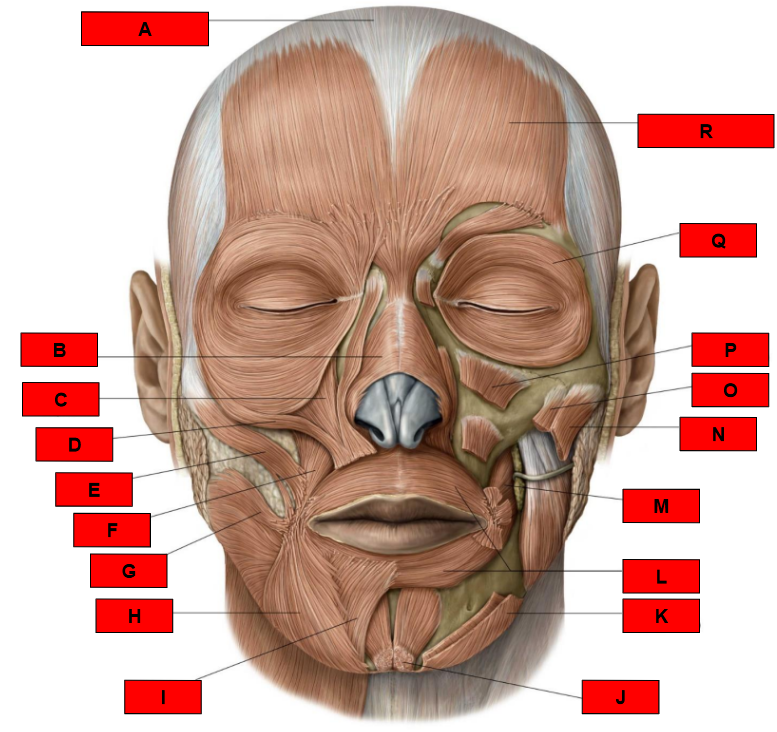
What is indicated by B?
Nasalis

What is indicated by C?
Levator labii superioris

What is indicated by D?
Zygomaticus minor

What is indicated by E?
Zygomaticus major

What is indicated by F?
Levator anguli oris
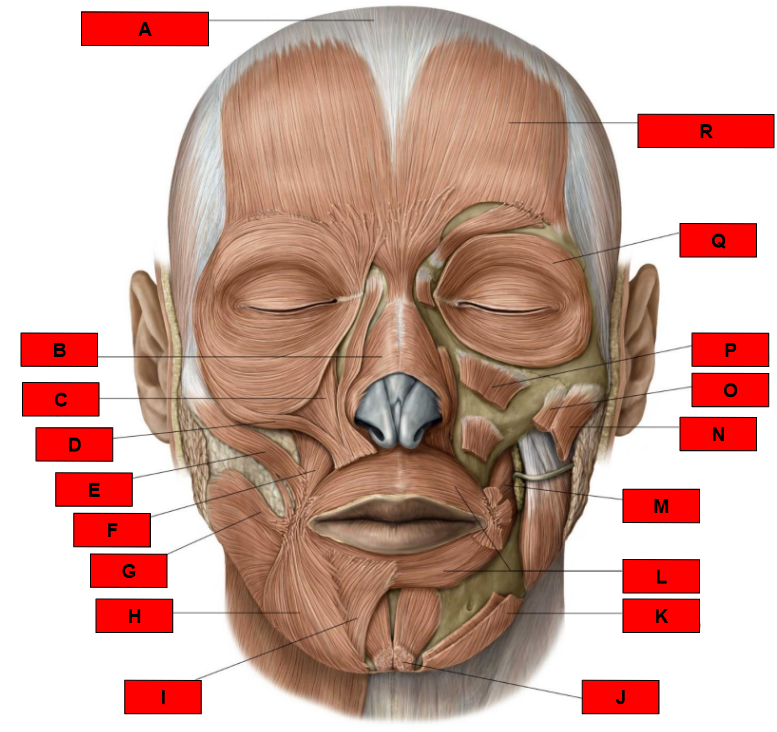
What is indicated by G?
Risorius

What is indicated by H?
Depressor anguli oris

What is indicated by I?
Depressor labii inferioris

What is indicated by J?
Mentalis
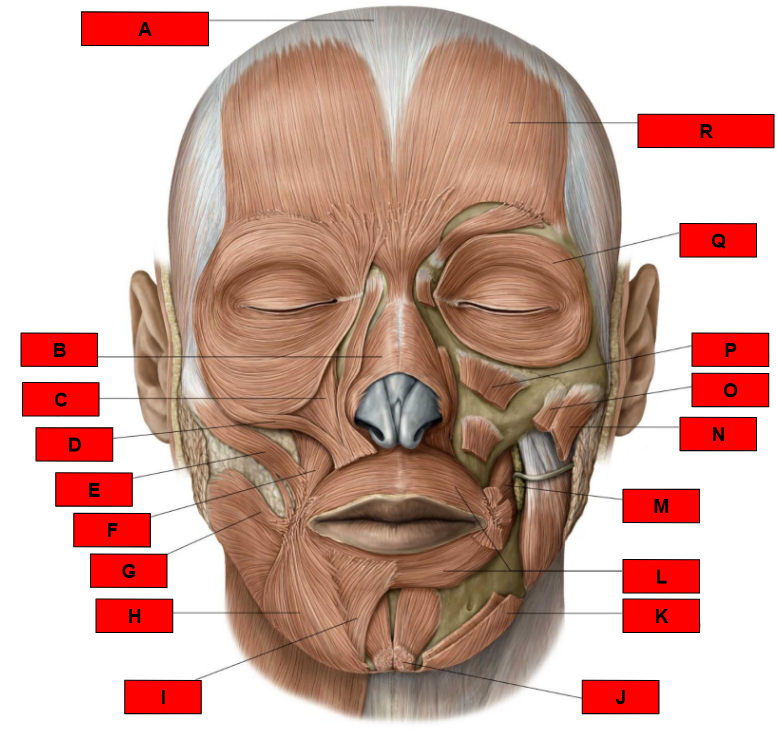
What is indicated by K?
Depressor anguli oris
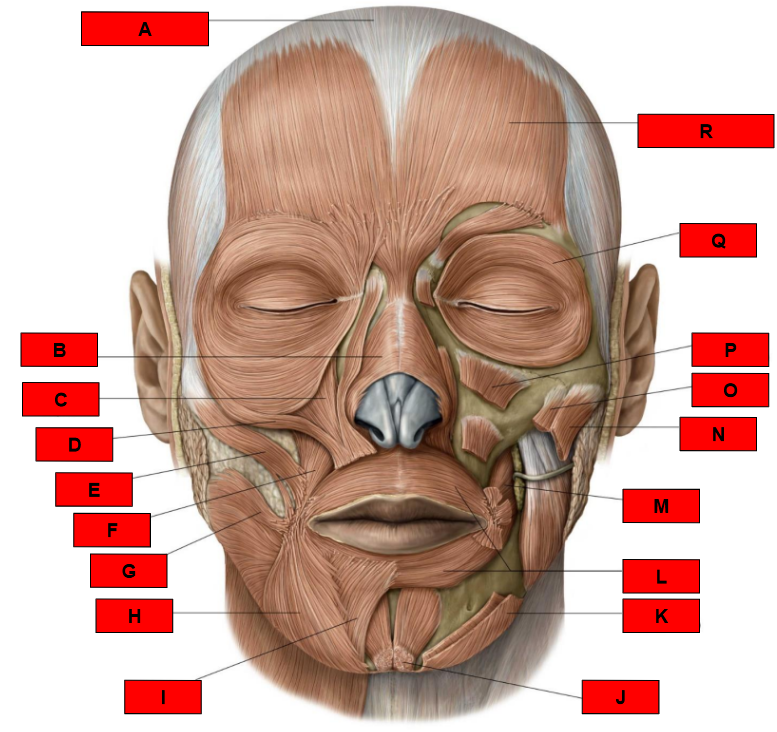
What is indicated by L?
Orbicularis oris

What is indicated by M?
Buccinator

What is indicated by N?
Zygomaticus major

What is indicated by O?
Zygomaticus minor

What is indicated by P?
Levator labii superioris
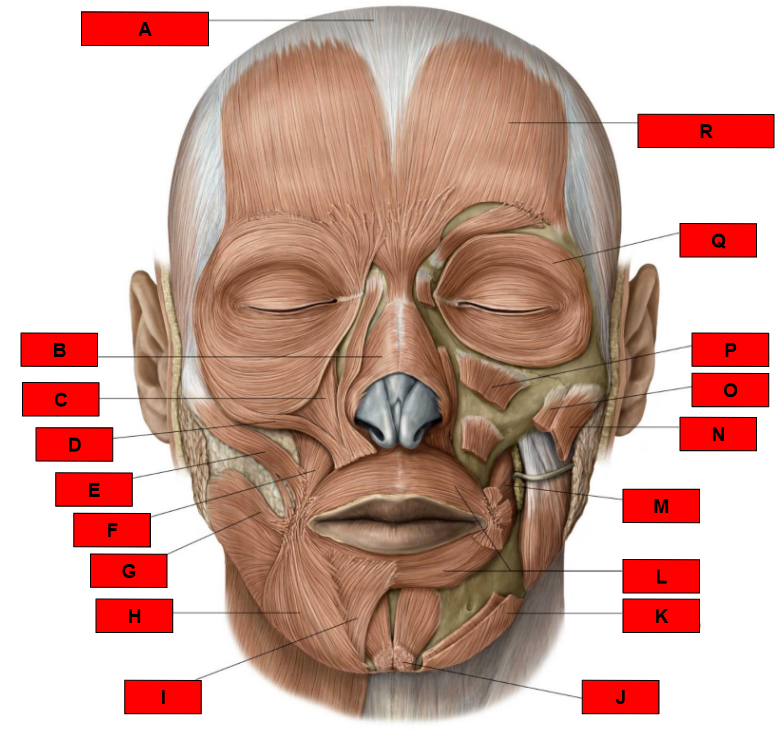
What is indicated by Q?
Orbicularis oculi

What is indicated by R?
Occipitofrontalis frontal belly

What is indicated by A?
Occipitofrontalis frontal belly

What is indicated by B?
Orbicularis oculi

What is indicated by C?
Nasalis

What is indicated by D?
Zygomaticus minor

What is indicated by E?
Orbicularis oris
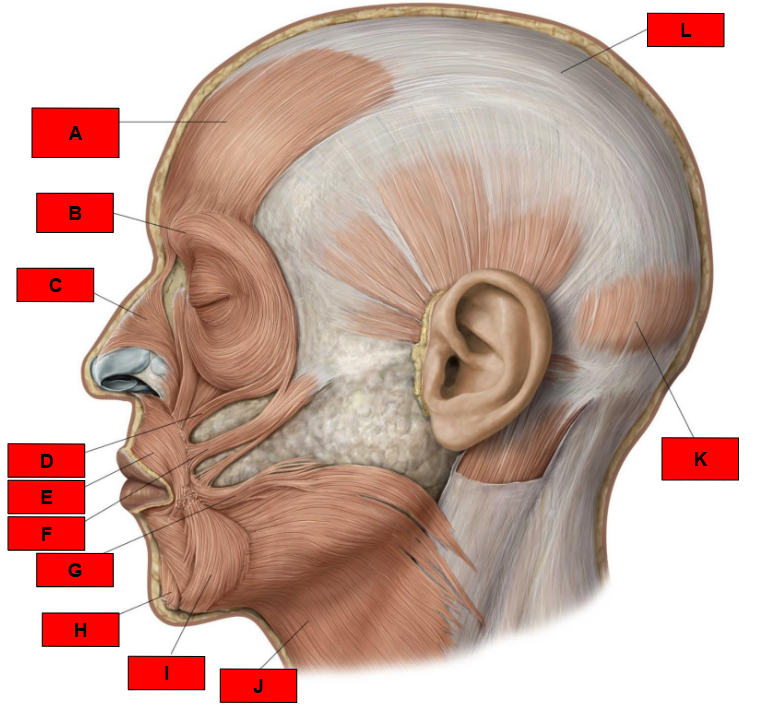
What is indicated by F?
Zygomaticus major

What is indicated by G?
Risorius
What is indicated by H?
Mentalis
What is indicated by I?
Depressor anguli oris

What is indicated by J?
Platysma

What is indicated by K?
Occipitofrontalis occipital belly

What is indicated by L?
Galea aponeurotica

What is indicated by A?
Temporal branches

What is indicated by B?
Zygomatic branches

What is indicated by C?
Buccal branches
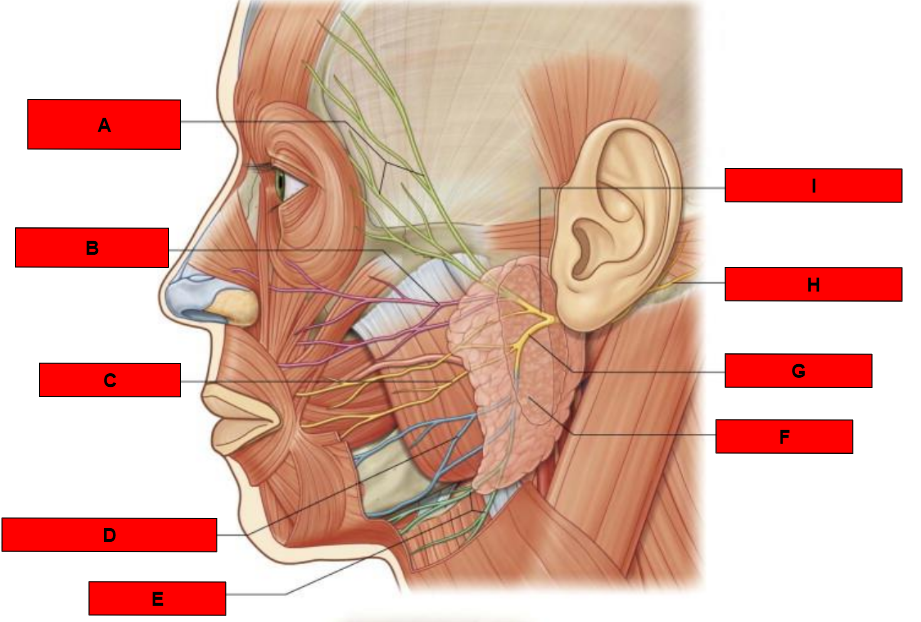
What is indicated by D?
Marginal mandibular branches
What is indicated by E?
Cervical branches
What is indicated by F?
Parotid gland
What is indicated by G?
Cervicofacial branch

What is indicated by H?
Posterior auricular nerve

What is indicated by I?
Temporofacial branch
What is Bell’s palsy?
Weakness/paralysis of facial muscles; usually unilateral, idiopathic
What is Herpes Zoster Oticus (Ramsay-Hunt Syndrome)?
Reactivation of varicella zoster virus along the sensory distribution of facial nerve; causes facial skin lesions on/around ear
Where does the parotid duct open?
Opposite 2nd maxillary molar
What are the three divisions of the trigeminal nerve?
V1 (ophthalmic), V2 (maxillary), and V3 (mandibular)
What sensory information does the V1 (ophthalmic) nerve provide?
Forehead, anterior scalp, upper eyelids, dorsum of nose
What sensory information does the V2 (maxillary) nerve provide?
Cheeks, lower eyelids, upper lip
What sensory information does the V3 (mandibular) nerve provide?
Lower lip, chin, lateral scalp
What are the branches of V1 (ophthalmic) nerve?
Supraorbital, supratrochlear, lacrimal, infratrochlear, and external nasal
What are the branches of V2 (maxillary) nerve?
Infraorbital, zygomaticofacial, and zygomaticotemporal
What are the branches of V3 (mandibular) nerve?
Mental, buccal, and auriculotemporal
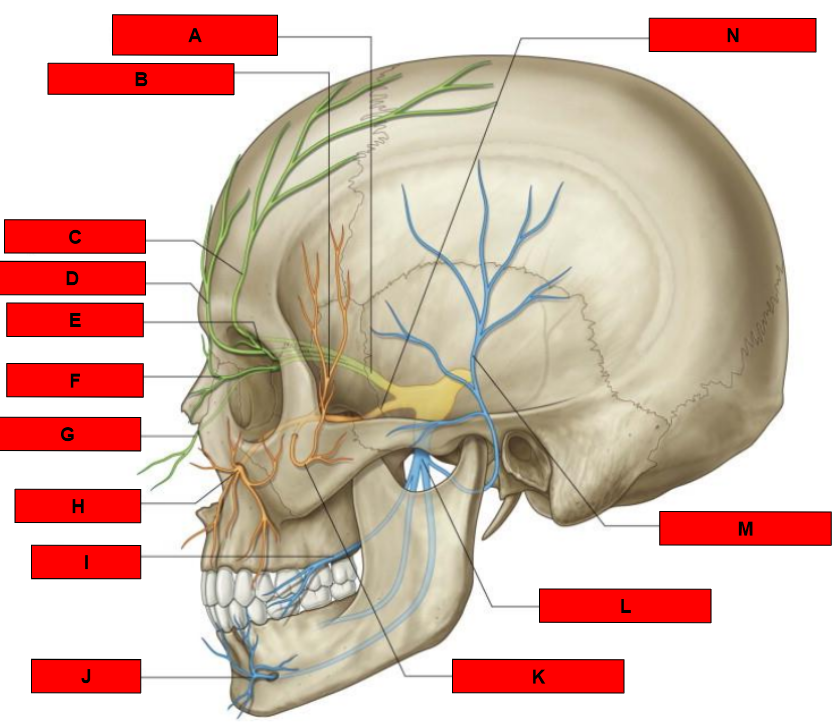
What is indicated by A?
Ophthalmic nerve
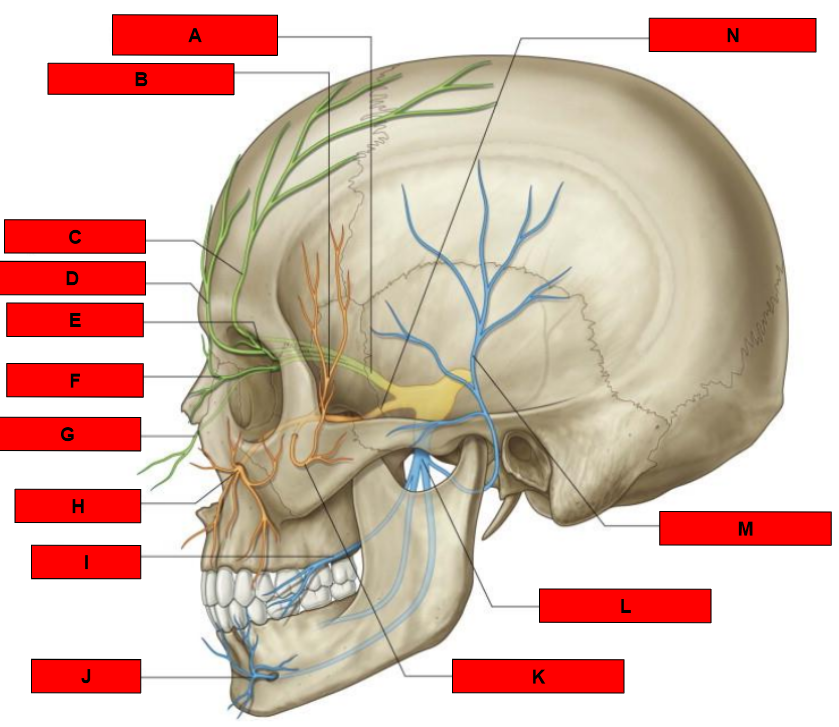
What is indicated by B?
Zygomaticotemporal nerve
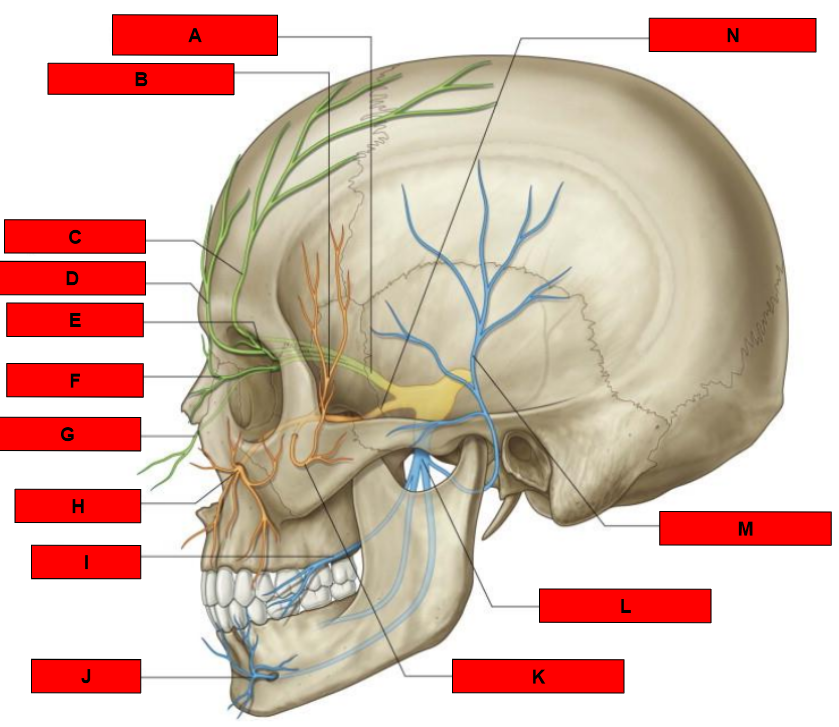
What is indicated by C?
Supraorbital nerve

What is indicated by D?
Supratrochlear nerve

What is indicated by E?
Lacrimal nerve

What is indicated by F?
Infratrochlear nerve
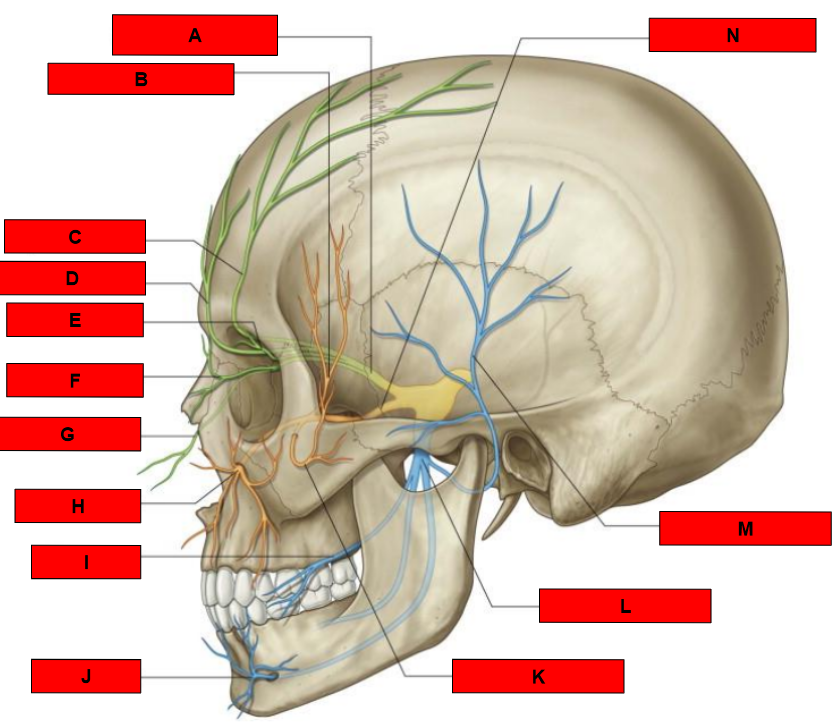
What is indicated by G?
External nasal nerve

What is indicated by H?
Infraobital nerve

What is indicated by I?
Buccal nerve
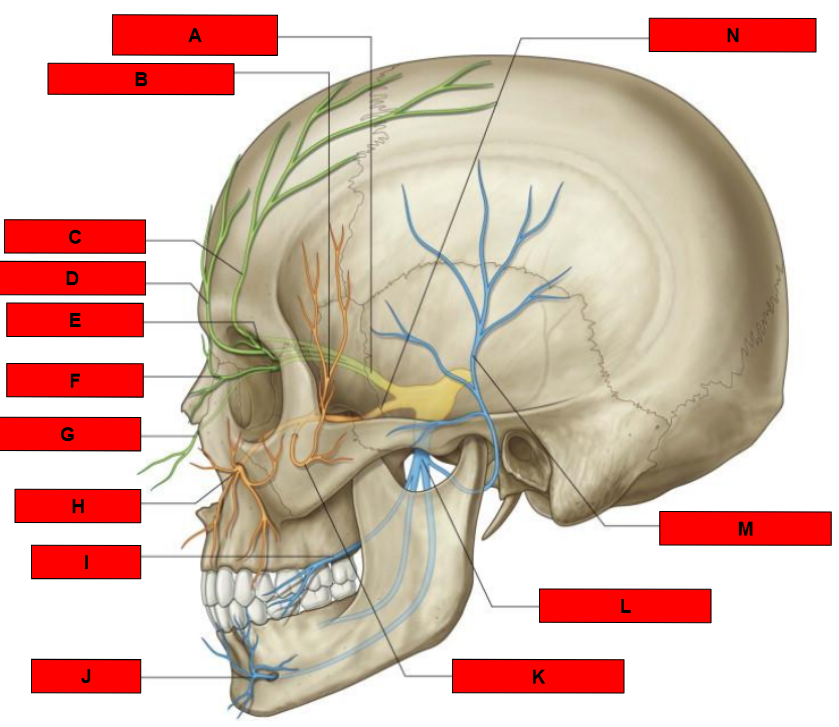
What is indicated by J?
Mental nerve
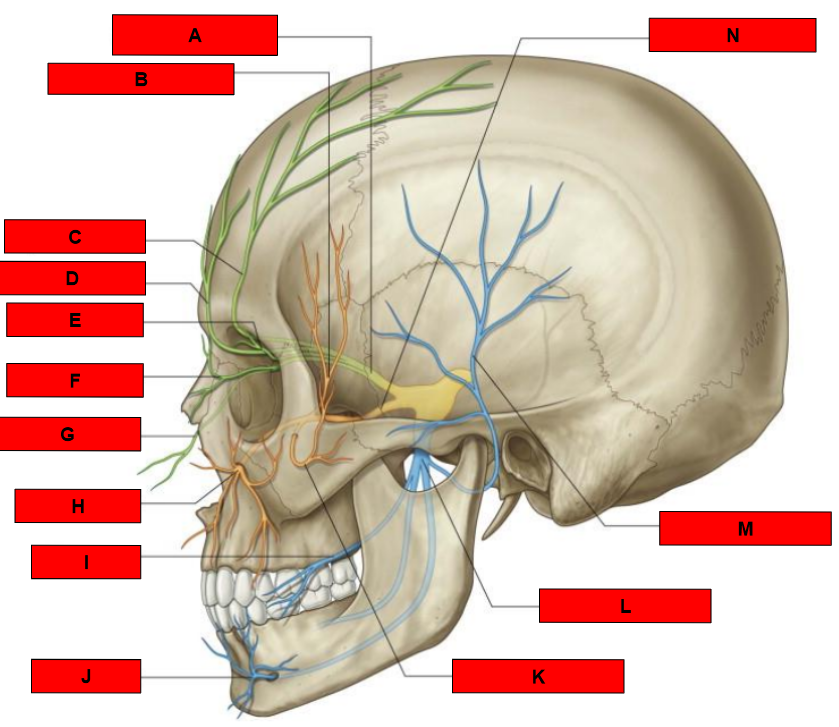
What is indicated by K?
Zygomaticofacial nerve
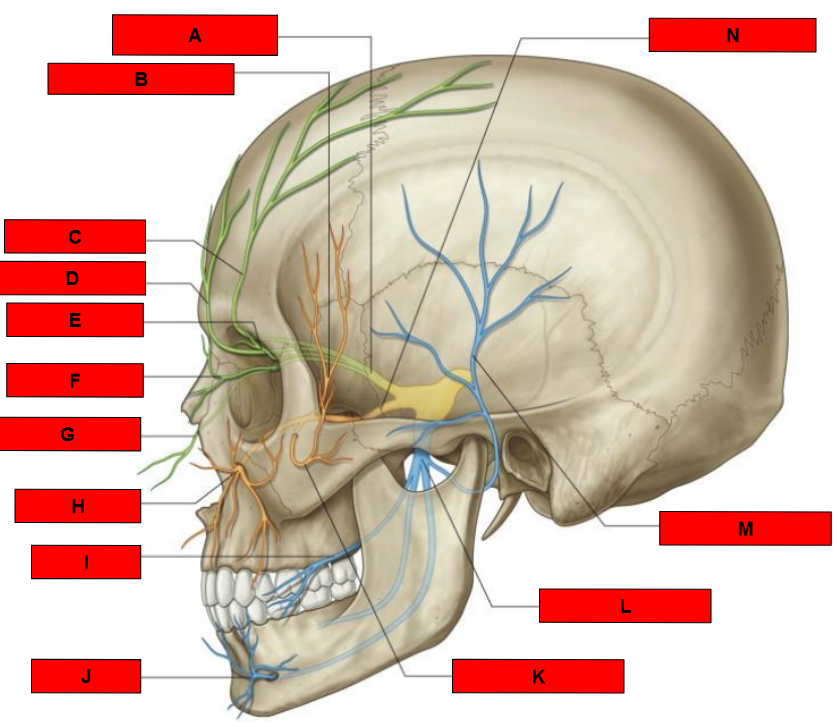
What is indicated by L?
Mandibular nerve
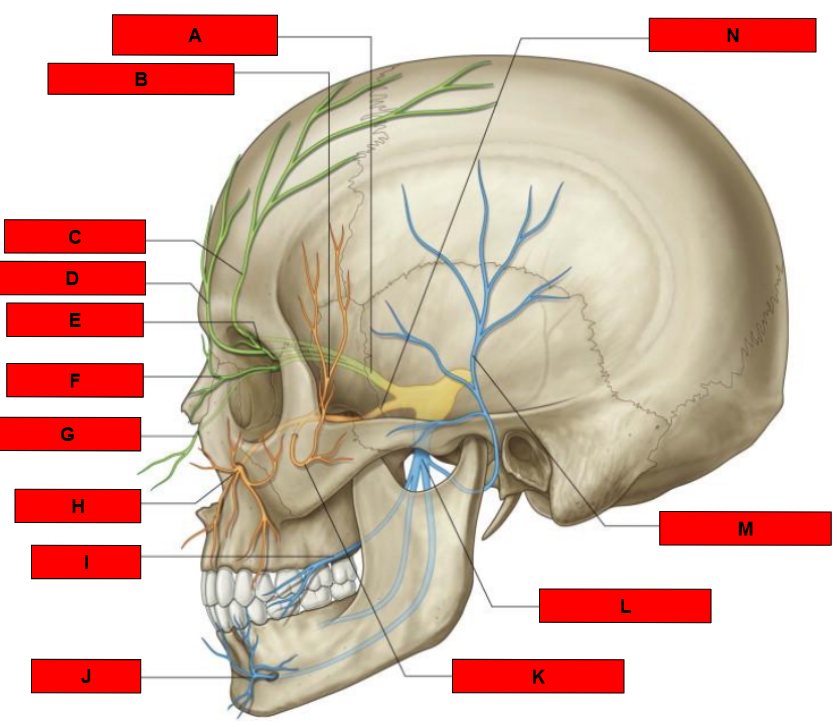
What is indicated by M?
Auriculotemporal nerve

What is indicated by N?
Maxillary nerve
What is the most commonly affected division of the trigeminal (CN V) in herpes zoster?
Ophthalmic
What is Hutchinson’s sign?
Vesicles on the tip of the nose that indicate herpes zoster of the trigeminal nerve
What is tic douloureux?
Trigeminal neuralgia; sudden attacks of excruciating facial pain
What is the most commonly affected division of the trigeminal nerve in tic doulourex?
Maxillary nerve (V2)
What supplies the face?
Branches of both external and internal carotid arteries
What are the branches of the facial artery?
Superior and inferior labial arteries, lateral nasal artery, and angular artery
What is a branch of the superficial temporal artery?
Transverse facial artery
What are the branches of the internal carotid artery that supply the face?
Supraorbital artery and supratrochlear artery
Where is the blood supply to the scalp found?
Layer of dense connective tissue
What is a special characteristic of the veins of the face?
Lack valves
Where does the facial vein begin?
Medial angle of eye (angular vein)
What forms the facial vein?
Union of supraorbital and supratrochlear veins
What does the angular vein anastomose with?
Ophthalmic veins to form the cavernous sinus
What anastomoses with both the facial vein and cavernous sinus?
Pterygoid plexus of veins
What is cavernous sinus thrombosis?
Inflammation of cavernous sinus, often from facial infection
Where does lymph from the posterior scalp drain?
Occipital and mastoid nodes
Where does lymph from the lateral face, anterior scalp, and eyelids drain?
Parotid lymph nodes
Where does lymph from the upper lip and lateral parts of lower lip drain?
Submandibular lymph nodes
Where does lymph from the chin and center of lower lip drain?
Submental lymph nodes
Where are the parasympathetic preganglionic fibers found?
Lesser petrosal nerve (branch of CN IX)
Where are the parasympathetic ganglia?
Otic ganglion
Where are the parasympathetic postganglionic fibers found?
Auriculotemporal nerve (branch of CN V3)