Exam 2 - Part 2
 Call Kai
 Learn
 Practice Test
 Spaced Repetition
 Match
 Flashcards
 Knowt Play
1/34

There's no tags or description
Looks like no tags are added yet.
35 Terms
Synthetic Cubism
Works of this phase emphasize the combination, or synthesis of forms in the image
Color assumes a strong role in these works
Shapes, while remaining fragmented and flat, are larger and more decorative
Smooth and rough surface textures may be contrasted with one another
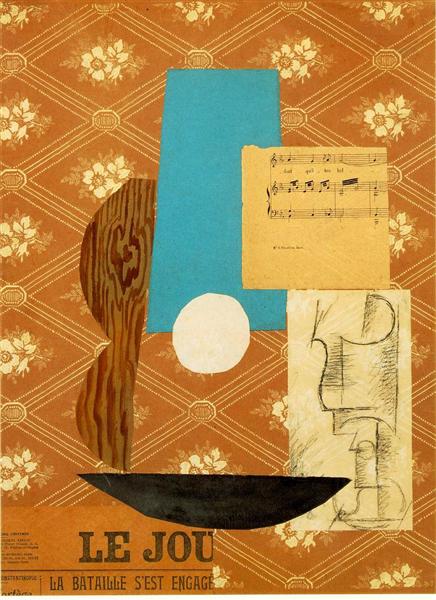
Collage technique where foreign materials such as newspapers or tobacco wrappers, are attached onto the canvas in combination with painted areas
Collage further emphasizes the differences in texture and, at the same time, poses the question of what is reality and what is illusion
Experimental additions such as faux and decorative papers which imitated cane or wood were used to contrast with painted areas

-
Synthetic Cubism, Pablo Picasso, Still Life With Chair Caning 1912
-
Synthetic Cubism, Pablo Picasso, Guitar, Sheet Music, and Wine Glass 1912

-
Synthetic Cubism, Pablo Picasso, Green Still Life, summer 1914

-
Cubist Sculpture, Georges Braque, 1914, The Artist’s Paris Studio

-
Cubist Sculpture, Raymond Duchamp-Villon, The Horse 1914

-
Cubism, Juan Gris, The Table 1914

-
Synthetic Cubism, Juan Gris, Still Life & Townscape (Place Ravignan) 1915

-
Robert Delaunay, Simultaneous Contrasts: Sun & Moon 1913

-
Sonia Delaunay, Blanket, 1911

-
Analytical Cubism, Marcel Duchamp, Portrait of Chess Players, 1911

-
Cubism, Marcel Duchamp, Nude Descending A Staircase No. 2 1912

-
Photograph, Eliot Elisofan, Marcel Duchamp Walking Down Stairs

-
Étienne-Jules Marey, A Man Doing a High Jump, 1892

-
Jacques Villon, Yvonne D. In Profile 1913
The November Group (Novembergruppe)
German Social Realism - Kathe Kollwitz
The New Objectivity
A style in Germany in 1920s as a challenge to expressionism
A return to unsentimental reality and a focus on an objective world, as opposed to more abstract, romantic, or idealistic tendencies of expressionism
Often associated with portraiture and its
leading practitioners include Max Beckmann, Otto Dix, and George Grosz
Their mercilessly naturalistic depictions, sometimes
Reminiscent of the meticulous process of the old master,
frequently portrayed weimar society in a caustically satirical manner…however, precise the depiction, it verges on satire

-
German Social Realism, Kathe Kollwitz, Female Nude With Green Shawl Seen From Behind, 1903

-
German Social Realism, Kathe Kollwitz, The Volunteers (Die Freiwill)

-
German Social Realism, Kathe Kollwitz, Lamentation: In Memory of Ernst Barlach (Grief)

-
New Objectivity, George Grosz, Fit For Active Service (The Faith Healers) 1916-17

-
New Objectivity, George Grosz, Republican Automatons 1920

-
New Objectivity, Otto Dix, The Scat Players - Card Playing War Invalids 1920
ATUMM
Airplanes
Tanks
U-Boats
Machine guns
Mustard gas

-
New Objectivity, Otto Dix, Corpse in Barbed Wire From the War 1924

-
New Objectivity, Otto Dix, Dr. Mayer-Hermann, 1926

-
August Sander, Wandering People From Series “People of the 20th Century”
Harlem Renaissance
movement lasted from 1919-1930s, mainly associated with NYC
James Van Der Zee, Sargent Johnson, Palmer Hayden, Augusta Savage, Aaron Douglas Romaire Bearden
All art forms such as music, dance, theater, and visual arts explored
The community developed greatly from post WWI, emigration from the south
Harlem became the economic, political, and cultural center of the black community

-
Harlem Renaissance, Palmer Hayden, A Janitor Who Paints

-
Harlem Renaissance, James Van Der Zee, Harlem Billiard Room

-
Harlem Renaissance, James Van Der Zee, Future Expectations

-
Harlem Renaissance, Romaire Bearden, Folk Musicians

-
Harlem Renaissance, Augusta Savage, The Harp

-
Harlem Renaissance, Augusta Savage, Gamin 1915

-
Harlem Renaissance, Jacob Lawrence, The Migration Series, Panel No1 During WWI There was a Great Migration North by Southern African Americans
Surrealism
Two Types: Naturalistic Surrealism and Abstract Surrealism
International movement of the 1920s and 1930s
Influence of psychoanalytical thought
Influence of Sigmund Freud and invincibility of artistic genius
Focus of the separation of the conscious self and subconscious self
The subconscious is a repository for artistic genius
Psychoanalytic theory carried with it this perception of women as objects to desire for fear, reviving forcefully the femme fatale
Dreams are the vehicle of the subconscious
Surrealist imagery often makes reference to very personal symbolism