PSYCH 1X03: Forming Impressions
 Call Kai
 Learn
 Practice Test
 Spaced Repetition
 Match
 Flashcards
 Knowt Play
1/21

There's no tags or description
Looks like no tags are added yet.
22 Terms
What are the two attribution theories
Covariation and correspondent inference theory
Covariation Theory
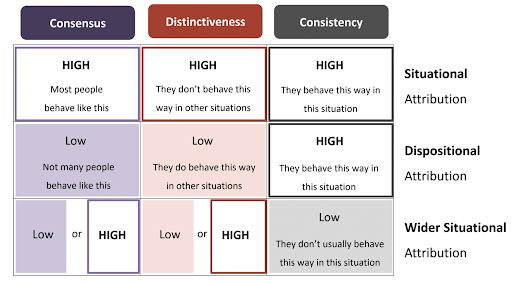
Three variables used to determine if a behaviour is dispositional (influenced by internal factors) or situational (influenced by external factors)
Consensus: How do others behave in the same situation (different people, same situation)
Distinctiveness: How does the same person behave in different situations (same people, different situations)
Consistency: How does the same person behave in the same situation at different times (same person, same situation)
When would you make a situational attribution, a dispositional attribution, and a wider situational attribution? (level of consensus, distinctiveness, and consistency)
Correspondant Interference Theory
Actively analyzes a person’s behaviour to make inferences as to why they perform a behaviour based on three variables
Use:
- Degree of choice: The amount of freedom they had in choosing their opinion or behaviour
E.g. Someone being assigned a side in a debate vs freely choosing what side to argue for
- Expectation: The degree to which an individual’s behaviour in a particular social role matches our expectations for that role
We gather more information about a person when their actions defy our expectations than we do when a behaviour is a typical part of a social role or otherwise expected given the circumstances
- Intended consequences: The goals and motivations of an underlying their behaviour
Ex: A girl from your physics class says hi to you but you doubt her sincerity because you know she is running for class representative (she wants to get your vote)
Fundamental Attribution Error
Tendency to over-value dispositional factors for the observed behaviours of others while under-valuing situational factors → “what people do = who they are”
Observance of Fundamental Attribution Error across cultures
Pronounced in Western culture
Indians make attributions to situational factors more than dispositional factors compared to Americans
Fundamental Attribution Error = diminished in collectivist societies
Individualist society (American) = increases probability of Fundamental Attribution Error
Collectivist society (Chinese) = decreased probability of Fundamental Attribution Error
Actor/Observer Effect
We are more susceptible to the Fundamental Attribution Error for others’ behaviours but we are aware of the situational factors influencing our own behaviour
Self-serving bias
We attribute our success to dispositional factors and our failures to situational factors
Ex: Winning a game of cards = dispositional (I had good strategy)
Ex: Losing a game of cards = situational (I had a bad deck)
Above Average Effect
Bias in your perception may lead you to think you are above average on many things that may be important to you (beauty, driving, social skills, etc)
Representativeness heuristic vs probability
Representativeness heuristic: you classify people by considering how well their behaviour fits with a certain prototype
We often discount probability in favour of a representative prototype
Ex: Given a description of Jennifer, asked if she is a bank teller or a bank teller and a feminist
Higher probability she is just a banker instead of both
But representativeness heuristic takes over > bank teller + feminist
Tversky & Kahneman’s study: 3 groups with varying degrees of familiarity with statistics; even those very familiar with statistics let the representativeness heuristic take over probability
Availability heuristic and how it can influence our perception of an experience
Availability heuristic: considers the experiences most readily available in memory
Ex: First half of term taught by Dr. First, second half taught by Dr. Second
First half of term you went to class often + talked with people after class
Second half you skipped class often + did not talk with people after class (burnt out)
Asked to rank the professors > more positive memories with Dr. First > rank Dr. First higher
The availability of flaws in memory influences our perception of an experience
Ex: Students asked to rate a class
Survey 1: List 2 improvements = easily available flaws → leads one to believe there are many flaws → lower rating
Survey 2: List 10 improvements = less available flaws → leads one to believe there aren’t many flaws → higher rating
4 factors governing attractiveness
Proximity: More attracted to people who are close in physical and functional (how often do we get to interact) distance to us
Familiarity: Rate faces as being more attractive the more familiar they are to us
Physical Attractiveness: Use physical attractiveness as an indicator of personal characteristics; physically attractive → kind, warm, sensitive
Others’ Opinions of Us: When opposite to the initial impression, the new impression is strongly influential
Mere Exposure Effect
Mere Exposure Effect: Tendency to be more positive towards familiar stimuli / perceive familiar stimuli as more favourable
How do we rate those who didnt have a good first impression of us but now like us?
Case study where people were shown the results of people who had talked about them, and were asked to rate how much they liked those people
Negative impression to positive impression = gain → boosts our self esteem
We tend to like people who originally did not like us
Do we tend to like people who we anticipate interacting with
Yes
Halo Effect
Halo Effect: Tendency to attribute more positive characteristics to individuals that make a positive impression
What was revealed about those who have low self esteem and attraction to others
We like those who like us back, especially when we have low-self esteem
Waltser study: women who had their self-esteem lowered were more likely to rate a male who had asked them on a date as more attractive than those who had their self-esteem heightened
Terry Anderson
Hezbollah in Lebanon held Terry Anderson hostage for seven years, isolated
Anderson felt his mind disintegrate when he was alone for long stretches of time
When he shared his cell with other hostages, his thinking recovered
False Consensus Effect
As social animals it is important to us that we fit in with groups and that our beliefs are not totally out of line with the norms of our society
False Consensus Effect: We tend to believe more people share our views than they actually do
Effect helps protect our self-esteem
Illusory Correlation
Illusory Correlation: When individuals believe that two variables are related even though there is no evidence for that relationship → relevant for formation of stereotypes
What is the Implicit Association Test and what does it reveal about unconscious stereotypes
Implicit Association Test (IAT): A speeded categorization task where participants categorize stimuli into four different categories using two response keys.
Categories paired so that two categories require one response key and two categories require the other response key.
If the participant completing the task views two categories requiring the same response as compatible, their performance on the IAT will be fast and accurate
E.g. positive words/white faces and negative words/black faces sharing keys
If instead, two related categories are incompatible, their performance on the IAT will be slower with more errors
E.g. positive words/black faces and negative words/white faces sharing keys
Test reveals the presence of unconscious stereotypes
Greenwald, McGhee, and Schwartz study with unprejudiced white people completing an IAT
Results: participants were significantly faster at categorizing words in the compatible pairing compared to the incompatible pairing
What 3 aspects does intergroup bias span
Stereotypes (cognition): beliefs about attributes that are thought to be characteristic of members of particular groups
prejudice(affect): a negative attitude or affective response toward a certain group and its individual members
Discrimination (behaviour): negative behaviour towards members of a particular group based on their membership in that group