OHCD- Combined
 Call Kai
 Learn
 Practice Test
 Spaced Repetition
 Match
 Flashcards
 Knowt Play
1/103

There's no tags or description
Looks like no tags are added yet.
104 Terms
oral health equity
-everyone has a fair and just opportunity to achieve good oral health, regardless of their income, race, geography, disability status, or insurance status
-important because: not all people have the same access to dental care, barriers such as cost, transportation, provider shortages, and lack of insurance can affect oral health outcomes, these barriers contribute to differences in oral disease, untreated dental needs, and access to care
sources of inequity in oral healthcare
-geography: rural residents are disproportionately burdened by limited access to dental care and provider shortages
-income: poor and low income families are over 3x more likely than high income families to have unmet dental needs
-race/ethnicity: Hispanic Americans are 2x as likely and black americans are 1.5x as likely as white americans to have unmet dental needs
-disability status: adults with a disability rated their oral health as fair/poor at 2x the rate of adults without a disability
-insurance status: uninsured are 3x as likely as private insured to forego dental care due to cost
dental insurance
-financial arrangement in which individuals, employers, or government programs pay premiums to a third-party payer in exchange for partial coverage of dental care costs

employer contributions and leverage
-employers play a major role in shaping dental coverage
-employers often pay a substantial share of employees’ premiums
-gives employers significant leverage over: which plans are offered, which benefits are included
-result: covered dental benefits may reflect employer priorities and budget constraints more than patient or provider preferences
risk pool
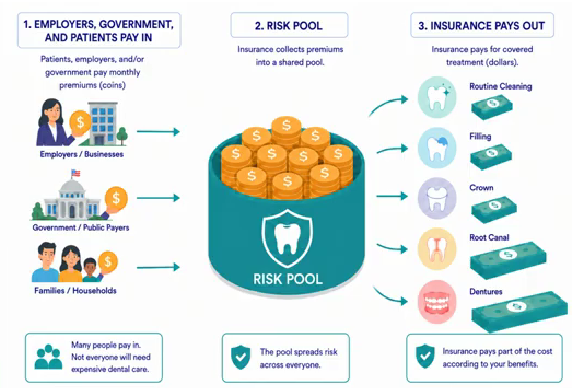
how does dental insurance work?
-works by spreading financial risk across a large group of people, called “risk pooling”
-patients, employers, and/or governments pay monthly premiums into a pool; insurance company uses that shared money to help pay for dental care when any insured member needs it
-most people only need routine care, while fewer people need expensive treatments like crowns or root canals; since there is a possibility that more people end up needing complex treatment, insurance companies taken on the financial risk of having to pay out more than they take in through premiums
-to mitigate risk, insurance companies use cost-sharing tools like deductibles, copayments, annual maximums, and waiting periods to control costs
-dental insurance helps make dental care more affordable and predictable, but it does not cover the full risk of complex treatment
definition of insurance
-a contract between you and an insurance company to help protect you and your loved ones from financial loss due to an unexpected event, like an accident, illness, natural disaster, or other unexpected circumstances
medical insurance v. dental insurance
-meant to protect against financial catastrophe from serious illness or injury while making preventive and routine services affordable
-dental disease: dental insurance often functions less like catastrophic insurance and more like a benefit plan that helps pay for preventive and routine care; nature of majority of dental disease (chronic and slowly progressive like caries and periodontal disease) does not fit the typical definition of insurance
differences between medical and dental insurance

how insurance companies create value for dentists
-bring pts into practice through provider networks and employer-sponsored benefits (especially for a new dentist who is trying to establish a patient base)
-increase treatment acceptance by reducing pts’ out-of-pocket costs
-provide a predictable source of payment for covered services
-facilitate claims processing and payment through standardized coding, claim forms, and electronic transactions
-promote preventive care, which helps pts establish regular dental homes and return for ongoing treatment
how insurance companies create value for patients
-in exchange for a small or no premium payment, patients gain access to:
-no or low-cost preventive and diagnostic care
-financial protection from some unexpected dental expenses
-reduced treatment costs through shared risk and cost-sharing
-access to a network of participating providers
-check against clinically unsound or even fraudulent practices
approximately ____ more adults lack dental v. medical insurance
-3x
-10% of adults lack medical insurance
-27% of adults lack dental insurance

why people avoid dental care

glossary: third-party payer, premiums, risk pooling, member, financial risk, cost-sharing, deductible, copayment, annual maximum, waiting period

building blocks of oral healthcare system

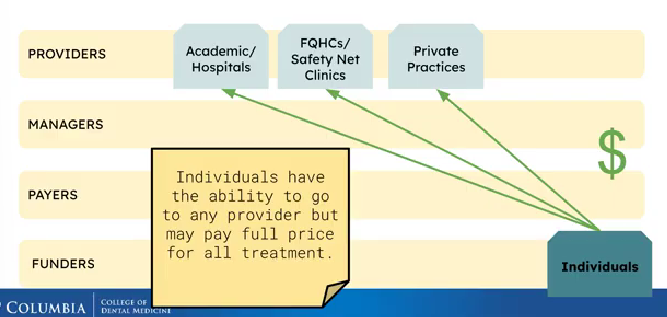
individual with no insurance or “out-of-pocket”
commercial or private insurance

managed care organizations (MCOs)
-companies that help manage dental benefits for large groups of patients, often in Medicaid programs
-government or insurance company pays the MCO a fixed amount of money per patient each month to oversee care
-MCO recruits networks of dentists and decides which services are covered and how providers are paid
-try to control costs while making sure patients receive necessary dental care: pre-authorizations, restricted provider networks
-dentists may be paid through fee-for-service, capitation, or other payment models depending on their contract with the MCO
Medicaid and Medicaid managed care

children’s health insurance program (CHIP)
-provides low-cost health and dental coverage to children in families who earn too much (based on the Federal Poverty Level) to qualify for Medicaid but cannot easily afford private insurance
-funded jointly by the federal and state governments
-benefits vary by state
-often includes preventive and restorative dental services to help improve children’s access to oral healthcare
-broader public insurance program for low-income populations while CHIP helps cover children whose families earn too much for Medicaid but still need affordable insurance
Medicare and Medicare Advantage

Medicare/Medicare Advantage details
-traditional Medicare: federally funded health insurance program primarily for adults age 65 and older and includes Part A (hospital insurance) and Part B (physician insurance); routine dental care generally not covered under Parts A and B
-Medicare Advantage (Part C): also federally funded, but government pays private insurance companies to manage and administer Medicare benefits
-many Medicare Advantage plans offer optional supplemental benefits not typically covered under traditional Medicare, including dental coverage (others may include vision, meals, transportation, etc.)
-though many Medicare Advantage plans offer some dental benefits, the kind and amount of services vary greatly (i.e. some offer only preventive care, charge individuals additional premiums, or have very limited annual funds for an individual’s dental services)
dental coverage across age

insurance reimbursement models in dentistry

4 different reimbursement models

fee-for-service (FFS)
-providers are paid a predetermined fee per procedure based on a contracted fee schedule
-most common type of reimbursement
-revenue = (# of procedures) x (cost per procedure)
capitation
-providers are paid per patient per month (PMPM) regardless of how many services are delivered and which services are done
-common in HMOs and Medicaid Managed Care plans
-revenue = (# of enrolled patients) x (fixed per member per month rate)
encounter-based payment
-safety-net and public programs, specifically FQHCs
-health centers receive a fixed payment for each qualifying patient encounter, regardless of the number of complexity of services provided during that visit
-revenue = (# of visits) x (fixed rate)
value-based care (VBC)
-aka value-based payment (VBP), pay-for-performance (P4P), or alternative payments mechanisms (APMs)
-links reimbursement to quality, outcomes, and cost performance
-new to dentistry and its implementation is in early stages, still being studied and trialed in various forms
-revenue = (base payment) ± (quality bonus/shared savings)
-base payment can be capitation for a patient population or FFS
-quality bonuses are awarded if practice achieves designated quality metrics
-shared savings occur if a provider stays under a designated budget; payer rewards the provider by sharing a portion of the savings
-in advanced schemes, payments can be withheld or subtracted if quality metrics are not achieved
reimbursement system considerations
-attempt to balance the needs of providers, payers, and patients
-providers must sustain their practices, payers must manage costs, and patients need access to quality care
-no reimbursement system is perfect- each has advantages and limitations
-important to think critically about how reimbursement structures influence provider behavior, clinical decision-making, and billing practices
-system-level decisions ultimately affect how patients are treated and whether they are able to access and afford quality oral healthcare
what can FFS incentivize? how can this affect care? how can this affect equity?
-performing many procedures in a short amount of time, performing higher-reimbursing procedures even when they may be outside the provider’s scope, training, or clinical judgment, recommending treatment that may not be unnecessary
-decrease in the quality of patient care due to time and money pressure, preventive counseling and lower-reimbursing services may receive less emphasis
-low-income patients may delay or decline treatment because high-cost procedures remain financially inaccessible despite insurance coverage
what can capitation incentivize? how can this affect care? how can this affect equity?
-”cherry-picking” pts with less complex needs, managing larger patient panels to maintain revenue, overbooking appts to accommodate large panels
-patients with complex needs may receive fewer treatment options, expensive or time-intensive procedures may be discouraged, long wait times and rushed treatment
-high-needs pts may be viewed as financially challenging to manage within fixed payment structures, patients may be offered lower-cost treatment options instead of more comprehensive care
what can encounter-based payment incentivize? how can this affect care? how can this affect equity?
-scheduling shorter visits and spreading treatment across multiple visits, limiting time-intensive or costly procedures during a single encounter
-prolonged and incomplete treatment, expensive or time-intensive procedures may be discouraged
-patients in safety-net settings may face transportation, childcare, or work-related barriers when treatment requires multiple visits, limited encounter payments may reduce availability or comprehensive and/or complex services
what can value-based care incentivize? how can this affect care? how can this affect equity?
-focusing heavily on measurable quality metrics and documentation, prioritizing data collection and reporting activities, selecting lower-risk patients to improve performance scores
-providers may spend more time on documentation and reporting requirements, care may become overly focused on measurable outcomes rather than individual patient needs
-providers caring for medically or socially complex populations may have more difficulty achieving standardized quality benchmarks unless measures are appropriately risk-adjusted
provider participation
-dental payment systems create an uneven provider marketplace
-dentists more likely to accept patients whose coverage adequately reimburses procedures and supports practice sustainability
-FFS arrangements offer more favorable payment and no provider risk compared to capitation or safety-net models, so low-income patients are left with fewer participating providers and more limited treatment options
-reimbursement-driven provider sorting perpetuates socioeconomic inequity in oral health access
approximately ___% of the US population has some form or private dental insurance
-50
DPPO, DHMO, and discount dental plans designs


differences between PPO and HMO

PPO schedule of benefits

co-insurance
-a percentage of the cost that the patient pays after the deductible has been met
-NOT copayment; a copayment is a fixed dollar amount paid by the patient for a covered service, more frequently encountered in medical insurance and DHMOs
waiting period
-time period for new members where basic care and/or major dental services may not be covered
covered v. non-covered services
-dental services not listed as a benefit
-if pt receives non-covered services, the dental plan will not pay for them
age limitation
-service will not be covered if pt is outside of the specified age range
frequency limitation
-service will not be covered more often than the specified frequency
-commonly 5-8 years for restorative and 2-3 years for periodontal
deductible
-amount the pt pays for covered dental care services before the plan begins to pay
-in most cases, pt must pay deductible amount each calendar/plan year
annual maximum
-the most a dental plan or dental policy will pay toward the cost of dental services
-after the plan pays this amount, the pt must pay the total cost of dental services but at the discounted rate if dentist is in-network
annual maximum v. out-of-pocket maximum
-an out-of-pocket maximum is the most a patient must pay for covered healthcare services before insurance covers 100% of the covered costs
-protection is common in medical insurance but generally does not exist in dental insurance
office fee schedule
-the fees a dental practice charges for its services
-reflects overhead, staffing, local market conditions, and business goals
-can be changed freely
insurance fee schedule
-discounted rate an insurer agrees to pay a participating provider for a service
-can be changed only through contract negotiations between the participating provider and insurance company
-contracts are typically confidential and should not be discussed amongst providers
UCR (usual, customary, and reasonable) fees
-estimates of the market prices in a geographic area
-often used as a reference by providers and insurers when establishing fees or calculating out-of-network reimbursement
insurance allowable fee or maximum contract allowance or allowed amount

negotiating fees
-negotiating reimbursement rates with insurers is possible but can be time-consuming and administratively complex
-providers may hire consultants or third-party organizations to negotiate contracts and fee schedules on their behalf
-larger practices and DSOs often have greater administrative resources, larger patient volumes, and increased negotiating leverage with payers
balance billing
-difference between office fee and the allowed amount
-occurs when a provider is not in the insurance company network
explanation of benefits (EOB)
-detailed summary from the dental plan on payments made for dental services
-dental plan sends this to the provider and patient once a claim is processed
-required by the federal government
insurance plan payment
-the amount a provider/practice will be reimbursed, usually in the form of a check or electronic fund transfer
alternate benefit or least expensive alternative treatment (LEAT)
-in some plans, an alternate benefit may be implemented
-a cost-control measure basing payment for a particular dental service on the least expensive effective treatment
-provision does not limit treatment options but limits payments for certain codes
-disclosed in the payer agreement
-not changing the treatment, just limiting the amount paid
solutions to reaching dental insurance maximum annual benefit

third-party dental financing
-care credit, cherry, sunbit, etc.
-advantages: helps pts afford higher-cost treatment, may increase case acceptance, allows treatment to begin sooner, many offer no interest repayment options within a certain time period, financing company manages patient repayment
-disadvantages: office pays transaction or merchant fees which decreases net revenue, staff must explain options and complete applications increasing administrative burden, some patients may face high interest rates, financing may encourage patients to take on unaffordable debt, not all patients will qualify due to credit
codes
-each dental procedure has an associated code
-codes used to communicate with or bill insurance companies, document visits, and collect data
-codes align especially well with a fee-for-service reimbursement system
CDT (current dental terminology) codes
-developed and maintained by the ADA council on dental benefit programs’ code maintenance committee- includes representatives from the ADA, dental specialty organizations, and dental payers
-codes that are used to report the services performed for pts; one element of properly documenting a procedure
-CDT codes reviewed and updated annually due to technology and methods of procedures continuously changing
-anyone can suggest a change to the CDT code set
groupings of CDT codes
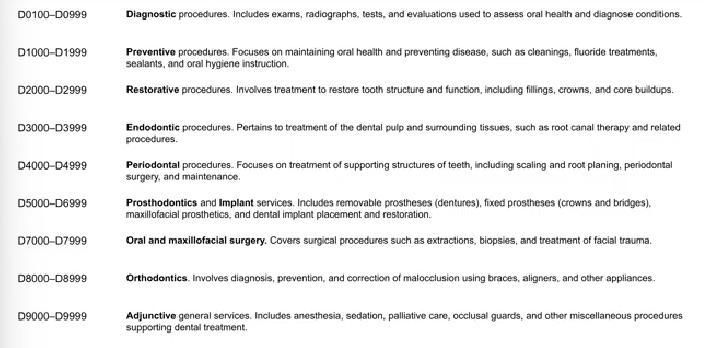
submitting a claim for dental services
-CDT codes are recorded on a dental claim form along with patient, provider, and payer-specific information
-claim forms may be submitted electronically or by mail
-many modern practice management systems have integrated electronic claim submission, allowing for more streamlined and efficient workflows
-some practices still use paper charts and film radiographs, so fax and traditional mail may still be used for documentation and claims processing
anatomy of a claim form

preauthorizations/pretreatment estimates
-a process where a dentist submits a treatment plan to the payer before treatment begins
-payer reviews the treatment plan
-payer notifies the patient and dentist about one or more of the following: eligibility, covered services, amounts payable, co-payment, deductibles, and plan maximums
-not a guarantee of payment; final reimbursement depends on eligibility, remaining benefits, plan rules, and the services actually provided
-most PPO plans do not require preauthorization but many HMO or Managed Care plans do mandate preauthorization for non-preventive treatment
advantages to submitting preauthos
-clarify what the dental plan is expected to cover before treatment begins
-give the pt estimated out-of-pocket cost and reduce financial surprises
-may improve treatment acceptance by giving pts greater cost certainty
-help pt and provider plan treatment timing, sequencing, and payment arrangements
-reduce misunderstanding and improve informed financial consent
disadvantages to submitting preauths
-more paperwork for front office
-potential delay in treatment while patient waits for insurance to reply
-patients may mistakenly believe approval guarantees coverage or clinical necessity
anatomy of a claim form- middle section

ICD-10 diagnosis coding in dentistry
-unlike in medical billing and coding, diagnostic codes are not mandatory yet
-Epic and other integrated dental-medical EHRs prompt for this so it is becoming more common and seamless
-some plans are beginning to require
groupings of ICD-10 diagnosis codes

advantages of diagnostic coding in dentistry
-improves documentation and record-sharing
-may improve communication with insurers and treatment justification process
-supports quality improvement and value-based care
-facilitates medical/dental integration
-enhances public health surveillance and data collection
disadvantages of diagnostic coding in dentistry
-learning curve to using correct codes
-because not widely used, potential for inconsistency between providers
-adds an additional step to documentation, particularly in non-integrated EHRs
-ICD diagnostic code set is not yet as specific as some dentists would like
anatomy of a claim form- bottom section

examples of “enclosures” or supporting documentation
-x-rays (PAs, BWs, pan)
-intraoral photos
-detailed narrative describing diagnosis, history, why a procedure was necessary
-chart notes
-perio chart
-comprehensive treatment plan
-reports from specialist
-appeal letter (if treatment was previously denied)
-proof of insurance payment (EOB) from pt’s primary insurance company (if there is more than one) = coordination of benefits
possible reasons for claim delay or denial- administrative
-pt does not have an active plan
-waiting period applies
-frequency limitation applies
-annual maximum met
-missing or incomplete patient, provider, or insurance information
-incorrect CDT code, tooth number, or date of service
possible reasons for claim delay or denial- clinical
-no documentation of clinical necessity
-radiographs are not diagnostic or incorrect x-ray is submitted
-if a more conservative restoration is acceptable
-if there is no new decay or missing tooth structure and the existing restoration is clinically acceptable
-poor prognosis (advanced periodontal disease or inadequate endodontic treatment)
-narrative does not corroborate radiographic findings
AI in claims review
-same AI systems used chairside to support clinical diagnosis and pt education increasingly being used to assist with dental insurance claims review
-AI can analyze radiographs and clinical documentation to identify findings such as missing tooth structure, bone loss, and caries
-determine whether submitted procedures align with payer guidelines and documentation requirements
-reduce administrative burden for insurers and help providers receive reimbursement faster when claims and documentation are complete and high-quality
-potential denials identified by AI are routed to licensed dental consultants for human review and decision-making
appealing denial claims
-a claim denial is not necessarily a final decision about payment for a claim
-an appeal is a formal request for insurer’s review of denied or unpaid claims
-a proper appeal involves sending the plan a written request to reconsider the claim
-additional documentation should be included to give the plan a clearer picture of why you recommended the treatment
-may help to ask to request to discuss the case with the dental consultant on a professional level (“peer-to-peer”)

children v. adult public dental insurance coverage
-approx. 38% of US children
-23% of adults
medicaid v. medicare

medicaid eligibility
-based on income relative to the federal poverty level (FPL), not a fixed dollar amount; income threshold changes based on household size and is updated annually
-FPL is a national benchmark, but each state determines which % of that benchmark qualifies an individual for coverage
-benchmarks can vary for different populations (children, pregnant individuals, people with disabilities)
medicaid program
-states administer and design their own medicaid programs
-each state determines whether or not to offer dental benefits for adults
-some states offer extensive adult benefits (NY) while some offer none at all
-states determine minimum provider reimbursement rates and how medicaid is administered (FFS v. managed care)
medicaid funding
-states choose how much money to allocated to their medicaid programs
-the federal government matches at least 50% of medicaid spending, with poorer states receiving a larger federal match, up to 83%
adult medicaid serviced offered by state

children eligibility
-children are eligible at much higher income levels, either through medicaid or CHIP, often extending well above adult medicaid thresholds
-dental benefits are required for children with medicaid through the early and periodic screening, diagnostic, and treatment (EPSDT) benefit
-CHIP was created to cover children whose families earn too much to qualify for medicaid but may not be able to afford private insurance; mandates dental benefits
child dental benefits under medicaid

the number of dentists participating with medicaid and CHIP for child dental services is
-low and disproportionate
-43% of US dentists participate in medicaid and CHIP for child dental services but only 33% of US dentists treated at least one medicaid patient

seniors

medicare- americans 65+ (parts a, b, c, d)

medicare eligibility
-primarily based on age
-most individuals qualify at age 65
-some individuals under 65 qualify due to disability, end stage renal disease, or ALS
-unlike medicaid, medicare eligibility is federal and does not vary by state
medicare program
-traditional medicare does not cover routine dental services except in the small number of cases that are inextricably linked to a medical service that medicare does cover
-medicare advantage plans (part c) must cover all services covered by traditional medicare and may offer additional benefits such as dental, vision, and hearing coverage
-a medicare-eligible individual can choose to enroll in either original medicare (parts a and b) or a medicare advantage plan (part c), but not both at the same time
-enrollees can change their plan selection every year
medicare funding
-federally funded through payroll taxes, premiums, and federal general revenues
-traditional medicare pays providers directly, while medicare advantage plans receive risk-adjusted capitated payments from the federal government
-medicare advantage dental benefits are funded primarily through federal medicare payments to private plans, although some plans may charge beneficiaries additional premiums for enhanced coverage
medicare advantage growth

medicare advantage supplemental benefits

medicare advantage comprehensive benefit availability

one big beautiful act
-set to go in effect in jan 2027, the law does not directly eliminate medicaid dental benefits, but it reduces medicaid funding and changes eligibility rules
-children’s dental coverage remains federally required through EPSDT; adult dental benefits remain optional for states
-more adults may lose medicaid (and their dental coverage) because of work requirements, more frequent renewals, and stricter eligibility rules
-states facing budget pressure may respond by reducing adult benefits, limiting covered services, or lowering dental reimbursement rates
-dental practices may see more coverage interruptions, eligibility checks, uncompensated care, and reduced provider participation, even where dental benefits remain unchanged

compliance
-process of following applicable laws, regulations, payer policies, and professional standards when delivering care, documenting services, coding procedures, and submitting claims
-protects patients and promotes ethical care
-ensures accurate and appropriate reimbursement
-reduces risk of audits, penalties, and legal action
-maintains participation in insurance networks and public programs
-framework that helps providers deliver care and bill appropriately while minimizing the risk of fraud, waste, and abuse
fraud
-knowing and intentional deception or misrepresentation of treatment
-subject to civil and criminal penalties
-may include fines, repayment of claims, exclusion from federal programs (medicare/medicaid), loss of license, and potential imprisonment
waste
-overuse or inefficient use of healthcare services that leads to unnecessary costs, often without intent to deceive
-typically addressed through administrative actions
-may require repayment, corrective action plans, audits, and increased oversight
abuse
-practices that are inconsistent with accepted professional standards and may result in harm or improper payment, even if there was no intent to deceive
-may result in civil penalties, repayment obligations, audits, sanctions, and possible exclusion from payer networks or federal programs
FFS
-FFS can incentivize: performing many procedures in a short amount of time, performing higher-reimbursing procedures, even when they may be outside the provider’s scope/training/clinical judgment, recommending treatment that may not be clinically necessary
-fraud potential: billing for services not provided or misrepresenting procedures to increase reimbursement
-waste potential: overutilization of procedures and unnecessary treatment
-abuse potential: upcoding, unbundling procedures
-key compliance focus: accurate coding, documentation, and medical necessity