Lecture 3 Tooth Development Eruption & Shedding
 Call Kai
 Learn
 Practice Test
 Spaced Repetition
 Match
 Flashcards
 Knowt Play
1/69

Earn XP
Description and Tags
10/22/26 lecture, had quiz 2, test 1 next week
70 Terms
In which week(s) of prenatal development does the BUD stage occur?
8
The bud stage is: extensive _____ of the _____ _____ into buds.
proliferation, dental lamina
Define proliferation.
controlled cellular growth
How many buds are there on each max/mand arch?
10

Give blue arrow.
dental lamina

Give pink arrow.
oral epithelium

Give green arrow.
tooth bud

Give orange arrow.
ectomesenchyme
In which week(s) of prenatal development does the CAP stage occur?
9-10
The bud stage continues ______ and the cells _______.
proliferation, differentiate
The tooth germ develops in the cap stage, meaning the _____ of the tooth.
primordium
Give the 3 things that make up tooth germ:
enamel organ, dental papilla, dental sac
The enamel ORGAN is the formation of the tooth ____ in a _____ shape with a _____ depression.
bud, cap, central
What tissue makes up dental papilla? Give the location inside enamel organ.
ectomesenchyme, concavity
What tissue makes up the dental sac? Give the location inside the enamel organ.
ectomesenchyme, outside

Give green.
primordium

Give pink.
enamel knot

Give blue.
enamel organ

Give purple.
dental papilla
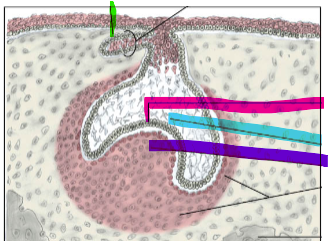
Give black indicator, bottom right.
dental sac

What do the blue, purple, and black indicators make up?
tooth germ
What are succedeaneous teeth?
replace baby teeth
What is successional dental lamina?
dental lamina extends into ectomesenchyme (will form succedanenous permanent teeth)
What teeth are nonsuccedaneous?
permanent molars
Nonsuccedaneous permanent teeth develop from buds that grow off an extension of the primary _____ _____ _____ ______.
second molars, dental lamina
In which week(s) of prenatal development does the BELL stage occur?
11-12
The bell stage is the ongoing process of ______, _______, and _______.
proliferation, differentiation, morphogenesis
How many types of cell layers form during the bell stage? Where are they?
4, enamel organ
Give the 4 cell layers formed in the BELL stage.
inner EE, outer EE, stellate reticulum, stratum intermedium (EE = enamel epithelium)
Which layer serves as a protective barrier for the enamel organ? It will outline the shape of the future organ.
outer enamel epithelium
What will the inner enamel epithelium differentiate into?
ameloblasts
What will the ameloblasts form?
enamel matrix
What will the OUTER cells of dental papilla layer differentiate into?
odontoblasts
What will the odontoblasts form?
dentin matrix
What will the CENTRAL mesenchymal cells of the dental papilla layer differentiate into?
pulp tissue
What are the final stages of odontogenesis?
apposition and maturation
The apposition stage is also known as the ______ stage.
secretory
The ______, ______, and _____ are secreted during APPOSITION until the crown is complete.
enamel, dentin, cementum
What happens to the hard dental tissue during the maturation stage?
matrices fully mineralize
Give the order of tooth development.
initiation, bud, cap, bell, apposition and maturation
What embryonic tissues are responsible for ODONTOGENESIS?
ectoderm, mesenchyme
What is mesenchyme made of? Give what it will develop into.
embryonic CT, dentin cementum pulp
What is ectoderm made of? Give what it will develop into.
embryonic epithelium, enamel
What is the boundary between mesenchyme and epithelium?
basal lamina
What tissue initiates odontogenesis? It is the first communication.
mesenchyme
During apposition, many_______ occur between the ectodermal tissue of the enamel organ and mesenchymal tissue of the dental papilla and dental sac.
These interactions are necessary for the production of enamel, dentin, and cementum.inductions
Which cells are involved in cytodifferentiation?
odontoblasts, ameloblasts
Give the first step of cytodifferentiation.
IEE cells stop dividing (morpho differentiation is complete)
How do the cells grow in the second step of cytodifferentiation? The nuclei will move AWAY from the _____ _____.
tall, basal lamina
Give the term for the nuclei moving to the part of the cell AWAY from the basal lamina. (step 2 of cytodiff)
polarity
What cell is involved in step 3 of cytodifferentiation?
pre-ameloblasts
In step 3 (cytodifferentiation) the preameloblasts are involved, they develop _____ _______ organelles.
protein synthesis
In step 4 (ctyodifferentiation) the future ______ touch the basal lamina, meaning that the critical ______ occurs for ________.
odontoblasts, communication, cytodifferentiation
During root development, the outer and inner enamel epithelium layers form…
Hertwigs epithelial root sheath
What are the 2 functions of the Hertwig Epithelial Root Sheath?
root shape, induction of root dentin
What is responsible for root development?
cervical loop
What is the most cervical part of the enamel organ?
cervical loop
The tooth is forming from the _____ to the _____.
crown, root
What is produced when the Hertwig Epithelial Root Sheath disintegrates?
epithelial rests of Malassez
Where are the Epithelial Rests of Malassez located (ERM)?
PDL surrounding root
Cementum is deposited ______ throughout the functional life of the tooth.
continuously
What kind of eruption is the vertical movement of the tooth?
active
What kind of eruption occurs when the gum recedes but the tooth is not actually moving?
passive
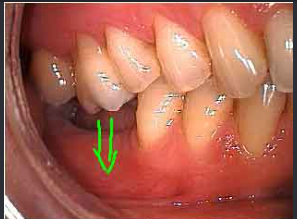
What is this image showing?
hyper eruption
Give the 3 phases of tooth eruption.
pre-eruptive, prefunctional, functional
Which phase of tooth eruption is involved with the bony crypts of teeth?
pre-eruptive
Molars have no primary predecessor; their enamel organs develop from….
dental lamina of primary 2nd molars
Initially, primary and secondary teeth share the same:
bony crypt
Give the term for this definition: loss of the primary dentition by physiologic resorption of the roots, the loss of the bony support as well as removal of connective tissue, epithelial cells and the PDL.
shedding
The tooth germ develops into…