Unit 3-Biochemistry
 Call Kai
 Learn
 Practice Test
 Spaced Repetition
 Match
 Flashcards
 Knowt Play
1/253

There's no tags or description
Looks like no tags are added yet.
254 Terms
__ control by regulatory molecules
allosteric
in allosteric enzymes, binding at distance sites ___ the complex
changes
isozymes
alternate enzymes that catalyze same reactions but have different catalytic (kcat/km) and/or regulatory properties
phosphorylation is a ___ ___ modifications
reversible covalent
irreversible ___ ____ to create an active enzyme
proteolytic cleavage
why do kinases transfer phosphoryl group from ATP rather than adding free inorganic phosphate directly to protein?
adding directly is unfavorable but transferring from ATP is favorable
kinases add phosphate to ___ chain of Ser, Thr, or Tyr and each have ___ group
side; OH
___modification is a means of regulating enzyme activity
covalent
kinases catalyze the transfer of ___ group from ___ to specific protein ___attaching it to ___, ___, ___ residue
phosphoryl; ATP; substrate; Ser, Thr, Tyr
ATP is the donor because ___ of the terminal gamma ___ bond is strongly favorable (delta G not prime ~30 kJ/mol). sometimes described as an ‘___ ___ carrier’
hydrolysis; phosphate; activated phosphate
energy coupling: rather than trying to add phosphate directly (unfavorable), ___ transfers phosphoryl group from ATP to protein in single enzymatic step, making phosphorylation ___
kinase; favorable
phosphorylating Ser, Thr, Tyr ___ changes protein ___
reversibly; chemistry
substrate specificity: Ser/Thr kinases
phosphorylate hydroxyl on short-chain R groups
substrate specificity: Tyr kinases
phosphorylate hydroxyl on aromatic R group
why phosphorylation is effective: temporarily adding a phosphoryl group (2- charge) is effective in ___ changing local ___
reversibly; chemistry
phosphorylation is effective because it can include new ___ attractions with ___/___ R groups and/or repulsions with ___/___ R groups
electrostatic; Lys/Arg; Asp/Glu
phosphorylation is effective because this can affect overall ___ of protein and/or ability to interact with ___ partners
shape; binding
kinases and phosphatase reaction produce different ___ with chemically distinct reaction each with their own favorable ___
products; delta G
ATP hydrolysis, enzymatic protein phosphorylation and enzymatic protein dephosphorylation are
favorable
reactions catalyzed by kinases and phosphatases are ___ in cells. favorable yet ___ without an enzyme, so cell retains full control when ___ and ___ occur
irreversible; slow; phosphorylation; dephosphorylation
enzymes provide ___: phosphate is directed to or released from specific ___ ___ rather than transferred to water or another molecule
specificity; protein target
as reactions catalyzed by kinases and phosphatases are irreversible, this allows cell to ___ and ___ change the ___, ___, and/or ___ partners of target protein in response to signal
rapid; reversible; activity; localization; binding
mRNA is synthesized
5’ to 3’

if the tRNA anticodon has the sequence 3’-UCC-5’, what is the corresponding mRNA codon sequence? what is the template DNA sequence? after this sequence is found, the ___ ___ is used to find the corresponding amino acid
5’-AGG-3’. 3’-TCC-5’. codon chart
mRNA/DNA are synthesized ___’ to ___’ one codon at a time. protein synthesis is synthesized ___ term to ___ term
5; 3; N; C
ribosomes ___ the rapid template-directed synthesis of ___ ___ between appropriate amino acids
catalyze; peptide bonds
amino acids arrive at the ribosome as ___ ___or charged because this functional group containing the amino acid is linked to the ___ peptide bond formation occurs by transferring the growing chain from one tRNA to the next
tRNA esters; tRNA
esters are made from ___ and ___
carboxyl; hydroxyl
tRNAs have ___ functionally critical regions separated in 3D space containing the ___ loop and the ___ end
two; anticodon; 3’ CCA
the anticodon loop ___ bonds with the codon. accessible for ___-___ base pairing during ___
H; codon; anticodon; translation
3’ CCA end is the site of ___ ___ attachment through the ___ linkage. the carboxyl group of the amino acid reacts with the ___ or ___ hydroxyl group of terminal ribose
amino acid; ester; 2’; 3’

the amino acid is attached at tRNAs ___ OH growing at the ___ end
3’; 3;
DNA coding strand has the same sequence as ___ except with a ___ instead of a ___
mRNA; T; U
don’t use codon table with ___ template. template must be the ___ complement of codons because DNA serves as the template for ___ synthesis so it must be complementary to that. DNA must ___-___ with coding strand
DNA; reverse; mRNA; base-pair
amino acid is attached to correct ___ and ___ it enters the ribosome. The attachment is the interpretation of the ___ code. around ___ aminoacyyl-tRNA synthetases
tRNA; before; genetic; 20
___ (not empty) tRNAs deliver correctly matched higher ___ value amino acids to ribosome
charged; G
each synthetase must correctly recognize both the specific ___ ___ and appropriate corresponding ___. errors would result in wrong amino acid incorporated into the protein regardless of ___
amino acid; tRNA; codon
charged tRNA means the aminoacyl-tRNA is an ___ ___ ___that carries the correct amino acid to the ribosome where codon-anticodon base pairing positions it correctly
activated amino acid
to favor a reaction, of amino acid + ATP reversibly becomes amino-acyl-AMP + PPi, break down ___
PPi
to favor a reaction, ___ the products or ___ the reactants
break down; supply
translation is best described as
amino acid linked to tRNA
amino acids must be ___ before peptide bond formation
activated
peptide bond hydrolysis is ___ (negative delta G) while producing aa1-aa2 (positive delta G) from amino acids is ___
favorable; unfavorable
establishment of the genetic code occurs with attachment of ___ to a particular ___
amino acid; tRNA
formation of ___ bond between free ___ is not ___ favorable
peptide; amino acid; thermodynamically
what are activated intermediates in protein synthesis?
amino acid esters
aminoacyl-tRNA synthetase ___ a multi-step reaction. What is product of first reaction?
two-step; aminoacyl-AMP
reaction driven by hydrolysis of ___ and is seen many times
pyrophosphate
biosynthesis (making things) requires ___ ___
activated intermediates
hydrolyzing polymers is already ___. the reverse of ___polymers requires an ___ monomer
favorable; building; activated
DNA synthesis requires ___, RNA synthesis requires ___, protein synthesis requires ______-___ ___ not free amino acids
dNTP; NTP; aminoacyl-tRNA esters
ATP considered activated from of ___
Pi
to go from polymers to monomers (favorable reaction) ending with a ___ delta G value, the intermediate ___ the G value
low; increases
aminoacyl-tRNA synthetases ___ amino acids via a ___ step adenylation reaction
activate; two
step 1 in adenylation reaction: ___+___ reverse arrows ___-___ + ___
amino acid, ATP, aminoacyl-AMP, PPi
step 2A in adenylation reaction: ___-___ + ___ reverse arrows ___-___+___
aminoacyl-AMP, tRNA, aminoacyl-tRNA, AMP
the sum (two parts) of two step adenylation reaction is delta G not prime around ___
zero
step 2B in adenylation reaction: ___ —>___ catalyzed by ___. only thermodynamic ___
PPi, 2Pi, pyrophosphate, driver
full adenylation reaction equation
amino acid + ATP + tRNA + H20 —> aminoacyl-tRNA + AMP + 2 Pi
higher G value of aa-tRNA ester reflects ___ reactivity of ___ linkages and free ___ groups. ___ more easily attacked by incoming ___ group making peptide bond formation ___. this is an example of ___ ___
increased; ester; carboxyl; ester; amino; favorable; energy coupling

energy coupling
highly favorable reaction (PPi hydrolysis) drives an unfavorable reaction
without pyrophosphatase, ___ accumulates and step 1 is ___ with no net forward progress. aa-AMP does not ___ (made/unmade). ATP is mostly ___(retained in PPi). as a result, no net production of ___
PPi; reversible; accumulate; unused; aa-tRNA
with pyrophosphatase, ___ rapidly hydrolyzed to ___ due to ___ principle that shifts step 1 equilibrium ___. aa-AMP ___ as step 1 proceeds forward driving step 2. ATP energy used via ___ ___to drive overall reaction. as a result, net production of ___
PPi; 2Pi; Le Chatlier’s; forward; accumulates; Le-Chatliers; aa-tRNA
PPi hydrolysis is intrisically ___ and pyrophosphatase does not chnage the ___ but provides the ___ ___
favorable; delta G; rate enhancement
ribosome is site of __ ___
protein synthesis
structural role of ribosome
rRNA forms core of both large and small subunits
interface between subunits of ribosome is entirely ___ (no protein-protein contacts)
rRNA
catalytic role of ribosome contains the ___ ___ center where the peptide bond forms and is lined by ___, not protein, making the ribsome a ___
peptidyl transferase; rRNA; ribozyme
decoding role of ribosomes contains ___ ‘___’ subunit of rRNA and participates in ___ positioning and ___ recognition. mRNA binds to ___ to recruit ___ subunit
small; 16S; mRNA; codon; small; large
Svedberg units (S) influenced by ___ and ___ (subunit size)
mass; compactness
ribosomes have ___ tRNA binding sites that bridge the ___ and ___ subunits
three; 30S; 50S
A site stands for ___ which is the ___ site for each incoming ___ ___
aminoacyl; entry; charged tRNA
P site stands for ___ which holds the ___ carrying the growing ___ chain
peptidyl; tRNA; polypeptide
E site stands for ___ that holds the ___ tRNA before it’s ___ and ___
exit; empty; released; recharged
anticodon ends of ___ and ___ site tRNAs read mRNA template in smalls subunit. the 3’CCA ends that carry the ___ or growing chain reach into the ___ ___ center in the large subunit where ___ occurs
A; P; amino acid; peptidyl transferase; catalysis
the positioning of A and P site allows ___ by ___ that result in the formation of new ___ ___
catalysis; approximation; peptide bond
A and P site tRNA 3’ ends are ___ during protein synthesis
aminoacylated
due to ___ ___, the reaction is already favorable and A and P site substrates are ___ ___
activated intermediates; optimally positioned
polypeptide chain’s furthest terminal end from ribosome subunits
N
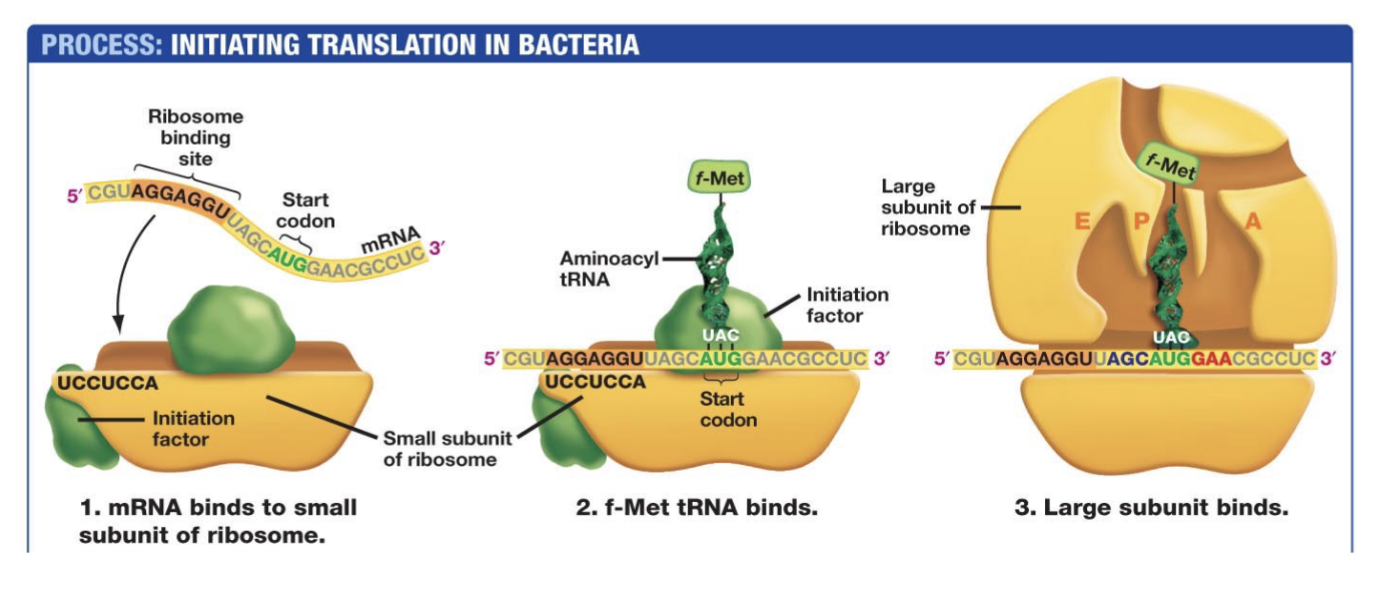
initiation of translation establishes the ___ frame and assembles the ___ complex
reading; 70S
reading frame establishment: ribosomal binding site ___’ of the mRNA ___ codon binds to part of the ___ subunit 16S to correctly position the ___ codon in the ___ site
5’; start; small; AUG; P
initiation factors: prevent premature ___ subunit binding. correct ___ must be bound and reading frame set up. result, ___ initiation complex with fMET-tRNA in the ___ site, ___ site empty and ready for first incoming ___ tRNA
large; tRNA; 70S; P; A; charged
elongation steps: incoming ___, ___ bond formation, ___
aminoacyl tRNA; peptide; translocation

P site acts as a ___ with the chain of polypeptides before incoming ___ arrives at A site and the bond forms
placeholder; tRNA
synthetase catalyzes a ___ step reaction. breakdown of ___ through another enzyme increases the supply of ___ reactant in the second step
two; PPi; aa-AMP
delta G and delta prime equation
delta G= delta G prime + RTln ([products]/[reactants])
breaking down PPi and supplying aa-AMP (second reaction) each ___ their [product]/[reactant] ratio making the ln term ___ so delta G can fall below delta G prime
lower; negative
ln(0-1) = ___, ln (1)= ___, ln (greater than 1)= ___
negative; 0; positive
ribosomal peptide bond synthesis has ___ delta G and chymotrypsin peptide bond breakage has ___ delta G
negative; negative
aa-AMP is a ___ ___ in the 2 step-pathway catalyzed by aa-tRNA synthetase (product of first reaction and reactant in next)
shared intermediate
ATP investment comes as ___, is rapidly favorably broken down by ___
PPi; pyrophosphatase
breaking down ___ and supplying ___ is effective in making delta G more ___ through Le Chatelier’s principle
products; reactants; negative
if we make 800 aa, how many of those aa are needed to be activated?
ALL 800
imprecise but common to describe NTPs/dNTPs as ___ energy in their phosphoanhydride bonds. more accurately, NTP/dNTP hydrolysis ___energy overall because its products are ___ stable than its reactants
storing; releases; more
after translocation, ___ site empty. between the P and A site is the ___ ___ center
A; peptidyl transferase
peptide chain attaches to aa in ___ site before translocating to ___ site
A; P
___ ___ facilitate the termination of protein biosynthesis. they recognize the ___ codon in the ___ site and extend into the large subunit to interact with the ___ ___ center
release factors (RF); stop; A; peptidyl transferase
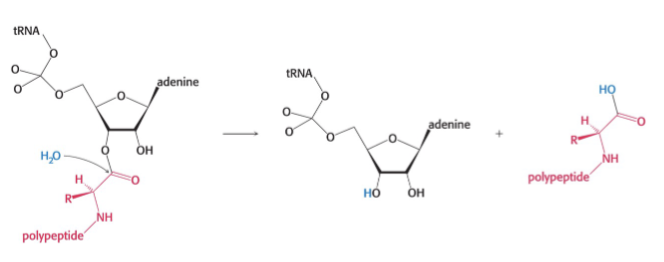
release factors facilitate the attack of ___ on the final ___-tRNA ___ linkage through its ___ carbon. hydrolysis releases the full ___
water; polypeptide; ester; carbonyl; protein
protein synthesis is very
energy intensive
at cellular pH, ATP, GTP and other nucleoside triphosphate typically carry a ___ or ___ charge
3-, 4-