Enzyme inhibitors (Tifft)
 Call Kai
 Learn
Learn Practice Test
 Spaced Repetition
 Match
Match Flashcards
 Knowt Play
1/20

There's no tags or description
Looks like no tags are added yet.
Name | Mastery | Learn | Test | Matching | Spaced | Call with Kai | Chat |
|---|
No analytics yet
Send a link to your students to track their progress
21 Terms
Enzyme Inhibitors (Overview)
Enzyme activity can be regulated in multiple different ways.
This video will focus on inhibition of enzyme activity, specifically by molecules that bind to enzymes through non covalent interactions and act as inhibitors.
Inhibitor molecules
How do inhibitors bind
Characteristics of binding
Inhibitor molecules bind enzymes through non covalent interactions that include hydrogen bonds, ionic interactions, and the hydrophobic effect
binding between an enzyme E and an inhibitor I can reach equilibrium just like binding between any protein and ligand
inhibitors that bind non covalently linked to enzyme inhibition that is reversible
Strength of Inhibition
referred to as
what does it depend on
The strength of inhibition for an inhibitor is referred to by the term alpha.
The value of alpha depends on KI and the concentration of the inhibitor.
KI, what is it, equation for it
alpha, what is it, equation for it
KI is the dissociation constant for the enzyme and inhibitor.
Just like Kd divided by the concentration of ligand is equal to the concentration of P divided by the concentration of PL. The KI divided by the concentration of the inhibitor is equal to the concentration of E divided by the concentration of EI
Alpha, which is the strength of inhibition, is equal to one plus the concentration of I divided by KI.

Types of Inhibitors
Inhibitors can be categorized as different types based on how they bind to the enzyme and how they affect enzyme activity.
competitive, uncompetitive, noncompetitive/mixed
Competitive inhibitors compete with the substrate for binding to the enzyme. Often competitive inhibitors bind in the same physical location as the substrate.
Uncompetitive inhibitors bind to the enzyme only when substrate is bound and therefore must bind to a site that is not the same as the substrate binding site.
Noncompetitive inhibitors are also called mixed inhibitors and bind to both the enzyme alone and the enzyme substrate complex. Noncompetitive inhibitors bind to a site that is not the same as the substrate binding site.
Competitive meaning
where does it bind
compete with the substrate for binding to the enzyme.
Often competitive inhibitors bind in the same physical location as the substrate
uncompetitive
Uncompetitive inhibitors bind to the enzyme only when substrate is bound
therefore must bind to a site that is not the same as the substrate binding site.
noncompetitive/mixed
binding site
Noncompetitive inhibitors are also called mixed inhibitors
bind to both the enzyme alone and the enzyme substrate complex.
Noncompetitive inhibitors bind to a site that is not the same as the substrate binding site.
Competitive Inhibitors
Competitive inhibitors bind to the enzyme forming enzyme inhibitor complexes.
A solution with enzyme, substrate, and inhibitor could contain E, ES and EI complexes.
The presence of a competitive inhibitor decreases the apparent binding affinity of the enzyme and substrate and therefore increases the apparent KM of the enzyme.
If there is sufficient substrate which can outcompete the inhibitor present, all enzyme can be bound to substrate and found in ES complexes.
Therefore, enzymes in the presence of competitive inhibitors can reach the same Vmax as without substrate, but the Vmax will be reached at a higher concentration of S.
Uncompetitive Inhibitors
possible complexes
how does it affect the variable values
Uncompetitive inhibitors bind to enzyme substrate complexes forming ESI complexes.
A solution with enzyme substrate and inhibitor could contain E, ES and ESI complexes.
The presence of an uncompetitive inhibitor increases the apparent binding affinity of the enzyme and substrate and therefore decreases the apparent KM of the enzyme.
In other words, there are more ES complexes, which includes ES and ESI complexes, relative to E in the presence of the inhibitor, than in the absence of the inhibitor.
Even at high levels of substrate, there will always be ESI complexes that can't make product. The reaction can't reach the same maximal velocity as without the inhibitor and the observed Vmax is decreased.
Noncompetitive (Mixed) Inhibitors
Noncompetitive or mixed inhibitors can bind to the enzyme regardless of whether or not the enzyme is bound to substrate forming both E, ES, EI, ESI complexes
For the purposes of this class, we will only consider noncompetitive inhibitors that bind to E and ES with the same affinity. Therefore, the inhibitor does not affect the binding affinity of the enzyme and substrate.
Even at high levels of substrate, there will always be ESI complexes that can't make product, and so the reaction can't reach the same maximal velocity as without inhibitor and the observed Vmax is decreased.
Summary of Inhibitor Types
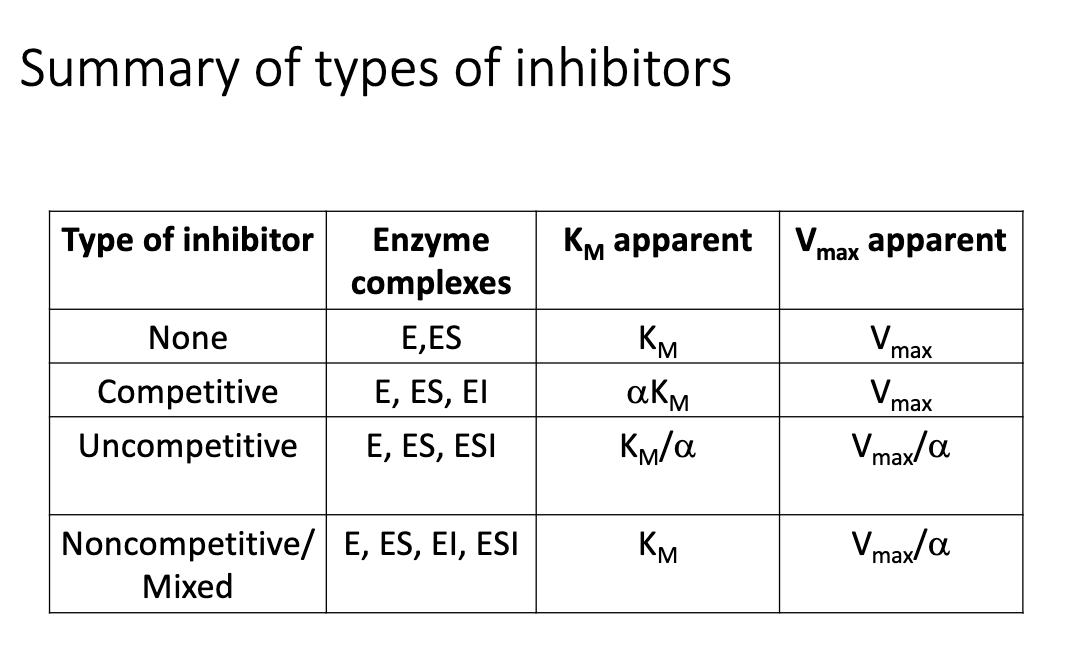
This table summarizes the three types of inhibitors described in this video Competitive, uncompetitive and noncompetitive or mixed
competitive inhibitors form EI complexes, and the apparent KM is increased by the value of alpha (the strength of inhibition).
Uncompetitive inhibitors form VSI complexes and decrease the apparent Km and the apparent Vmax. The apparent Km and Vmax are equal to the values in the absence of the inhibitor divided by alpha.
Noncompetitive or mixed inhibitors form EI and ESI complexes and decrease the apparent VMAX, which is equal to the VMAX in the absence of inhibitor divided by alpha
Binding of inhibitors
• Inhibitor molecules bind to the enzyme through non-covalent interactions
• Binding between enzyme and inhibitor can reach equilibrium
• Inhibition is reversible

Types of inhibitors

Competitive inhibition

Uncompetitive inhibition

Noncompetitive or mixed inhibition

Summary of types of inhibitors
Competitive Inhibition

Uncompetitive Inhibition

. Mixed (α=α′) — Also known as Noncompetitive Inhibition
