PETE 310 EXAM 1
 Call Kai
 Learn
 Practice Test
 Spaced Repetition
 Match
 Flashcards
 Knowt Play
1/179

There's no tags or description
Looks like no tags are added yet.
180 Terms
SARA
saturates, aromatics, resins, asphaltenes
% of saturates
49.8%
% of aromatics
21.7%
% of resins
26.5%
% of asphaltenes
2%
Aliphatic hydrocarbons examples
alkanes, alkenes, alkynes, and cyclic aliphatic hydrocarbons
Aromatic hydrocarbons examples
benzene, naphthalene
Hydrocarbon gas
Fuel gas, bottled fuel gas, solvent: C1-C2
Gasoline
Motor Fuel: C5-C10
Kerosene
Jet Fuel: C11-C12
Light Gas Oil
Diesel Fuel: C13-C17
Heavy Gas Oil
Lubricating Oil: C18-C25
Lubricants and Waxes
Petroleum Jelly, paraffin wax: C26-C38
Residum
Tars, Asphalt: C38+
Hydrocarbon Components of Petroleum
Hydrocarbon>aliphatics, aromatics>Alkanes, Alkenes, Alkynes, Cyclic Aliphatics
Ionic bond
transfer of electrons between atoms
Covalent Bond
Share one or more pairs of electrons
What other elements commonly occur in petroleum?
Sulfur, nitrogen, and oxygen
Which elements make up most of crude oil?
Carbon and hydrogen, more than 95%
Why can carbon form so many different compounds?
It forms strong bonds with itself and other elements, allowing chains, branches, and rings.

1 Carbon
Methane

2 Carbons
Ethane

3 Carbons
Propane

4 Carbons
Butane

5 Carbons
Pentane

6 Carbons
Hexane
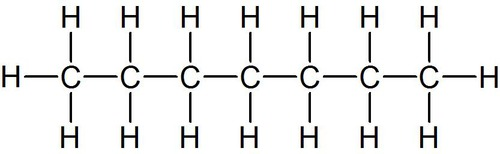
7 Carbons
Heptane
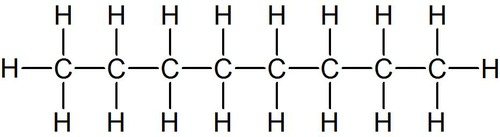
8 Carbons
Octane
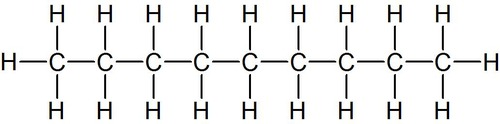
9 Carbons
Nonane
Hydrocarbon Percentages
Carbon: 84-87%, Hydrogen: 11-14%
Number of carbons in alkane increases:
-Boiling Point?
-Molecular Weight?
-Volatilty?
increase, increase, decrease
What type of strong bonds can carbon form?
Covalent
How does branching affect boiling point among alkane isomers?
More branching generally lowers boiling point by reducing effective contact between molecules.
Why are alkanes relatively unreactive?
They have strong C–C and C–H single bonds and no reactive double or triple bonds.
What does complete combustion of an alkane produce?
Carbon dioxide and water.
alkane vs. alkene
An alkene contains a carbon-carbon double bond. An alkane has only single carbon-carbon bonds.
what alkenes(CnH2n) are also called:
Olefins or unsaturated hydrocarbons
Why are alkenes more reactive than alkanes?
Their double bond contains a pi bond that can react to form new single bonds.
are alkanes reactive?
No
Cycloalkenes and Cycloalkadienes
Ring Structures bonded together with one or two double bonds
Cycloalkenes and Cycloalkadienes:
Addition Reactions
Double bond is eliminated
Cycloalkenes and Cycloalkadienes:
Cleavage Reactions
Ring structure disintegrates into a chain

Condensed Rings
Cycloalkanes and cycloalkdienes can have more than one ring and so can benzene rings
Three physical factors important to the physical behavior of molecules
pressure, temperature, intermolecular forces
What are cycloalkanes called in the petroleum industry?
Naphthenes or cycloparaffins.
Are cycloalkanes saturated?
Yes, their carbon-carbo bonds are all single bonds
What is the preferred bond angle around a tetrahedral carbon, such as in methane?
109.5
What are condensed or fused rings?
Rings that share carbon atoms
How does an aromatic hydrocarbon differ from a cycloalkane?
Aromatics have a stabilized aromatic electron system, such as benzene. Cycloalkanes have saturated, nonaromatic rings.
What are benzene’s formula and shape?
C6H6, a flat hexagonal ring with bond angles of approximately 120°.
Why is benzene different from a ring with three ordinary double bonds?
Its pi electrons are spread around the ring, making all six carbon-carbon bonds equivalent and stabilizing the molecule.
Why do many aromatic reactions leave the benzene ring intact?
aromatic ring is stable
What is a phenyl group?
A benzene ring acting as a branch: C6H5-
What are toluene and xylene?
Toluene is methylbenzene. Xylene is dimethylbenzene.
What do ortho, meta, and para mean?
They describe two substituents on benzene. Ortho: 1,2 positions, Meta: 1,3 positions, Para: 1,4 positions
What are cycloalkanoaromatics?
Compounds containing both cycloalkane and aromatic rings, often fused together.
What is associated gas?
Natural gas occurring with crude oil, either dissolved in it or present as a separate gas phase.
What are resins and asphaltenes?
Heavy, complex petroleum components containing multiple aromatic rings and often sulfur, oxygen, and nitrogen.
What sequence does the lecture’s Yen-Mullins model show?
Molecules> nanoaggregates>clusters>bulk phase separation.
What are the approximate sizes in the Yen-Mullins model?
Molecules: 1 nm, nanoaggregates: 2 nm, clusters: 5 nm
Three thresholds of Asphaltenes
Formation of nanoaggregates, formation of clusters, and bulk phase separation.
Why can mixing petroleum fluids cause asphaltene problems?
Mixing changes composition and can destabilize asphaltenes, causing aggregation, precipitation, and possible deposition.
What does the Flory-Huggins-Zuo equation describe?
How asphaltene concentration changes with elevation under gravity at equilibrium
Why can asphaltenes become more concentrated near the bottom of an oil column?
Why can asphaltenes become more concentrated near the bottom of an oil column?
What belongs in the saturates fraction
paraffins and naphthenes/alkanes and cycloalkanes
How does wax deposition reduce production?
Wax builds up in equipment, restricts flow, and can plug tubing or flowlines.
How does wax differ from asphaltenes?
Wax consists mainly of heavy saturated hydrocarbons. Asphaltenes are complex, aromatic-rich components that often contain sulfur, oxygen, and nitrogen.
Gaseous Hydrocarbons under ambient conditions:
Methane, ethane, propane, and butane.
Liquid Hydrocarbons under ambient conditions:
Pentane and Hexane
Solid or semi-solid Hydrocarbons under ambient conditions:
Paraffin wax, tar and asphalt
What are the non-hydrocarbon components of petroleum?
Nitrogen, carbon dioxide, hydrogen sulfide, hydrogen, and helium, along with sulfur-, oxygen-, and nitrogen containing organic compounds, including resins and asphaltenes.
What hydrocarbon components make up LPG
propane and butanes (n-butane and isobutane)
What is a homologous series?
A homologous series is a family of compounds with similar structures and chemical properties, with physical properties that change systematically as carbon number increases.
Example of homologous series
The alkane series: methane, ethane, propane, and butane. Successive members differ by CH2
Why are hydrocarbons made mainly of carbon atoms rather than boron, silicon, or phosphorus?
carbon forms strong bonds with itself and with other elements
What are the four types of aliphatic hydrocarbons?
Alkanes, Alkenes, Alkynes, Cyclic aliphatics
What does temperature measure physically?
The average kinetic energy of the molecules.
Which effects tend to bring molecules closer together?
Higher pressure and intermolecular attraction
What generally happens when pressure increases at constant temperature?
Molecules move closer together. Gas compresses and may condense if the temperature allows it.
What generally happens when pressure decreases at constant temperature?
Gas expands, and liquid may vaporize. Mixtures can also show retrograde condensation.
Why do larger hydrocarbon molecules generally favor the liquid phase?
They generally have stronger intermolecular attractions than smaller molecules.
How does vapor pressure change as temperature increases?
it increases
What is vapor pressure?
The equilibrium pressure of vapor above its liquid at a specified temperature.
What is the critical point?
The point where liquid and vapor become identical in their properties.
Where does the vapor-pressure line end?
At the critical point
What is the sublimation-pressure line?
The boundary where solid and vapor coexist at equilibrium.
What is the melting line?
The boundary where solid and liquid coexist at equilibrium.
On a pure-substance P–T diagram, do bubble and dew points form separate curves?
No. They coincide on the vapor-pressure line.
What is specific volume, and how is it related to density?
Volume per unit mass: v = V/m = 1/p
What is the bubble point?
The condition where the first bubble of vapor appears as a liquid begins vaporizing.
What is the dew point?
The condition where the first drop of liquid appears as vapor begins condensing. During vaporization, it is where the last drop disappears.
What exists between the bubble and dew points?
Liquid and vapor together at equilibrium
Why is the two-phase section horizontal for a pure substance at constant temperature?
Pressure stays at the vapor pressure while liquid changes into vapor
What changes along that horizontal section as volume increases?
The vapor fraction increases and the liquid fraction decreases; pressure and temperature remain constant.
What is the saturation envelope on a pure-substance P–V diagram?
The boundary connecting the bubble points and dew points of different isotherms.
How do saturated liquid and vapor densities change as temperature approaches the critical temperature?
Liquid density decreases and vapor density increases until they become equal.
What does the Clapeyron equation describe?
How equilibrium vapor pressure changes with temperature
What is a Cox chart?
A vapor-pressure chart with a specially adjusted temperature scale that makes many hydrocarbon vapor-pressure curves nearly straight.
How does a mixture’s P–T phase diagram differ from a pure substance’s?
A mixture generally has a two-phase region between separate bubble-point and dew-point curves. A pure substance has one liquid–vapor equilibrium line.
What does each mixture phase envelope assume about overall composition?
The overall composition is fixed