orgo chem exam 3
 Call Kai
 Learn
 Practice Test
 Spaced Repetition
 Match
 Flashcards
 Knowt Play
1/34

There's no tags or description
Looks like no tags are added yet.
35 Terms
Alkyne naming: Alkene takes ___
priority
Alkyne naming: number the chain to give the triple bond the ____
lowest number (diyne, tryne)
Alkyne naming: compounds having both double + triple bond
en/ynes
Alkynes are ___
linear
Alcohol naming:
parent chain - # - (di, tri…) ol
Preparation of alkynes from dihalides - KOH
double dehydrohalogenation(two consecutive E2 elimination reactions) - 2 equivalents
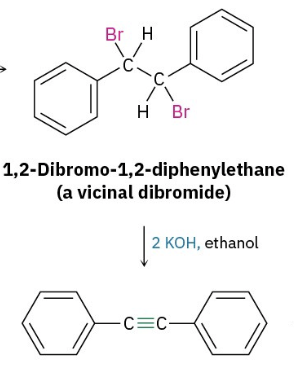
Preparation of Alkynes from Dihalides - Sodium Amide
double E2 elimination

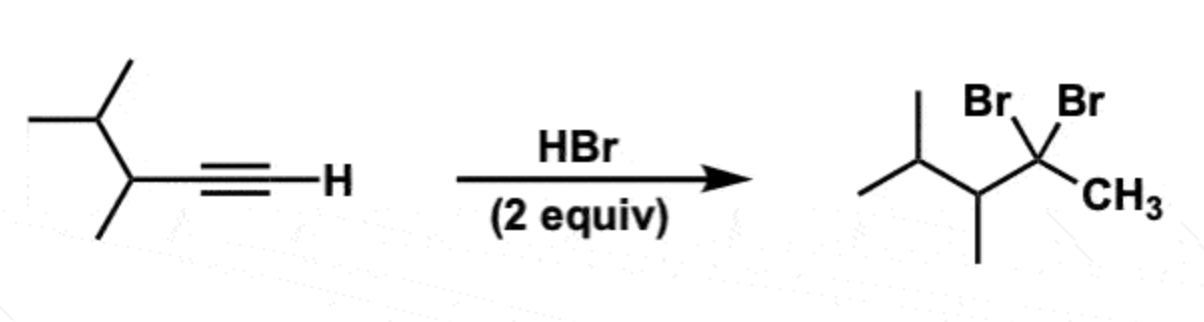
Hydrohalogenation of alkynes
electrophilic addition of a hydrogen halide (HCl, HBr, or HI) across the carbon-carbon triple bond of an alkyne (anti-markovnikov if ROOR + HBr) - anti-addition
Halogenation of alkynes
electrophilic addition reaction where halogens (Cl₂ or Br₂) add across a carbon–carbon triple bond

geminal dihalide
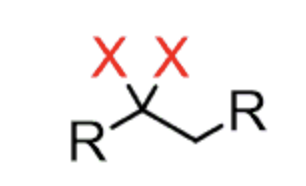
Vicinal dihalide

allylic position

vinyl position

benzylic position

allylic carbocation

vinylic carbocation

benzylic carbocation

hydration of alkynes (oxymercuration)
electrophilic addition reaction that converts an alkyne into a ketone (markovnikov)

Tautomerization in alkynes
chemical process in which constitutional isomers—called tautomers—readily interconvert through the relocation of a hydrogen atom (proton) paired with the shifting of a single bond and an adjacent double bond

enolate
reactive organic anion formed by removing a proton from the alpha-carbon (the carbon atom adjacent to a carbonyl group) of a carbonyl compound like an aldehyde, ketone, or ester

Hydroboration in alkyne
two-step chemical reaction that converts an alkyne into an aldehyde (from a terminal alkyne) or a ketone (from an internal alkyne) with anti-Markovnikov regioselectivity and syn addition stereochemistry

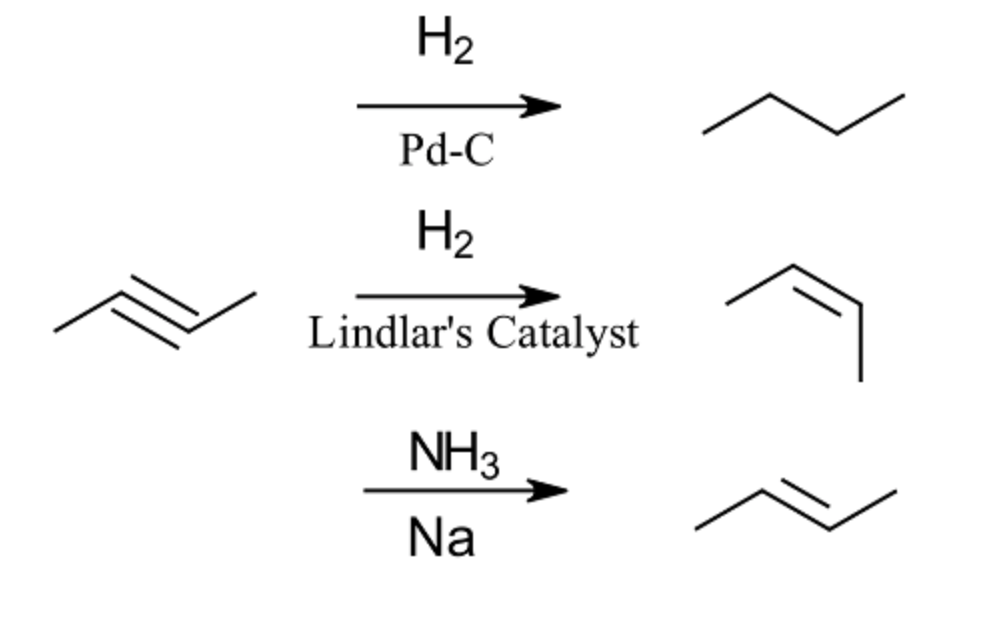
hydrogenation in alkynes
adds hydrogen (H₂) across a carbon-carbon triple bond, breaking the π bonds to form either an alkene or a fully reduced alkane
internal oxidative cleavage of alkynes
breaks the carbon-carbon triple bond (\(C \equiv C\)) and converts each formerly triple-bonded carbon into a carboxylic acid

terminal oxidative cleavage of alkynes
yields one carboxylic acid and carbon dioxide

Acidity of Alkynes
Terminal alkynes are significantly more acidic than other simple hydrocarbons like alkenes and alkanes
Acetylide ion
1)the conjugate base of a terminal alkyne or acetylene, formed when a strong base removes the acidic terminal proton
2)can react with alkyl halides to form C-C bonds(only with bromides/iodines)

deprotonation of alkynes
1)terminal: deprotonates a terminal alkyne to form a sodium alkynide ion (acetylide anion) and ammonia gas/liquid
2)Synthesis of Alkynes via Double Elimination: vicinal dihalides or geminal dihalides undergo double dehydrohalogenation ((two consecutive E2 eliminations), first elimination forms a vinylic halide/alkene, and the second elimination strips away the second equivalent of HBr or HCl to form a triple bond

Organic synthesis
construction of organic compounds from simple starting materials via chemical reactions
Retrosynthesis
problem-solving technique in organic chemistry used to design the synthesis of complex target molecules by working backward
Organohalides
organic compounds that contain at least one covalent carbon-halogen (C-X) bond, where X can be fluorine, chlorine, bromine, or iodine
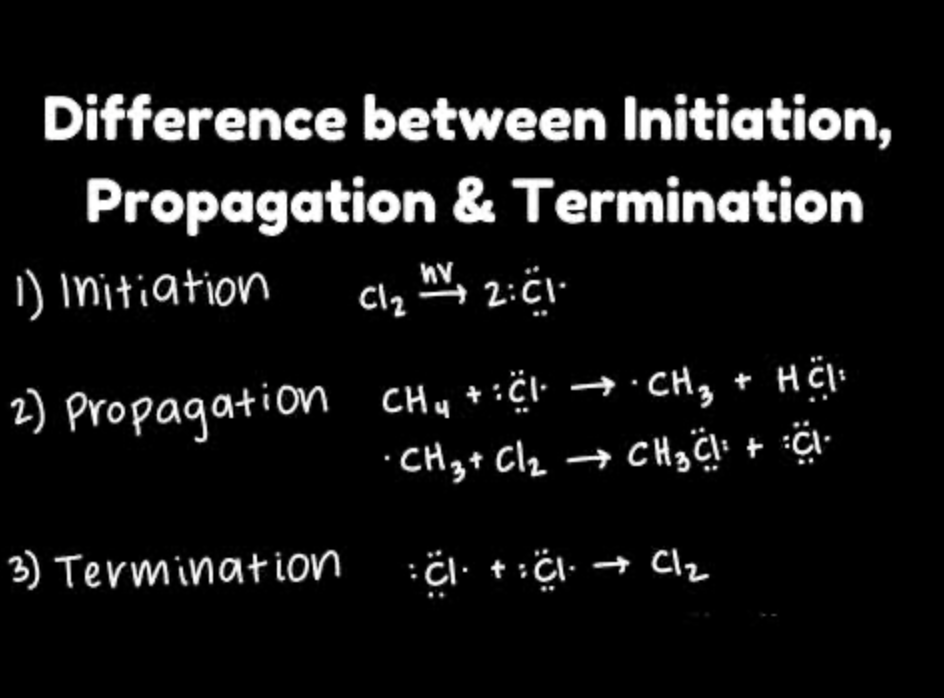
free-radical halogenation
1)Initiation
2)Propogation
3)Termination
allylic halogenation with NBS (N-Bromosucciminide)
Acts as a slow-release, low-concentration source of \(Br_{2}\), which selectively promotes free-radical allylic substitution via the Wohl-Ziegler reaction

Allylic halogenation with Br2
free-radical substitution reaction where a hydrogen atom at an allylic position (a carbon atom adjacent to a C=C double bond) is replaced by a bromine atom, leaving the double bond intact

Allylic halogenation with HBr
anti-Markovnikov addition across the pi-bond; allylic bromination replaces an allylic hydrogen with bromine while leaving the double bond intact

stability of radicals
