[AMAERO] L1 | AERODROME PLANNING
 Call Kai
 Learn
Learn Practice Test
 Spaced Repetition
 Match
Match Flashcards
 Knowt Play
1/29

There's no tags or description
Looks like no tags are added yet.
Name | Mastery | Learn | Test | Matching | Spaced | Call with Kai | Chat |
|---|
No analytics yet
Send a link to your students to track their progress
30 Terms
planning of an airport
is such a complex process that the analysis of one activity without regard to the effect on other activities will not provide acceptable solutions. An airport encompasses a wide range of activities which have different and often conflicting requirements.
Yet they are interdependent so that a single activity may limit the capacity of the entire complex.


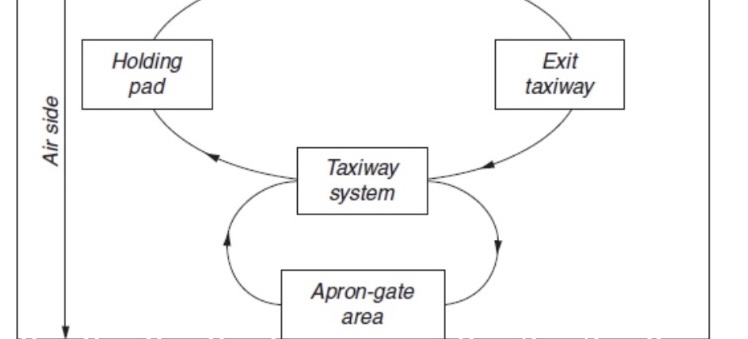


Airport System Plan
is a representation of the aviation facilities required to meet the immediate and future needs of a metropolitan area, region, state, or country. (ALL AIRPORTS WITHIN THE AREA)
Airport System Plan
presents the recommendations for the general location and characteristics of new airports and heliports and the nature of expansion for existing ones to meet forecasts of aggregate demand. It identifies the aviation role of existing and recommended new airports and facilities .
Airport System Plan
It includes the timing and estimated costs of development and relates _____________ to the policy and objectives of the relevant jurisdiction.
Airport Site Selection
The emphasis in airport planning is normally on the expansion and improvement of existing airports.
However if an existing airport cannot be expanded to meet the future demand or the need for a new airport is identified in an airport system plan, a process to select a new airport site may be required.
The scope of the site selection process will vary with size, complexity, and role of the new airport
LAND AREA
DISTANCE CENTER
AWAY FROM OBSTACLE
FLAT SURFACE
FLOOD FREE
WIND & WEATHER
What are the key components of Airport Site Selection? (6)
Airport Master Plan
is a concept of the ultimate development of a specific airport. The term development includes the entire airport area, both for aviation and non-aviation uses, and the use of land adjacent to the airport.
It presents the development concept graphically and contains the data and rationale upon which the plan is based.
Airport Master Plan
The overall objective of the this is to provide guidelines for future development which will satisfy aviation demand in a financially feasible manner and be compatible with the environment, community development, and other modes of transportation.
Airport Project Plan
focuses on a specific element of the airport master plan which is to be implemented in the short term and may include such items as the addition of a new runway, the modification of existing of runways, the provision of taxiways or taxiway exits, the addition of gates, the addition to or the renovation of terminal building facilities, or the modification of ground access facilities.
Land-Use Planning
A ________ for property within the airport boundary and in areas adjacent to the airport is an essential part of an airport master plan.
This plan on and off the airport is an integral part of an area wide comprehensive planning program, and therefore it must be coordinated with the objectives, policies, and programs for the area which the airport is to serve.
Land-Use Planning
Incompatibility of the airport with its neighbors stems primarily from the objections of people to aircraft noise. A ________ must therefore project the extent of aircraft noise that will be generated by airport operations in the future.
A/C NOISE
COMMERCIAL ASPECT
ZONING
Aspects of Land-Use Planning (3)
Environmental Impact Assessment
must be considered carefully in the development of a new airport or the expansion of an existing one.
Aircraft noise is the severest environmental problem to be considered in the development of airport facilities.
Environmental Impact Assessment
Studies of the impact of the construction and operation of a new airport or the expansion of an existing one upon acceptable levels of air and water quality, noise levels, ecological processes, and demographic development of the region must be conducted to determine how the airport requirements can best be met with minimal adverse environmental and social consequences.
Economic and Financial Feasibility
The __________________ of alternative plans for a new airport or expansion of an existing site must be clearly demonstrated by the planner.
Even if the selected alternative is shown to be economically feasible, then also it is necessary to show that the plan will generate sufficient revenues to cover annual costs of capital investment, administration, operations, and maintenance.
This must be determined for each stage or phase of development detailed in the airport master plan.
TERMINAL FEE
PARKING FEE
LANDING FEE
RENT
ADDS & PROMOTION
FEE (TIME & GATE)
[Economic and Financial Feasibility] Example on how your Airport can generate income (6)
Continuing Planning Process
This necessary in order to respond to the needs of air transportation in a changing environment.
Changes in aviation demand, community policies, new technology, financial constraints, and other factors can alter the need for and the timing of facility improvements.
The staging of airport improvements assists in the reevaluation of continuing needs at the points in time when implementation decisions are required.
Forecasting for Airport Planning
Plans for the development of the various components of the airport system depend to a large extent on the activity levels which are forecast for the future.
It is essential in the planning and design of an airport to have realistic estimates of the future demand to which airports are likely to be subjected.
Forecasting for Airport Planning
To adequately assess the causes of performance breakdowns in existing airport systems and to plan facilities to meet future needs, it is essential to predict the level and distribution of demand on the various components of the airport system.
Forecasting Methods
The selection of the particular methodology is a function of the use of the forecast, the availability of a database, the complexity and sophistication of the techniques, the resources available, the time frame in which the forecast is required and is to be used, and the degree of precision desirable.
Time Series Method
Market Share Method
Econometric Modeling
Simulation Modeling
There are four major forecasting methods: (4)
Time Series Method
[four forecasting methods]
______ or extrapolation is based upon an examination of the historical pattern of activity and assumes that those factors which determine the variation of traffic in the past will continue to exhibit similar relationships in the future.
This technique utilizes times series type data and seeks to analyze the growth and growth rates associated with a particular aviation activity
Market Share Method
[four forecasting methods]
These are forecasting techniques which are utilized to proportion a large-scale aviation activity down to a local level are called market share, ratio, or top-down models.
Inherent to the use of such a method is the demonstration that the proportion of the large-scale activity which can be assigned to the local level is a regular and predictable quantity.
Market Share Method
[four forecasting methods]
This method has been the dominant technique for aviation demand forecasting at the local level and its most common use is in the determination of the share of total national traffic activity which will be captured by a particular region, traffic hub, or airport.
Econometric Modeling
[four forecasting methods]
The most sophisticated and complex technique in airport demand forecasting is the use of __________.
Trend extrapolation methods do not explicitly examine the underlying relationships between the projected activity descriptor and the many variables which affect its change.
There are a wide range of economic, social, market, and operational factors which affect aviation.
Simulation Modeling
[four forecasting methods]
Airports with multiple runways and taxiways, varying use configurations, fleet mixes, and weather conditions render strict analytical methods extremely difficult it not impossible to accurately estimate airfield capacity and delay.
Specific FAA software models include the FAA's airport and airspace simulation model, the airport delay simulation model (ADSIM), and the runway delay simulation model (RDSIM).
The Federal Aviation Administration
[Simulation Modeling] _____________ has a team dedicated to development and application of a variety of software tools designed to simulate various elements of the airport and airspace system. These tools simulate and analyze operations from capacity, delay, as well as operational feasibility perspectives,