PHAR30080 L15 RH principles of neurodegen diseases
 Call Kai
 Learn
 Practice Test
 Spaced Repetition
 Match
 Flashcards
 Knowt Play
1/16

There's no tags or description
Looks like no tags are added yet.
17 Terms
learning outcomes

neurodegenerative diseases
heterogenous group of neurological disorders adversely affecting the lives of millions of people worldwide
progressive and irreversible loss of vulnerable population of neurons
collapse of the structure and function of neural networks and loss of neurons
breakdown of the core communicative circuitry
no cure
neurodegen disease classification
amyloidoses
tauopathies
synucleinopathies
TDP-43 proteinopathies
cellular/anatomical distribution
table: correlation between aggregates and disease
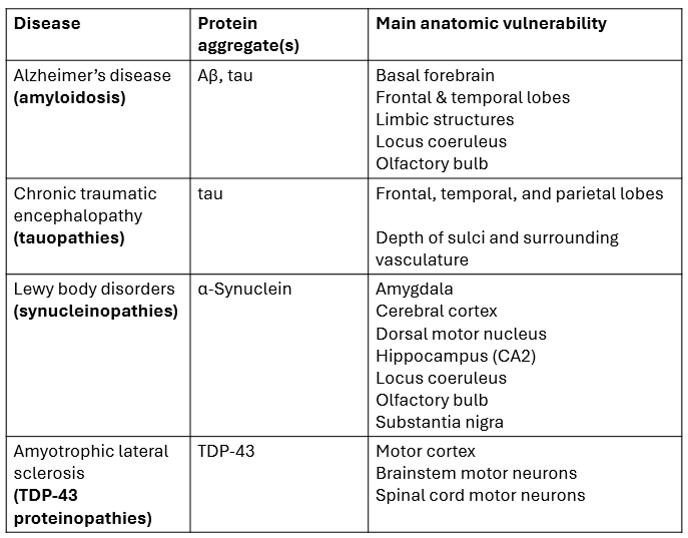
brain regions, genetics and aggregating prots image

pathological hallmarks of ND diseases image

pathological protein aggregation image

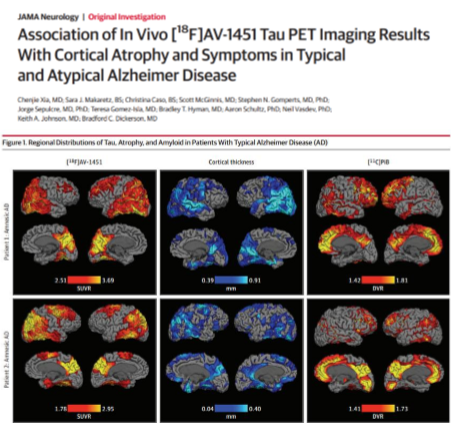
biomarkers for NDD protein aggregation
magnitude of cortical atrophy correlated with tau/amyloid burden
evidence that magnitude of tau burden act as a valid marker for clinical symptoms and ND in AD
development of disease-modifying therapies
protein misfolding as a principle mechanism
= misfolding protein PrPc → cause/driver of prion’s pathology
excitotoxicity
neurotoxic effects due to excessive Glut
results in neuronal cell death caused by excessive activation of Glut receptors (NMDA), leading to a harmful influx of Ca2+ → Ca2+ overload
excitotoxicity image
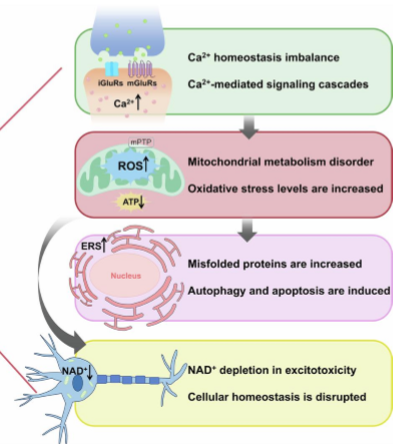
mechanisms of excitotoxicity image
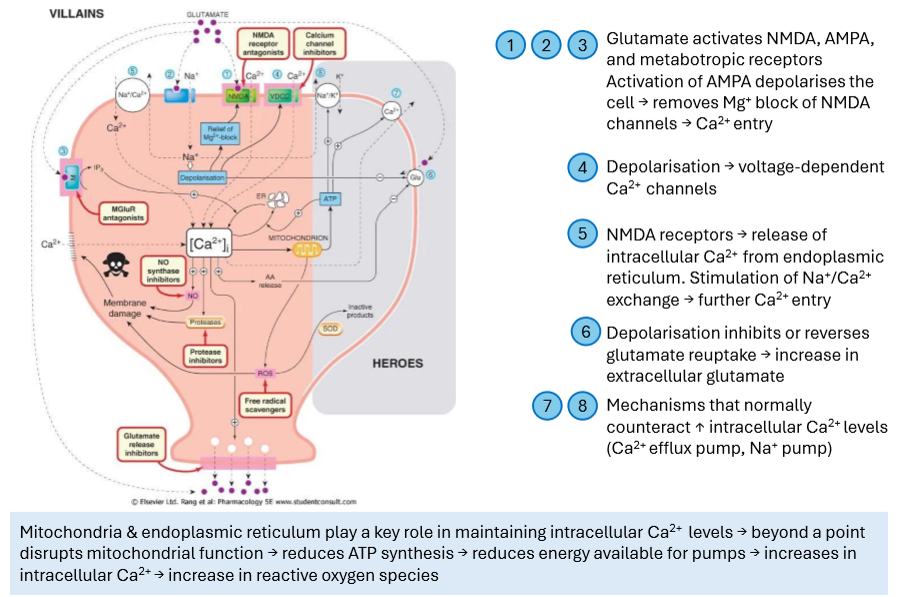
Step 1. mechanisms of excitotoxicity
Glut activates both NMDA, AMPA and metabotropic receptors
activation of AMPA depolarises the cell → removes Mg2+ block on NMDA → Ca2+ entry
Step 2. mechanisms of excitotoxicity
depolarisation → voltage-dependent Ca2+ channels
Step 3. mechanisms of excitotoxicity
NMDA receptors: release of intracellular Ca2+ from ER, stimulation of Na+/Ca2+ exchange → further Ca2+ entry
Steps 4. mechanisms of excitotoxicity
depolarisation inhibits or reverses Glut reuptake → increase in EC Glut
Step 5. mechanisms of excitotoxicity
mechanisms that normally counteract increase of IC Ca2+ levels (Ca2+ efflux pump, Na+ pump)